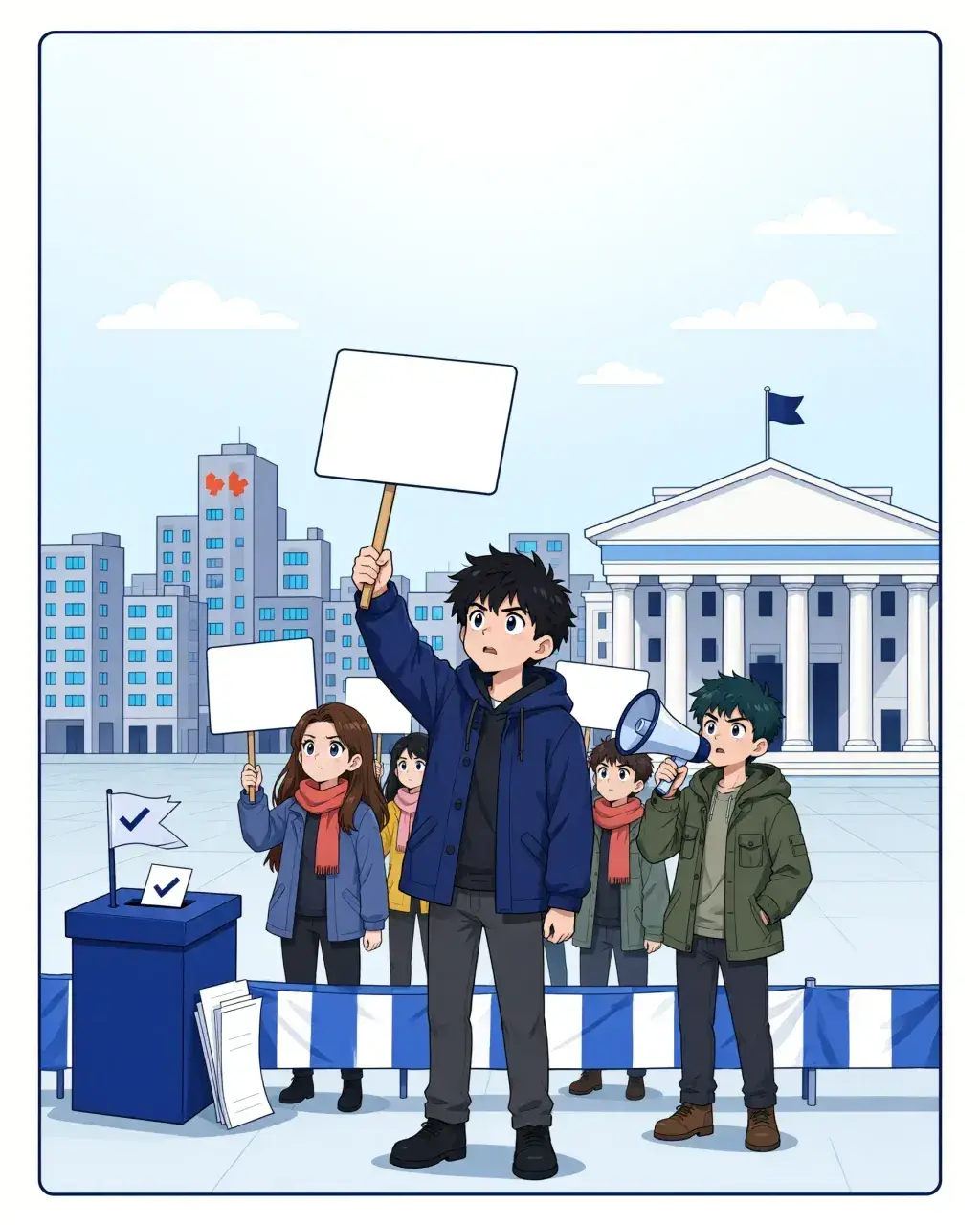
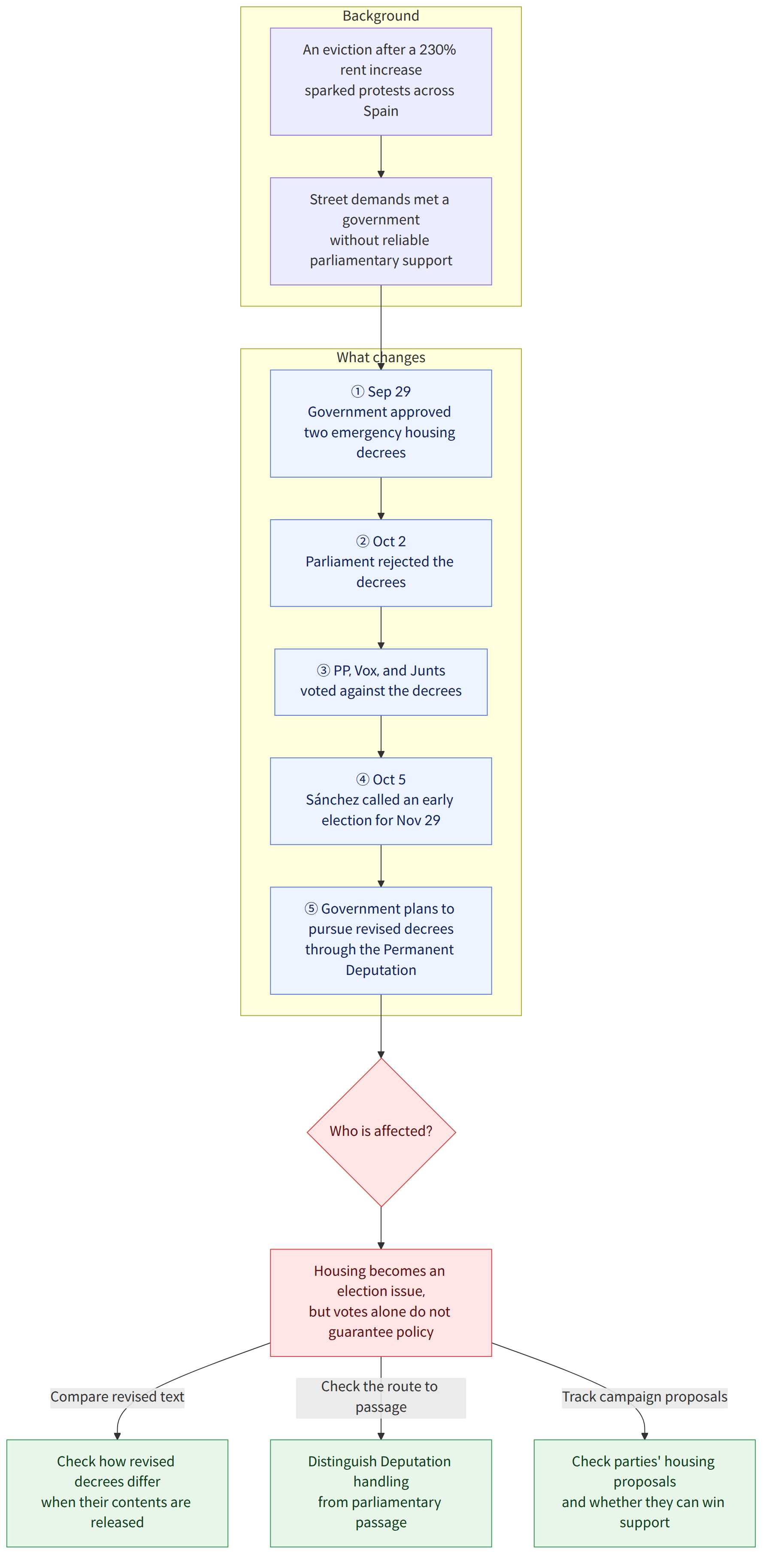
Spanish Prime Minister Pedro Sánchez announced an early general election on October 5. The election will be held on November 29, 10 months ahead of schedule. As the housing crisis and evictions move from street protests to parliamentary debate and then onto the election agenda, Sánchez faces a political test: can he turn voters’ frustration into votes?
Background and context
One event that brought housing to the forefront of the election was the eviction of 87-year-old Maricarmen Abascal, a person with a disability who lives in Madrid. According to the article, an investment fund bought Abascal’s home, after which the rent was raised by 230%; Abascal was later evicted. The case led to protests across Spain and encampments in the centers of major cities.
The street protests prompted a government response. On September 29, the Spanish government approved two emergency housing decrees, but parliament rejected them on October 2. The conservative People's Party (국민당, PP), the far-right Vox (복스), and the Catalan nationalist party Junts (준츠) voted against them.
The vote showed not only that the government had proposed housing measures, but also that it lacked the support needed to pass them in parliament. The article explains that even after Sánchez returned to the premiership in November 2023, his government had not secured a parliamentary base capable of reliably supporting legislation. In particular, the rejection of these decrees showed that parliamentary cooperation is needed for demands that have grown on the streets to become government policy.
What this news means
The housing crisis could be both a political liability for Sánchez and an opportunity to set the election agenda. The article interprets Sánchez as seeking to rally voters by making the housing measures rejected by parliament an election issue. In other words, his strategy is to frame the rejection not simply as government impotence, but as a political choice over how to address housing problems. This is the article’s interpretation, however, not a confirmed fact that Sánchez’s election strategy will succeed.
The key question for voters is whether political attention to the housing crisis can lead to actual policy. Although protests and encampments pushed the issue onto the agenda, the proposed measures were rejected by parliament. It will therefore be important to watch not only how long housing remains a central election issue, but also what alternatives the parties propose and whether they can win parliamentary support for them.
For example, voters who feel the burden of housing costs or fear eviction can look beyond whether candidates or parties mention housing and examine what measures they propose and whether those measures have the support needed to pass in parliament. Even if public frustration translates into votes, that alone does not guarantee that the decrees will pass or that the housing crisis will be resolved.
What is confirmed and what remains unknown
Confirmed facts
- Prime Minister Sánchez announced an early general election on October 5, with the election set for November 29.
- The election is being held 10 months ahead of schedule.
- The two emergency housing decrees approved by the government on September 29 were rejected by parliament on October 2.
- The People's Party (국민당, PP), Vox (복스), and Junts (준츠) voted against the housing decrees.
- The government announced plans to pursue revised housing decrees again through the Permanent Deputation (디푸타시온 페르마넨테), a standing body that performs key functions while parliament is dissolved.
What remains unknown
- The results Sánchez and the Spanish Socialist Workers’ Party (사회노동당, PSOE) will achieve in the November 29 election are not yet known.
- The specific contents of the revised housing decrees and whether they will pass in parliament remain unknown.
- It has not yet been decided how Junts will cooperate with the Sánchez government after the election.
- It remains uncertain whether Sánchez can keep housing at the center of the agenda until election day and turn the issue into votes.
What readers should watch
- When the revised housing decrees are released, readers will need to check how they differ from the measures previously rejected. Based on the information currently available, their specific contents are unknown.
- Readers can distinguish between how the decrees are handled by the Permanent Deputation and whether they pass in parliament. Announcing plans to pursue them again is not the same as actually passing them.
- It is worth watching what proposals each party puts forward on housing during the campaign, and whether Sánchez can turn street protests into votes.