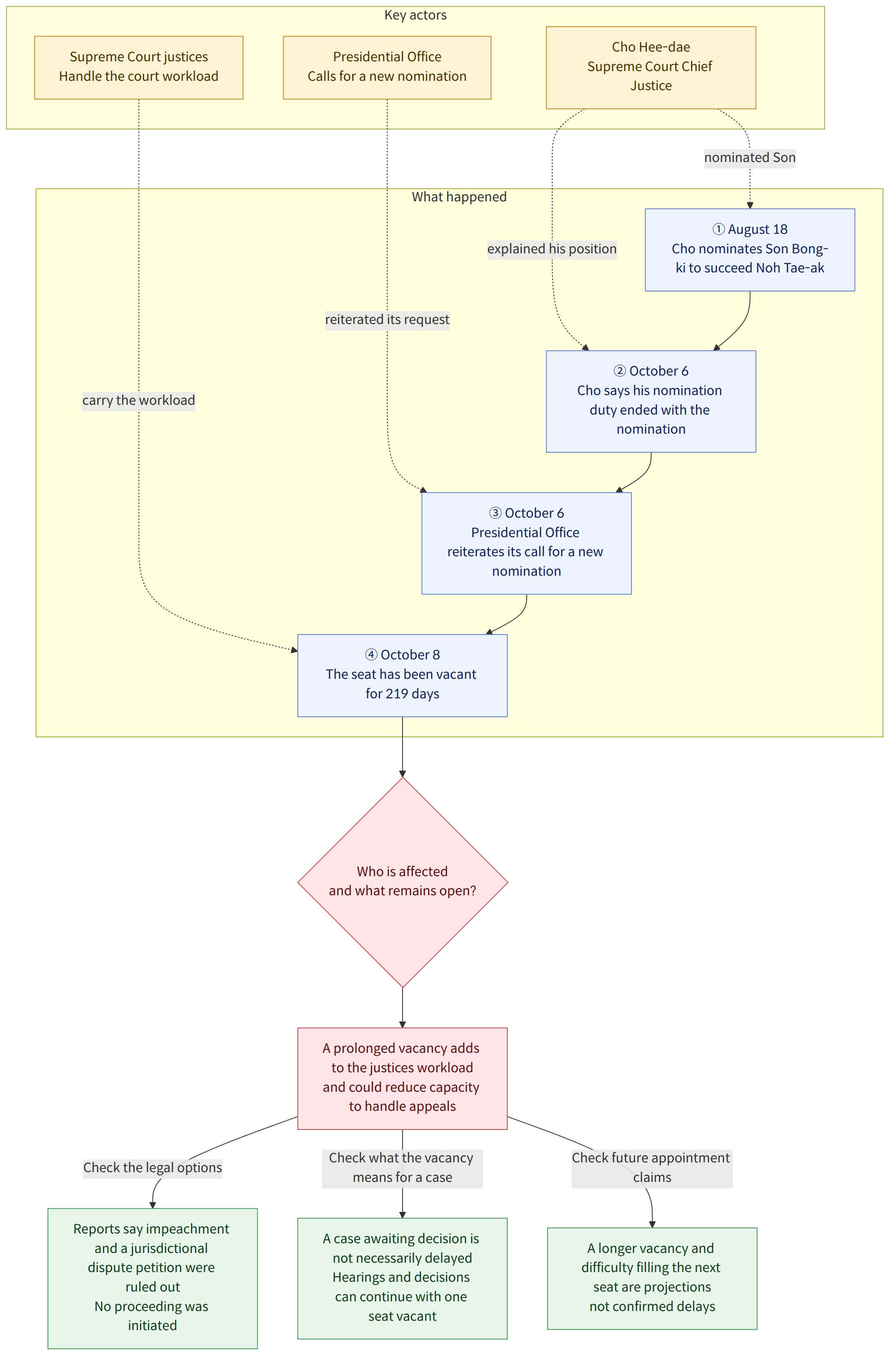
The standoff between the Presidential Office (청와대) and the Supreme Court (대법원) over one Supreme Court justice seat has dragged on. On August 18, Chief Justice Cho Hee-dae nominated Son Bong-ki, a presiding judge at Daegu District Court (대구지법), in writing to President Lee Jae-myung to succeed former Justice Noh Tae-ak. At a National Assembly audit (국정감사) held by the Legislation and Judiciary Committee (법제사법위원회) on October 6, Chief Justice Cho said that his constitutional powers and duties had ended with the nomination. The Presidential Office reiterated its existing request that the process for a new nomination be carried out as quickly as possible. As of October 8, the seat had been vacant for 219 days.
Background and context
The crux of the standoff is whether to nominate a new candidate for Supreme Court justice or maintain the nomination already made. At the audit, Chief Justice Cho said that neither the National Assembly nor the president could intervene in the chief justice’s nomination. The Presidential Office is calling for a new nomination, and reports say the issue has led to a roughly 50-day cycle of demands for a new nomination, refusals, and calls from the ruling camp for the chief justice to resign.
Political criticism has also intensified. Kim Min-seok, leader of the Democratic Party of Korea (더불어민주당), called on Chief Justice Cho to resign voluntarily on October 7, while senior party member Lee Seong-yoon raised the prospect of resignation and impeachment. Lawmaker Park Gyun-taek also said impeachment should be considered. Prime Minister Han Seong-sook criticized Chief Justice Cho, asking whether the president had any appointment authority if the nominee were appointed as proposed.
However, reports say the Presidential Office and the Democratic Party of Korea have ruled out impeaching Chief Justice Cho or filing a petition for adjudication of a jurisdictional dispute at the Constitutional Court (헌법재판소). Reports cited the difficulty of identifying a clear-cut unlawful act in the case of impeachment and the difficulty of predicting the outcome of a jurisdictional dispute. It is important to distinguish between these options being discussed and an actual proceeding being initiated.
What this news means
This is more than a dispute over appointments. The Supreme Court handles the final hearing and decision of cases. Even with one justice seat vacant, the court’s panels and en banc panel can hear and decide cases, but reports say that the 11 justices excluding the Minister of National Court Administration (법원행정처) must handle the workload of 12. As a result, concerns have been raised that a prolonged vacancy could add to the Supreme Court’s workload and affect its handling of appeals.
A judge with experience working at the Supreme Court said that a prolonged vacancy of even one justice would place a significant burden on the court’s handling of appeals. The concern that a vacancy could affect the public’s right to a trial should be understood not as meaning that hearings and decisions will stop immediately, but as a concern that the Supreme Court’s capacity to process cases could remain reduced.
For example, if you are a party to a case awaiting a decision at the Supreme Court, you cannot conclude that your case will necessarily be delayed solely because of the vacancy. However, because a prolonged vacancy means the justices have to shoulder a greater hearing workload, resolving the appointment dispute matters both for court operations and for people waiting for their cases to be heard.
The vacancy could also have a knock-on effect on future appointments. Reports projected that the current vacancy might remain unfilled until Chief Justice Cho’s term ends next June. They also added that appointing a successor to Justice Cheon Dae-yeop, who is due to retire next May, may prove difficult if the conflict between the Presidential Office and the Supreme Court is not resolved. These are projections about future developments, however, not confirmation that the appointments will actually be delayed.
Relevant procedures and information
The adjudication of jurisdictional disputes (권한쟁의심판) discussed in this case—a Constitutional Court procedure for resolving disputes between state agencies or local governments over infringements of their respective powers—is not a process that anyone can initiate. According to an internal legal guide, a party to a jurisdictional dispute, such as a state agency or local government, must claim that its powers have been infringed or are at risk of being infringed; individuals cannot file a petition.
A petition must also meet both of the applicable time limits. It must be filed within 60 days of the date the petitioner learned of the grounds for the dispute and within 180 days of the date those grounds arose. It has not been confirmed whether a petition will actually be filed in this case, who would file it, or what issues the case would raise. Therefore, the mere fact that reports have mentioned the possibility of such a petition does not mean one is imminent or that its outcome can be predicted.
An impeachment trial (탄핵심판) follows a different procedure from adjudication of a jurisdictional dispute. According to the legal guide, the National Assembly must vote to impeach before the Constitutional Court rules on whether to remove the public official from office. Reports have noted that it would be difficult to identify a clear-cut unlawful act in connection with impeaching Chief Justice Cho, but have not said that impeachment proceedings have actually been initiated.
What is confirmed and what remains unknown
Confirmed facts
- On August 18, Chief Justice Cho Hee-dae nominated Son Bong-ki, a presiding judge at Daegu District Court, in writing to succeed former Justice Noh Tae-ak.
- At the October 6 audit, Chief Justice Cho said that neither the National Assembly nor the president could intervene in the nomination and that his constitutional powers and duties had ended with it.
- The Presidential Office reaffirmed its position that the process for a new nomination should proceed quickly.
- As of October 8, the seat had been vacant for 219 days, and the Supreme Court can hear and decide cases while a seat is vacant.
What remains unknown
- What specific steps the Presidential Office and Chief Justice Cho might agree on to fill the vacancy.
- Whether the process to reconstitute the Supreme Court Justice Candidate Recommendation Committee (대법관후보추천위원회) will actually begin.
- Whether a motion to impeach or a petition for adjudication of a jurisdictional dispute related to this standoff will actually be filed.
- When the vacancy will be filled and what specific changes, if any, will occur in the Supreme Court’s handling of cases.
What readers should check
- When checking for changes to the nomination of a successor or the candidate recommendation process, distinguish announced actions from demands and predictions made by political figures.
- If a petition for adjudication of a jurisdictional dispute is actually filed, readers can check who filed it, whether the petitioner is a party claiming its own powers have been infringed, and whether both deadlines were met: 60 days from learning of the grounds and 180 days from the date they arose.
- Readers waiting for a case at the Supreme Court should not assume that the vacancy alone determines when their individual case will be handled or what its outcome will be; they should check the official status of the case.