
1. A Human Story
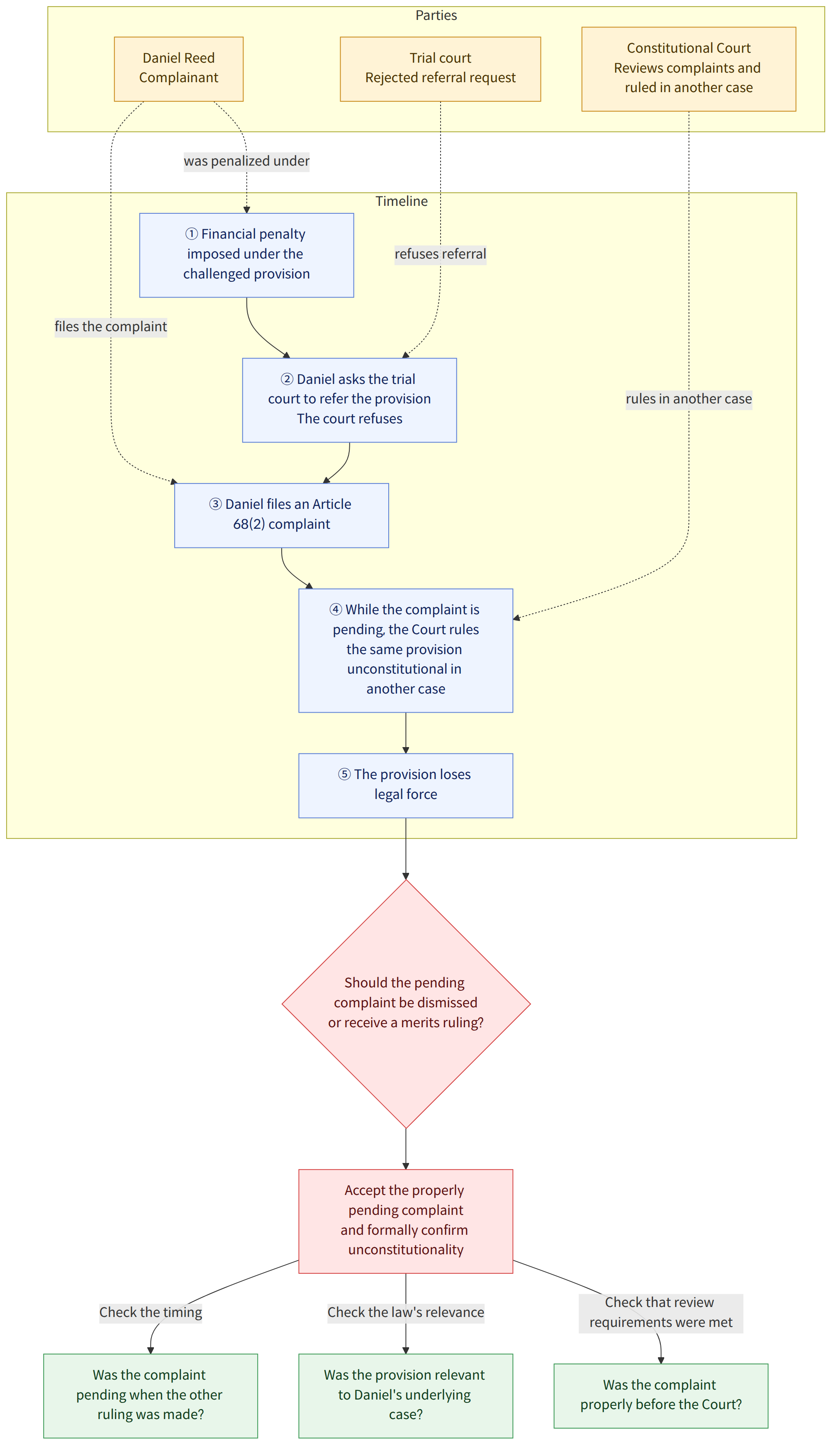
Daniel Reed had spent months contesting a financial penalty imposed under a provision of Korean law. His lawyer asked the trial court to refer that provision to the Constitutional Court, arguing that it violated the Constitution. The trial court refused. Daniel then took the next available step: a constitutional complaint under Article 68(2) of the Constitutional Court Act.
While Daniel’s complaint was pending, the Constitutional Court considered the same provision in a different case. It ruled that the provision was unconstitutional, and the provision lost legal force. Daniel’s lawyer wondered whether his own case had become pointless: if the law was already gone, would the Court simply close his file?
2. The Legal Question
When a person brings an Article 68(2) constitutional complaint and, while that complaint is pending, the Constitutional Court declares the challenged provision unconstitutional in another case, should the Court dismiss the later complaint—or formally rule that the provision was unconstitutional?
3. What Korean Law Says
Article 68(2) provides a route to constitutional review for someone whose request to have an ordinary court refer a relevant statute to the Constitutional Court has been rejected. The complaint is tied to the person’s underlying court case: the challenged provision must be relevant to the dispute being litigated.
A complaint that fails the legal requirements for review is dismissed. But a later decision declaring the same provision unconstitutional does not, by itself, mean that a properly pending Article 68(2) complaint should be dismissed.
The distinction is between a procedural dismissal and a decision on the constitutional merits:
- Dismissal means the complaint cannot be considered because it fails a legal requirement for review.
- A merits ruling means the Court decides the constitutional question and, in this situation, confirms that the challenged provision is unconstitutional.
The timing matters. The principle applies where the complaint was already before the Constitutional Court when the Court ruled on the same provision in another case. It also applies when cases that should have been handled together were not consolidated and one was left out of the combined proceedings.
Where the challenged provision becomes the subject of an unconstitutionality ruling in another case while the complaint is pending, the Court should issue a decision accepting the complaint and confirming the provision’s unconstitutionality—not dismiss the complaint merely because the provision has already lost force.
4. How Korean Courts Approach This
Korean constitutional review distinguishes between a case that is procedurally defective and one that still calls for a formal ruling on constitutionality. A prior ruling against the same provision may settle the central legal issue, but it does not turn a properly filed, pending complaint into a defective one.
The Constitutional Court’s approach preserves a clear judicial record of what happened to the challenged law. It also avoids treating a party’s pending constitutional challenge as though it had never warranted consideration simply because another case reached the Court first. The relevant principle is not that every complaint concerning an already-invalid provision must be heard. It is that, in this particular sequence—where the complaint was pending when the other ruling was made—the Court should confirm unconstitutionality rather than dispose of the complaint as procedurally inadmissible.
5. Applying the Law to the Case
First, Daniel used the Article 68(2) procedure after the trial court rejected his request for a constitutional referral. His complaint therefore arose from the recognized route for challenging a statute whose constitutionality mattered to his ongoing court dispute.
Second, the provision was at issue in his complaint. It was not an unrelated law: it was the provision on which the financial penalty against him had been based. That connection is important because Article 68(2) review concerns a statute relevant to the underlying case.
Third, the other constitutional ruling came while Daniel’s complaint was pending. This is the decisive timing point. The situation is not simply that Daniel filed a complaint after the provision had already been struck down. His case was already before the Court when it made the other ruling.
Fourth, the result in the other case does not require dismissal of Daniel’s complaint. The Constitutional Court has already concluded that the same provision is unconstitutional, but Daniel’s pending case still calls for the Court to formally confirm that conclusion in his proceeding. The proper outcome is an affirmative merits decision, not a procedural dismissal based only on the provision’s loss of force.
The same reasoning applies if Daniel’s case should have been joined with another case but was inadvertently left out of the consolidated proceedings. An administrative omission in handling related cases should not change the appropriate constitutional disposition.
6. Conclusion: What Happened, and What Should You Do?
Daniel’s complaint should not be dismissed merely because the challenged provision had already lost legal force after an unconstitutionality ruling in another case. The Constitutional Court should issue a decision confirming that the provision was unconstitutional. That resolves the constitutional question in Daniel’s proceeding; it does not, by itself, guarantee the precise outcome of his separate penalty dispute, which remains for the ordinary court to address in light of the constitutional ruling.
If you face a similar situation:
- Check the timeline carefully. Keep records showing when your Article 68(2) complaint was filed and when the other unconstitutionality ruling was issued.
- Bring the other ruling to the Court’s attention. Ask for a merits decision confirming unconstitutionality, rather than assuming the pending complaint should simply be closed.
- Follow up in the underlying case. Provide the constitutional ruling to the ordinary court and seek advice on how it affects the dispute still before that court.