
1. A Human Story
When the district office delivered its notice, Hannah Lee read it twice before she understood what it meant. The agency had placed her small repair workshop on a government list of businesses subject to relocation under a statute she had never heard of. The notice did not move her workshop that day, but it cleared the way for a later, separate relocation order.
Hannah challenged the statute through a constitutional complaint connected to her case. The Constitutional Court eventually ruled that the provision the agency had relied on was unconstitutional. By then, however, the deadline for an ordinary lawsuit against the original notice had passed. The district office had not yet issued the later relocation order, and Hannah’s workshop remained in place—but the designation still hung over her business.
2. The Legal Question
Does a government order become automatically void when the law authorizing it is later declared unconstitutional? Or does the affected person ordinarily have to bring a timely lawsuit to have the order cancelled—and, if that deadline has passed, can the order still be treated as void in exceptional circumstances?
3. What Korean Law Says
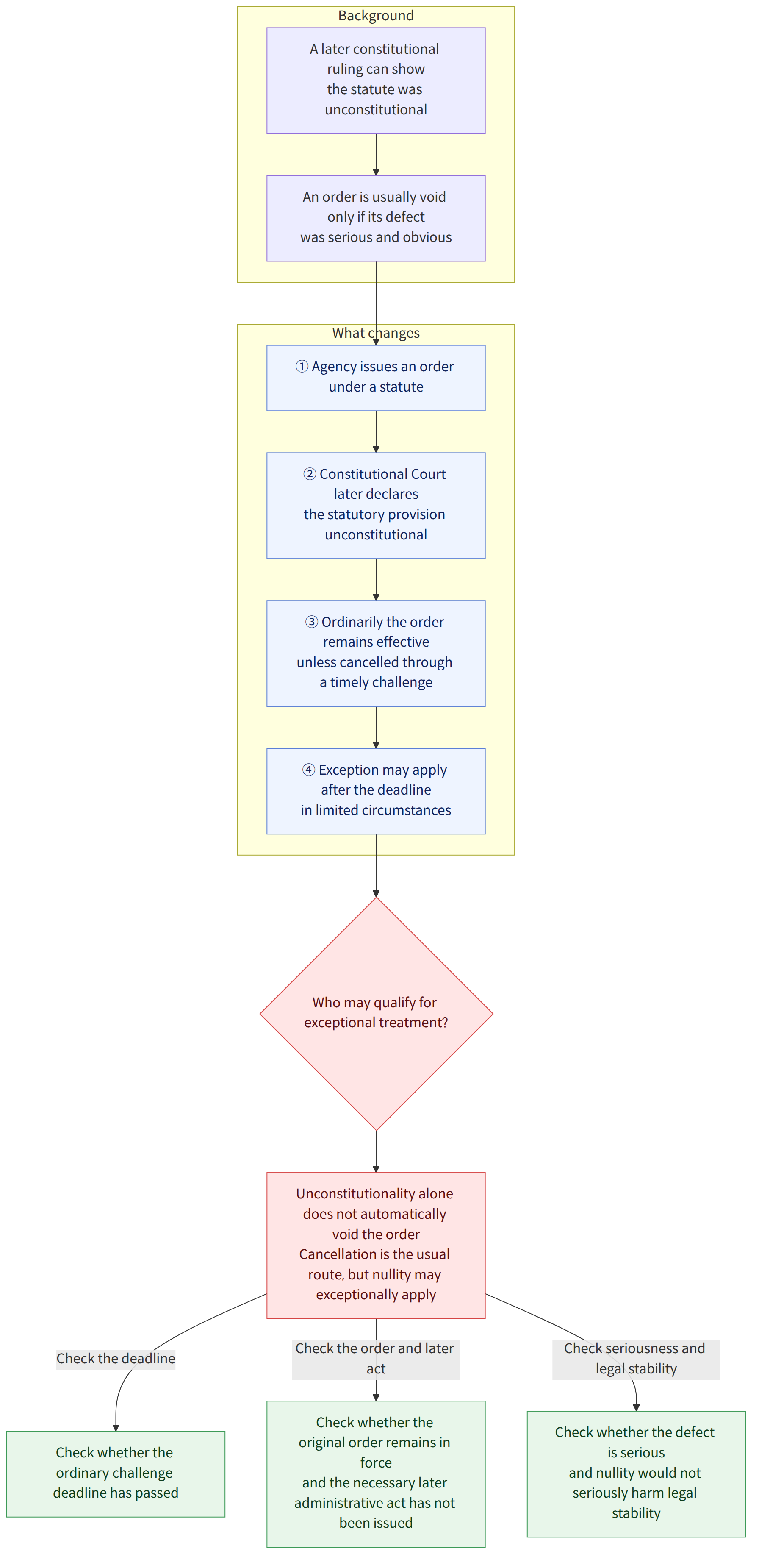
The key distinction is between an order that can be cancelled and one that is void from the outset. Both involve an unlawful administrative act, but the consequences differ. A cancellable order generally remains effective unless and until a court or the agency sets it aside. A void order, by contrast, is treated as having had no legal effect from the beginning.
Korean Supreme Court doctrine generally requires an administrative defect to be both serious and obvious before the order is considered void. A later constitutional ruling can establish that the statutory basis was unconstitutional, but it does not necessarily mean that the defect was obvious when the agency acted.
When an administrative order is issued under a law that is later declared unconstitutional, the order is defective as though it lacked a lawful basis. But, as a general rule, the prior unconstitutionality of the law was not objectively obvious before the Constitutional Court’s ruling. The defect therefore ordinarily supports cancellation, rather than automatic nullity.
That distinction matters in practice:
- Cancellation: The affected person generally must bring a challenge within the applicable statutory time limits. Until the order is cancelled, it may continue to have legal effect.
- Nullity: A person may seek a declaration that the order was void from the start. This route is generally reserved for defects that are both serious and obvious.
- Exceptional treatment: The Constitutional Court has recognized that an order based on an unconstitutional law may exceptionally be treated as void even after the ordinary challenge period has expired.
The exception is especially relevant where the original order remains in force, a further administrative order needed to carry out its purpose has not yet been made, and treating the original order as void would not seriously harm legal stability. The defect must also be serious enough to warrant that remedy.
The ordinary rule favors cancellation, but an exception may apply where the order remains effective, a necessary later administrative act has not been issued, and nullity would provide needed relief without seriously disrupting legal stability.
A constitutional complaint under Article 68(2) of the Constitutional Court Act is a route through which a person involved in litigation may challenge the constitutionality of a statute relevant to that dispute, subject to the procedure’s requirements. Winning that constitutional issue does not, by itself, erase every administrative decision previously made under the statute. The effect on a particular order must still be assessed.
4. How Korean Courts Approach This
Korean courts generally protect both constitutional rights and the stability of government decisions. They therefore distinguish between a statute’s eventual invalidation and the legal status of orders issued under it before the constitutional ruling.
The usual approach is that a later finding of unconstitutionality gives the affected person a basis to seek cancellation, but does not automatically turn the order into a nullity. The reason is practical as well as legal: before the Constitutional Court rules, the constitutional defect may not be sufficiently clear to make the agency’s action obviously unlawful at the time it was taken.
The courts also recognize that applying the ordinary rule in every case could deny meaningful relief. If an order is still producing effects, its intended purpose depends on a further administrative act that has not happened, and setting the first order aside would cause little disruption to settled legal relations, the case for treating it as void becomes stronger. The precise outcome depends on the character of the order and the surrounding circumstances—not merely on the fact that its enabling statute was struck down.
5. Applying the Law to the Case
Hannah’s situation must be examined step by step.
- The order had a statutory basis when issued. The district office relied on a statute that was still in force at the time. The Constitutional Court’s later ruling established that the statute was unconstitutional, but that timing alone does not make the earlier designation automatically void.
- The ordinary rule would treat the defect as a ground for cancellation. Under the general approach, Hannah should have brought a timely cancellation action against the designation. The later constitutional ruling would support her argument that the designation lacked a valid legal foundation, but would not ordinarily revive a missed deadline or establish that the order was void from day one.
- The designation remains operative. The notice still affects Hannah’s business. It is not merely a historical decision whose consequences have ended. This weighs in favor of considering whether the exceptional nullity rule applies.
- The necessary follow-up order has not been issued. The designation was intended to prepare the way for a separate relocation order, but the district office has not yet made that later decision. That matters because the contemplated purpose of the first order has not been fully carried out.
- Nullity would not necessarily unsettle completed legal arrangements. On these facts, no relocation has taken place and no follow-up order has been issued. Treating the designation as void would therefore be less likely to unsettle actions already taken in reliance on it. Hannah would still need to show that the underlying defect is sufficiently serious and that the exceptional remedy is justified.
Together, these circumstances place Hannah closer to the recognized exception than to the ordinary case. Her strongest argument is not simply that the statute was later declared unconstitutional. It is that the unconstitutional statute underpins an order that continues to burden her, that the intended later step has not occurred, and that declaring the order void would not significantly disturb settled legal relations.
6. Conclusion: What Happened, and What Should You Do?
Hannah has a substantial basis to seek a declaration that the designation is void despite the missed cancellation deadline. Given the continuing effect of the order and the absence of the contemplated follow-up relocation order, a court could apply the exceptional rule—provided it finds the defect serious enough and concludes that nullity would not unduly undermine legal stability. The constitutional ruling alone does not guarantee that result, but Hannah’s facts give her a meaningful route to relief.
If you face a similar situation:
- Act promptly. Do not assume a constitutional ruling cancels an administrative order automatically. Check the applicable deadline for a cancellation lawsuit as soon as possible.
- Preserve the full record. Keep the order, the statute it relies on, the constitutional ruling, and any notices showing whether a later administrative step has been issued.
- Get advice on the right remedy. Ask a Korean administrative-law lawyer to assess whether to seek cancellation, a declaration of nullity, or both, and to explain how the constitutional ruling affects your particular order.