
1. A Human Story
Hana Lee had built her small catering business one weekday lunch at a time. Then a dispute over a licensing requirement led to criminal charges under a provision of a national statute. Hana believed the provision was unconstitutional. If the court applied it, she could be convicted; if the provision could not constitutionally stand, the legal basis for the charge might disappear.
Her lawyer told her that she could ask the trial court to refer the constitutional question to the Constitutional Court. Hana imagined that meant filing a petition directly with the country’s highest constitutional tribunal and waiting for it to take over. The reality was more structured: first, the judge handling her criminal case had to decide whether the statute’s validity was genuinely relevant to the case and whether there was a reasonable constitutional doubt.
2. The Legal Question
When a statute that may determine the outcome of a case is alleged to violate the Constitution, who decides whether the issue goes to the Constitutional Court—and what can a party do if the trial judge refuses?
3. What Korean Law Says
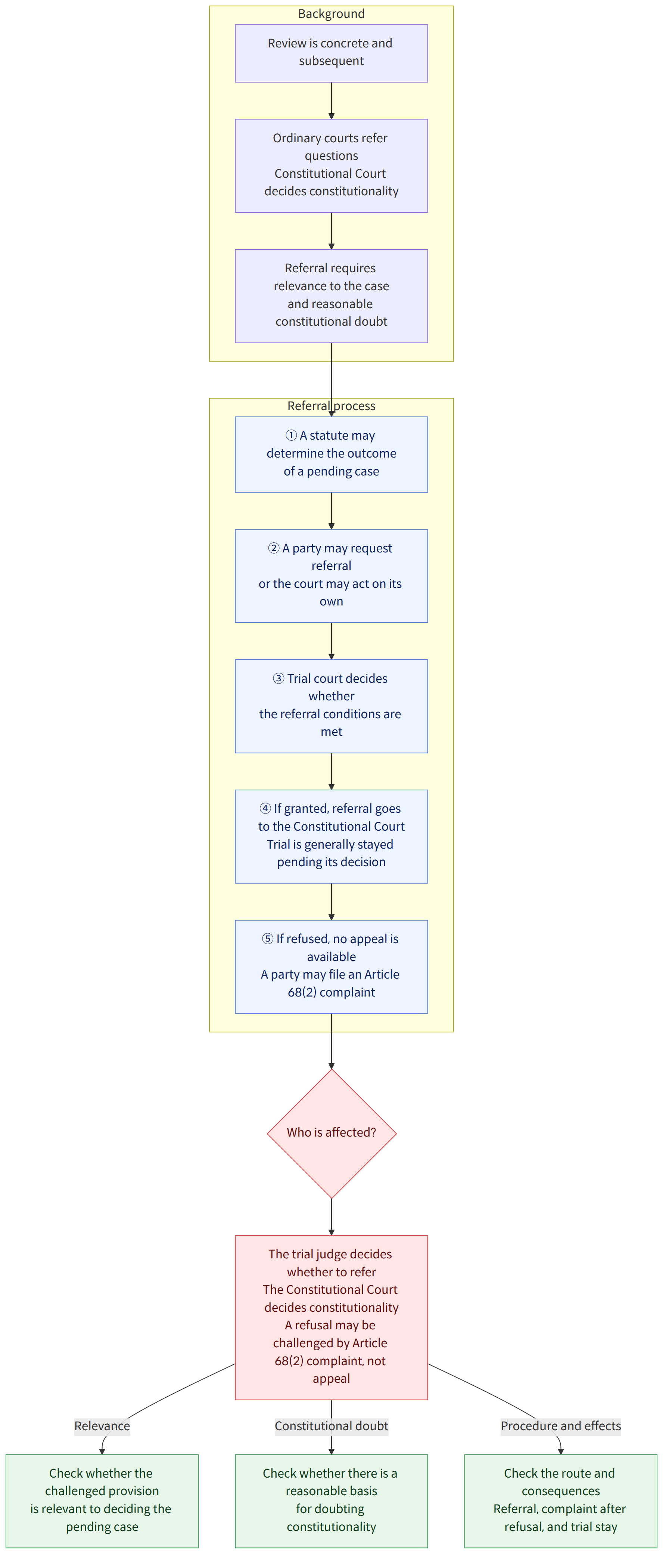
Korea’s constitutional review of statutes is generally concrete and subsequent. It is concrete because the question arises in a real case, not as an abstract request to review a law in isolation. It is subsequent because the statute has already been enacted and is being considered in litigation.
Under Articles 107(1) and 111(1)(1) of the Constitution, ordinary courts refer questions about the constitutionality of statutes to the Constitutional Court, which has authority to decide whether a statute is unconstitutional.
This divides responsibility between two institutions: the court hearing the underlying case has the authority to refer the question, while the Constitutional Court decides the constitutional issue. The party may ask for a referral, but cannot compel one merely by asserting that a law is unconstitutional.
A court may refer the issue on its own initiative or in response to a party’s application. Under Article 41(1) of the Constitutional Court Act, the key conditions are:
- The particular statute or provision must be relevant to the decision in the pending case.
- There must be a reasonable basis for doubting that the provision is constitutional.
- The court handling the case must decide to make the referral.
If a party applies and the court grants the request, the referral decision is sent through the prescribed court channel to the Constitutional Court. Although the paperwork passes through the Supreme Court when the referring court is not the Supreme Court, the Supreme Court does not screen the lower court’s referral on its merits. The Constitutional Court receives the referral and conducts the constitutional review.
The consequences of a refusal are important. Article 41(4) of the Constitutional Court Act says that a decision concerning referral cannot be appealed. A party therefore cannot bring an ordinary appeal—or a special appeal—to challenge the refusal as a stand-alone decision. But the law provides a different route:
If the court rejects a party’s request for referral, that party may file a constitutional complaint under Article 68(2) of the Constitutional Court Act, challenging the statute at issue in the pending case.
Once a party files that Article 68(2) complaint, the party may not make another referral application in the underlying case on the same grounds.
A granted referral also affects the trial itself. Under Article 42(1) of the Constitutional Court Act, proceedings in the underlying case are generally stayed until the Constitutional Court decides the constitutional question. The court may continue procedural steps other than its final judgment if it considers that necessary in an urgent situation. The Act also excludes the stay period from certain statutory time limits, including specified criminal detention periods and the civil deadline for delivering a final judgment.
4. How Korean Courts Approach This
The referral stage is a screening step, not the final constitutional judgment. The trial court does not decide whether the challenged statute is unconstitutional for the country as a whole. It asks whether the provision must be applied to resolve the particular dispute and whether the constitutional objection is sufficiently substantial to warrant review by the Constitutional Court.
A constitutional objection alone is not enough: the challenged provision must be a premise of the decision in the pending case, and the court must find a reasonable constitutional doubt.
This keeps constitutional review connected to actual litigation. If the case could be decided without applying the challenged provision, the constitutional question may not be a necessary premise of the judgment. Likewise, simply disagreeing with the law or with how it affects a party does not automatically establish a reasonable constitutional doubt.
If the trial court refers the issue, the underlying case is ordinarily put on hold while the Constitutional Court decides. If the trial court refuses, the main case does not stop simply because the party sought referral. The party may instead use the Article 68(2) complaint route, while any appeal from the eventual judgment allows the appellate court to consider relevant legal issues independently.
5. Applying the Law to the Case
Hana’s first task is not to argue that the statute is unfair in the abstract. She and her lawyer must identify the exact statutory provision and explain why the trial judge would have to apply it to decide the charge. If the criminal case can be resolved without relying on that provision, the constitutional issue may not be a proper basis for referral.
Next, they must give the court a reasoned constitutional argument. The court is not required to refer a question merely because Hana requests it. It must be persuaded both that the provision matters to the case and that the challenge raises a reasonable constitutional doubt.
In this fictional account, Hana’s lawyer makes that showing, and the trial court grants the referral. The court sends the referral decision through the required channel to the Constitutional Court. From that point, the trial is generally paused. The trial judge may still take urgent procedural steps if needed, but cannot deliver the final judgment while the constitutional question remains unresolved.
The Constitutional Court then considers the validity of the provision. For purposes of completing Hana’s fictional story—not as a prediction about any real law—the Court finds the provision constitutional. The referral process ends, the decision is sent back to the trial court, and the criminal case resumes. The trial court must then decide Hana’s case under the law as it stands, taking account of the Constitutional Court’s ruling. The referral itself does not decide whether Hana is guilty; it resolves the constitutional question that had to be answered first.
Had the trial court refused Hana’s request, she could not have appealed that refusal by itself. She could instead have considered a constitutional complaint under Article 68(2), subject to the applicable procedural requirements. She could not then repeat the same referral request in the underlying case on the same grounds.
6. Conclusion: What Happened, and What Should You Do?
Hana’s constitutional challenge reached the Constitutional Court because the trial judge concluded that the disputed provision mattered to the criminal case and that her objection raised a reasonable constitutional doubt. The Constitutional Court’s fictional ruling cleared the way for the trial to resume; it did not decide the criminal charge. That distinction is central: constitutional review tests the law, while the ordinary court decides the case involving the person before it.
If you face a similar situation:
- Identify the exact provision and explain why the court must rely on it to decide your pending case.
- Support the constitutional objection with specific reasoning. A bare claim that a law is unjust or unconstitutional may not be enough to secure a referral.
- If the request is denied, do not try to appeal the refusal as a separate ruling. Ask promptly about an Article 68(2) constitutional complaint and its procedural requirements, and remember that the same referral grounds cannot then be raised again in the underlying case.