
1. A Human Story
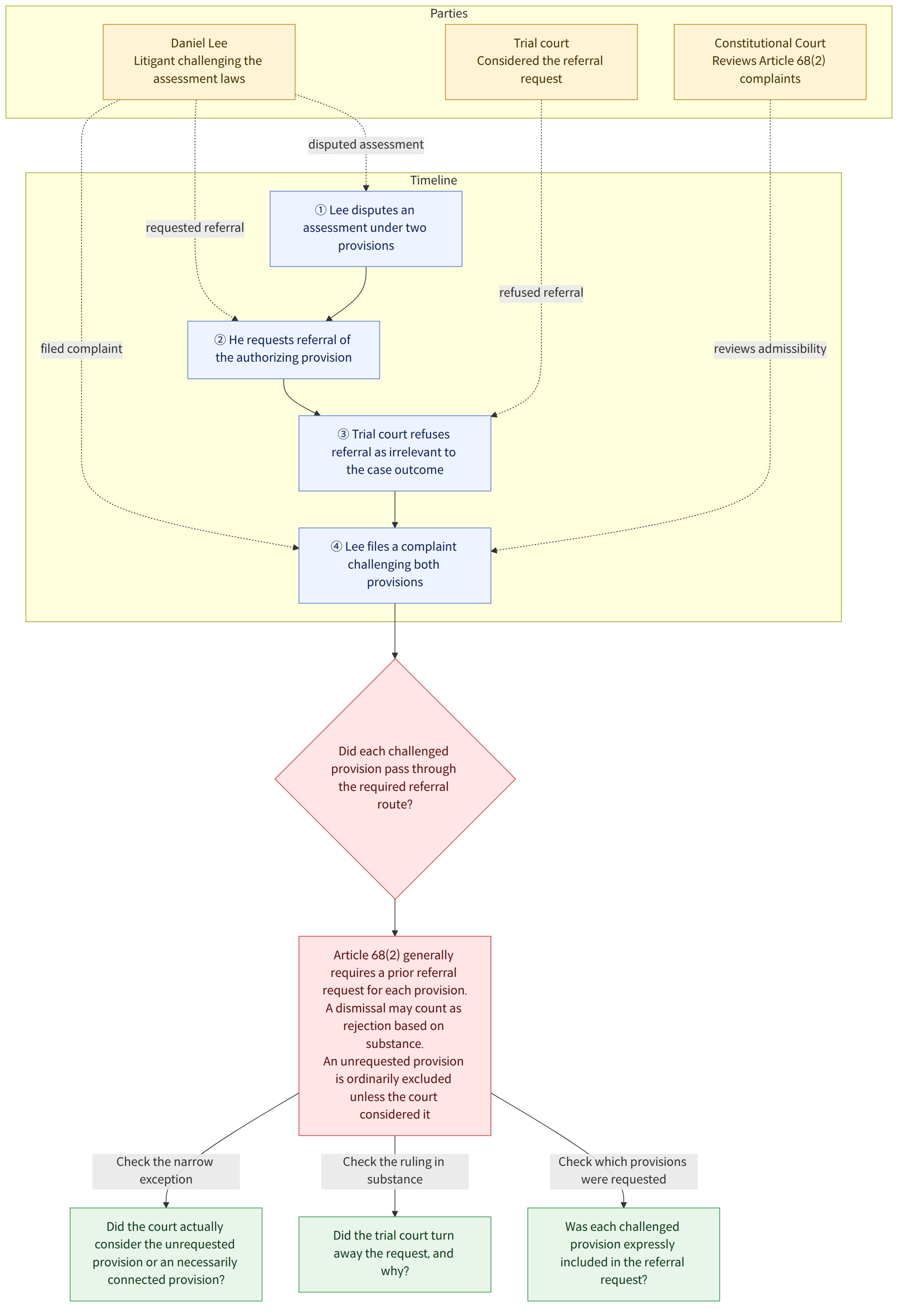
Daniel Lee had spent months disputing a costly assessment imposed on his small import business. The case turned on a statute that authorized the assessment and, Daniel believed, a related provision governing how the amount was calculated. He thought both rules were unfair and unconstitutional.
His lawyer asked the trial court to refer the first provision to the Constitutional Court. The court refused, explaining that the constitutional question did not affect the outcome of Daniel’s case. But Daniel’s written request had not separately identified the calculation provision. He later filed a constitutional complaint challenging both provisions, reasoning that they formed part of the same scheme.
The problem was not simply whether Daniel’s constitutional argument was persuasive. Before the Constitutional Court could consider the substance, it had to ask whether he had followed the special procedural route Korean law requires—and whether each challenged provision had passed through that route.
2. The Legal Question
Can a person bring a constitutional complaint under Article 68(2) of Korea’s Constitutional Court Act only after asking the trial court to refer the relevant statute for constitutional review and having that request rejected? And what if the court dismisses the request rather than formally rejecting it, or the complaint also challenges a provision that was not expressly included in the request?
3. What Korean Law Says
Article 68(2) creates a particular route to constitutional review for people involved in a court case. It is not a general invitation to challenge any law directly. The person must first ask the court handling the case to refer the relevant statutory provision to the Constitutional Court. If the request is rejected, the person may then bring an Article 68(2) complaint, subject to the applicable procedural requirements.
The basic rule: A complaint under Article 68(2) is available when the litigant’s request for a constitutional referral has been rejected. If no referral request was made—and therefore no court ruling rejected it—the complaint is generally inadmissible as to that provision.
That requirement applies provision by provision. A request concerning one section of a statute does not automatically open the door to a constitutional complaint about every related section. The Constitutional Court may, however, look beyond the formal wording in limited circumstances.
Key principles include:
- A prior referral request is generally essential. The litigant must ask the court in the pending case to refer the challenged provision for constitutional review.
- The court’s ruling is assessed in substance, not merely by its label. If the court should have rejected the request but instead used a procedural dismissal because it considered the issue irrelevant to the case, that dismissal may still qualify as a rejection for Article 68(2) purposes.
- An unrequested provision is ordinarily excluded. There may be an exception if the court actually considered that provision’s constitutionality, or if it was necessarily connected to a provision expressly included in the referral request and the court implicitly considered it as well.
- The Constitutional Court may adjust the review’s scope on its own initiative. That does not erase the prior-request requirement; it allows the Court to define the proper subject of review in appropriate circumstances.
Practical warning: Calling a court ruling a “dismissal” does not automatically defeat a later complaint—but neither does a connection between two provisions automatically excuse failing to request review of one of them.
4. How Korean Courts Approach This
Korean courts treat Article 68(2) as a procedure linked to an existing court case, not as an independent route for abstract constitutional review. The prior request gives the trial court an opportunity to decide whether the constitutional issue should be referred, while the requirement that the request be rejected identifies when the litigant may turn to the Constitutional Court.
At the same time, courts look at what a ruling actually did. If a trial court considered the request and turned it away on the ground that the challenged provision was not relevant to the case, the Constitutional Court may treat the ruling as a rejection even if the trial court used the procedural form of dismissal. Substance can matter more than terminology.
The general approach is stricter when a litigant never asked the trial court to review a particular provision. Ordinarily, there is no rejection to challenge and the constitutional complaint fails at the admissibility stage for that provision. The narrow exception is where the court in fact considered the provision, or where the provision was so necessarily connected to the one expressly raised that the court can be understood to have considered it implicitly.
5. Applying the Law to the Case
Daniel’s complaint would need to be examined separately for each provision.
- The provision he expressly challenged in the trial court. Daniel asked the trial court to refer the assessment provision. The court refused. That satisfies the basic sequence required by Article 68(2), assuming the other applicable filing requirements are met.
- The form of the trial court’s ruling. The trial court described its decision as a dismissal because it considered the constitutional issue irrelevant to the case. That label is not conclusive. If the court was, in substance, turning down Daniel’s request on that basis, the Constitutional Court may treat the decision as a rejection for purposes of the complaint.
- The calculation provision he did not expressly identify. Daniel did not ask the trial court to refer this provision. The ordinary rule therefore weighs against allowing a complaint about it: there was no separate rejection for the Constitutional Court to review.
- Whether an exception applies. Daniel would have a stronger argument if the trial court had actually examined the calculation provision, even without its being named, or if that provision was necessarily linked to the expressly challenged assessment provision and the trial court implicitly considered the linked issue. Merely saying that both provisions belong to the same statutory scheme would not, by itself, establish that exception.
- The scope of review. The Constitutional Court may adjust the subject of review on its own initiative where appropriate. But Daniel should not rely on that power as a substitute for identifying every relevant provision in his referral request. The threshold question remains whether the required procedural path was followed, expressly or in one of the limited recognized ways.
6. Conclusion: What Happened, and What Should You Do?
Daniel can proceed with his constitutional complaint concerning the assessment provision because he asked the trial court to refer it and received a ruling refusing the request. The fact that the trial court called its ruling a dismissal does not necessarily bar him if the court had, in substance, rejected the referral request.
His challenge to the calculation provision is different. Because Daniel did not expressly ask the trial court to refer that provision, his complaint about it is generally inadmissible unless he can show that the trial court substantively considered it or that it was necessarily linked to the provision he did raise and was implicitly considered. On the facts described, simply treating the provisions as related is not enough. Daniel’s complaint therefore may proceed as to the first provision, but not automatically as to the second.
For readers facing a similar issue:
- Identify every provision precisely in your referral request to the court handling your case; do not assume a request about one provision covers the entire statutory scheme.
- Keep the full record of the ruling and your request. The reasoning may matter more than whether the court called its decision a rejection or a dismissal.
- Get prompt legal advice about timing and admissibility. Article 68(2) has procedural requirements, and a missed step can prevent constitutional review before the merits are ever reached.