The U.S. State Department’s 2026 Trafficking in Persons Report included North Korea among the countries in Tier 3, the lowest category for efforts to combat human trafficking. North Korea denounced the assessment as “a grave provocation motivated by political considerations.” Reports said this was the 24th consecutive year North Korea had been classified as Tier 3.
A spokesperson for North Korea’s Foreign Ministry (북한 외무성) claimed that the report was full of lies, fabrications, prejudice, and hostility. North Korea pushed back, saying the United States was politicizing and weaponizing human rights to use them as a tool of its hostile policy toward North Korea. The spokesperson’s statement in English was reported by the Korean Central News Agency (조선중앙통신).
Background and context
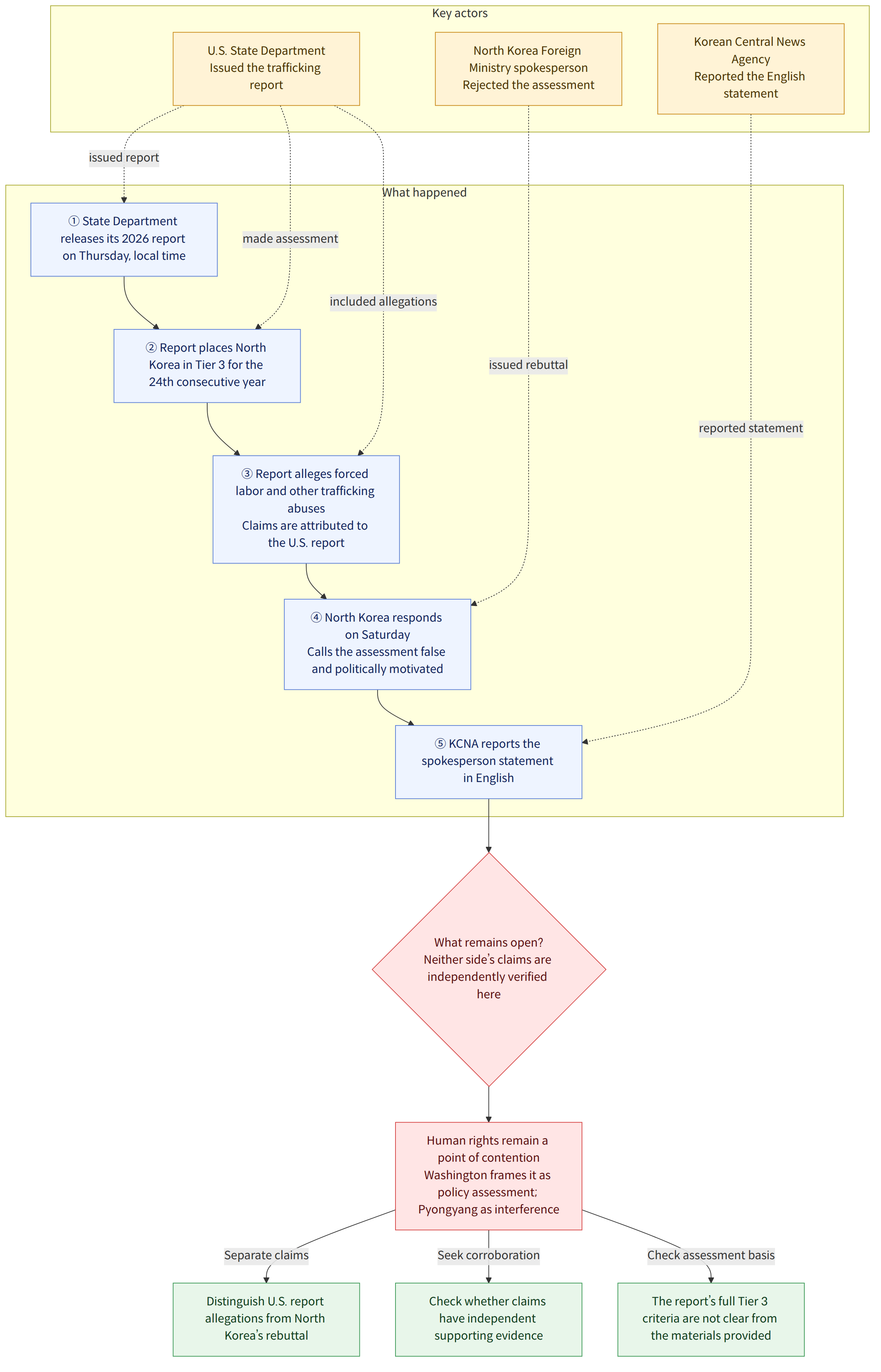
The U.S. State Department released the report on Thursday, local time, and North Korea responded on Saturday. China, Russia, Iran, and Cuba were also included among the countries in the lowest, Tier 3 category. The tiers represent the U.S. government’s assessment of each country’s efforts to combat human trafficking, but the full details of the criteria used in the assessment cannot be determined from the reports provided.
According to Korean-language reporting, the report said that up to 50,000 North Korean workers had been sent to China and up to 30,000 to Russia, and that up to 90% of their wages were withheld at source, earning North Korea hundreds of millions of dollars a year. The report was also said to have cited the confiscation of workers’ passports, restrictions on their movement, surveillance by state security agencies, and threats of retaliation against their families. These are claims attributed in the reporting to the U.S. report, not facts independently verified in this article.
The report was said to have noted that North Korean children were forced to work on farms, in factories, at construction sites, and in coal mines. It also mentioned the forced prostitution of North Korean women working in seafood-processing factories, restaurants, and coffee shops in China. The report further said that up to 30,000 children born in China to North Korean defector mothers and Chinese fathers were stateless because they had not been registered at birth. Reports said the report assessed that North Korea had shown no meaningful efforts to address human trafficking.
What this news means
This dispute shows that the conflict between Washington and Pyongyang is not only about assessments of human trafficking, but also about who can address human rights issues and from what perspective. The United States judged North Korea’s efforts to prevent trafficking inadequate through its ranking and report, while North Korea characterized the assessment as an attempt to use human rights to pressure it. In other words, one side treats the report as a policy assessment, while the other sees it as interference in its sovereignty and domestic affairs.
An important distinction for readers is that the report’s allegations and North Korea’s rebuttal are claims made by different parties. The figures on workers and wage deductions included in the reports were presented as claims made in the U.S. report, while North Korea criticized the report as a whole as false and fabricated. The materials provided do not contain findings that independently verify either side’s claims.
For example, when readers encounter an item in the report, they should distinguish whether it is a claim in a U.S. government report, a rebuttal from North Korea, or a point for which separate corroboration has been provided, rather than immediately accepting it as established fact. This distinction helps prevent confusion between the report’s findings and the two countries’ political interpretations.
Differences between the reports
The two reports agree on the central facts: North Korea’s pushback and its Tier 3 classification for the 24th consecutive year. The English-language report focused on North Korea’s denunciation of the report as “a grave provocation motivated by political considerations” and its claims that human rights were being politicized and weaponized. The Korean-language report also covered the numbers of workers the report said had been sent abroad, wage deductions, forced labor, stateless children, and North Korea’s warning of a strong response.
What is confirmed and what remains unknown
Confirmed facts
- The U.S. State Department released its 2026 Trafficking in Persons Report on Thursday, local time.
- The report ranked North Korea in Tier 3, the lowest category for efforts to combat human trafficking.
- North Korea was classified as Tier 3 for the 24th consecutive year; China, Russia, Iran, and Cuba were also included in the same tier.
- A spokesperson for North Korea’s Foreign Ministry criticized the report as a political provocation, and the Korean Central News Agency reported the statement.
What remains unknown
- The reports provided do not fully establish what evidence and assessment methods were used for each of the report’s findings.
- The reports do not say how the U.S. government responded to North Korea’s denunciation.
- It is not clear what evidence North Korea cited to rebut each of the report’s individual claims.
What readers should check
- When reviewing the report’s tier descriptions and individual cases, readers can identify the U.S. government report as the source of the assessment and claims.
- Specific figures, such as worker numbers and wage percentages, should be read with attention to whether they are claims made in the report or have been corroborated by other sources.
- Checking for further responses from North Korea and follow-up statements from the U.S. government can help readers assess whether this dispute expands beyond a diplomatic argument.
References
- Other coverage consulted: chosun.com