The controversy over the film “Assassin(s)” has shifted from the film’s content to the language directed at an individual actor. Rep. Joo Jin-woo of the People Power Party (국민의힘) called actor Yoo Hae-jin “North Korean-looking” and explained that he meant Yoo was taking North Korea’s side. Professor Jin Jung-kwon of Dongyang University (동양대) criticized Rep. Joo, saying that while it is possible to criticize a film, attacks on critics and actors should stop. Their public exchange led to a debate over the line between film criticism and personal attacks.
Background and context
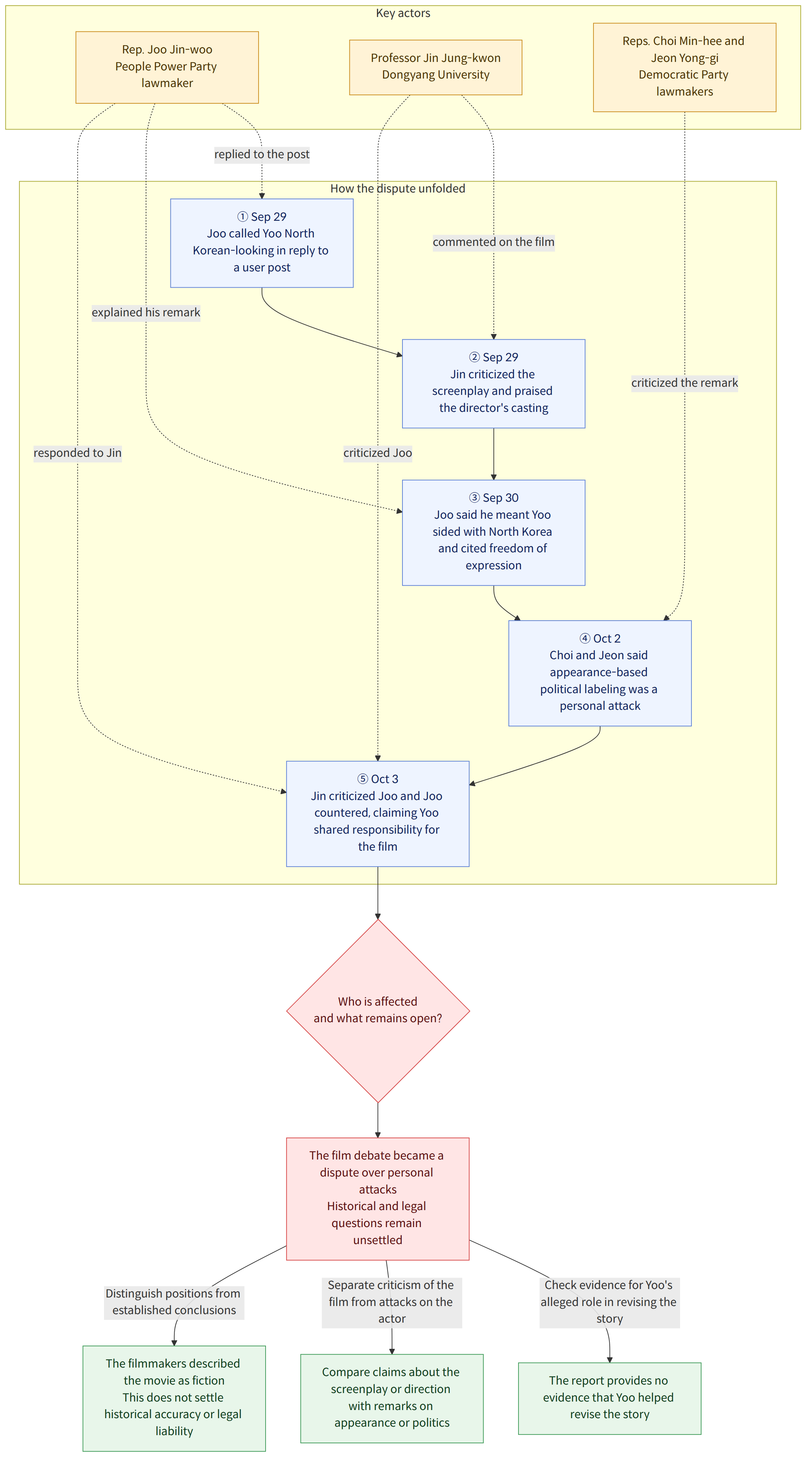
On September 29, Rep. Joo replied “North Korean-looking” to a Threads post in which a user wrote to Yoo, “Just go live in North Korea.” In a livestream on his YouTube channel the following day, he said the phrase meant that Yoo was taking North Korea’s side and argued that he, too, had freedom of expression.
On September 29, Professor Jin wrote on Facebook that he criticized the film’s screenplay but praised the director’s ability to cast well-known actors. On October 3, he criticized Rep. Joo, calling him “truly low-class” and saying, “I can’t stand how childish this is.” Professor Jin’s argument was that criticism of the film itself should be distinguished from attacks on critics and actors.
Rep. Joo responded on Threads on October 3. Referring to Professor Jin having called the film’s producer “a pupa with the IQ of a bug,” he wrote that the film was so immoral that he did not take issue with that expression. He also said that actors, as well as the director, bore responsibility, and claimed that Yoo had revised the director’s work and the story together with him. He directed Professor Jin to “stop making a low-grade both-sides argument” and accused him of “taking the side of the left’s despicable logic.” However, the reported information does not provide evidence to support the claims that Yoo participated in production and revised the story.
The debate expanded through public comments from political and cultural figures. At the Supreme Council meeting of the Democratic Party of Korea (더불어민주당) on October 2, Rep. Choi Min-hee criticized Rep. Joo for attacking the actor by calling him “North Korean-looking.” Rep. Jeon Yong-gi argued that mocking an actor’s appearance and labeling them politically because someone dislikes their work is not criticism but a personal attack. Cho Kuk, head of the Innovation Policy Research Institute (혁신정책연구원) of the Cho Kuk Innovation Party (조국혁신당), said he did not believe the film warranted legal liability and described Yoo as having the “look of a righteous army fighter.” These are the respective figures’ assessments and claims, not definitive judgments on the film’s historical interpretation or legal issues.
The film debate also continued online and offline. According to other reports, Naver (네이버) referred the case to police after detecting abnormal, automated activity in positive and negative reactions to the film’s reviews. However, reports said it had not established who was responsible, whether there was a political motive, or whether the star ratings themselves had been manipulated. There were also reports that members of a conservative civic group held a rally outside a location believed to be Yoo’s home.
What this means
The central issue in this debate is not whether criticism of the film itself should be prohibited. Criticizing the screenplay, the way historical fact and fiction are presented, or the direction is different—in both its target and its method—from language aimed at an actor’s appearance or political leanings. Professor Jin and Democratic Party lawmakers viewed the latter as personal attacks, while Rep. Joo questioned the actor’s participation in the film and responsibility for its content. To assess this difference, it is necessary to examine which scenes or content each claim is based on and how the actor’s role in the film is being linked to attacks on the individual.
The film’s interpretation of history is a separate issue. One report said the film is based on the 1974 assassination attempt against then-President Park Chung-hee, in which First Lady Yuk Young-soo was killed, and tells a story in which fictional investigators suspect possible involvement by the Park Chung-hee government or people within the intelligence agencies. The report said the filmmakers stated that the movie is fiction and is not intended to establish a new historical conclusion. This is the filmmakers’ position on the nature of the film; it does not settle disputes over the work’s specific depictions or historical accuracy.
The important point for readers is to distinguish politicians’ claims from established facts. For example, if you encounter Rep. Joo’s claim that “the actor helped revise the story,” you should not treat the existence of a reported claim and the confirmation of evidence supporting it as the same thing. The reports provided here do not present evidence for that claim. Likewise, the fact that automated activity was detected in online reactions does not establish that a particular group coordinated the activity or that the star ratings were manipulated.
What is known and what remains unclear
What is known
- On September 29, Rep. Joo replied to Yoo Hae-jin with “North Korean-looking,” and the following day explained that the phrase meant Yoo was taking North Korea’s side.
- Professor Jin publicly criticized Rep. Joo, saying that criticism of a film should be distinguished from attacks on actors and critics.
- Rep. Joo said that actors were also responsible for a film and claimed Yoo had participated in production and story revisions, but the reports did not provide evidence for that claim.
- Naver reportedly detected automated activity in reactions to reviews and referred the case to police, but the person responsible, any political motive, and whether the star ratings were manipulated have not been established.
What remains unclear
- Is there evidence to confirm the claim that Yoo participated in the film’s production and story revisions?
- What have Yoo and the film’s production team said about the “North Korean look” remark?
- Who was behind the automated activity detected by Naver, and what was its purpose?
What readers should check
- Read claims about the film separately from assessments of the actor personally, and check what evidence is offered for claims about historical facts or participation in production.
- When reading reports about online reviews, distinguish between the finding that “automated reactions were detected” and claims that star ratings were manipulated or that there was a political motive behind the activity.
- Check whether the people involved make further statements, but avoid sharing claims that have not been established as though they were confirmed facts.
References
- Other coverage consulted: m.koreaherald.com
- Other coverage consulted: chosun.com