
Seven Years of Devotion, Zero Sheets of Paper
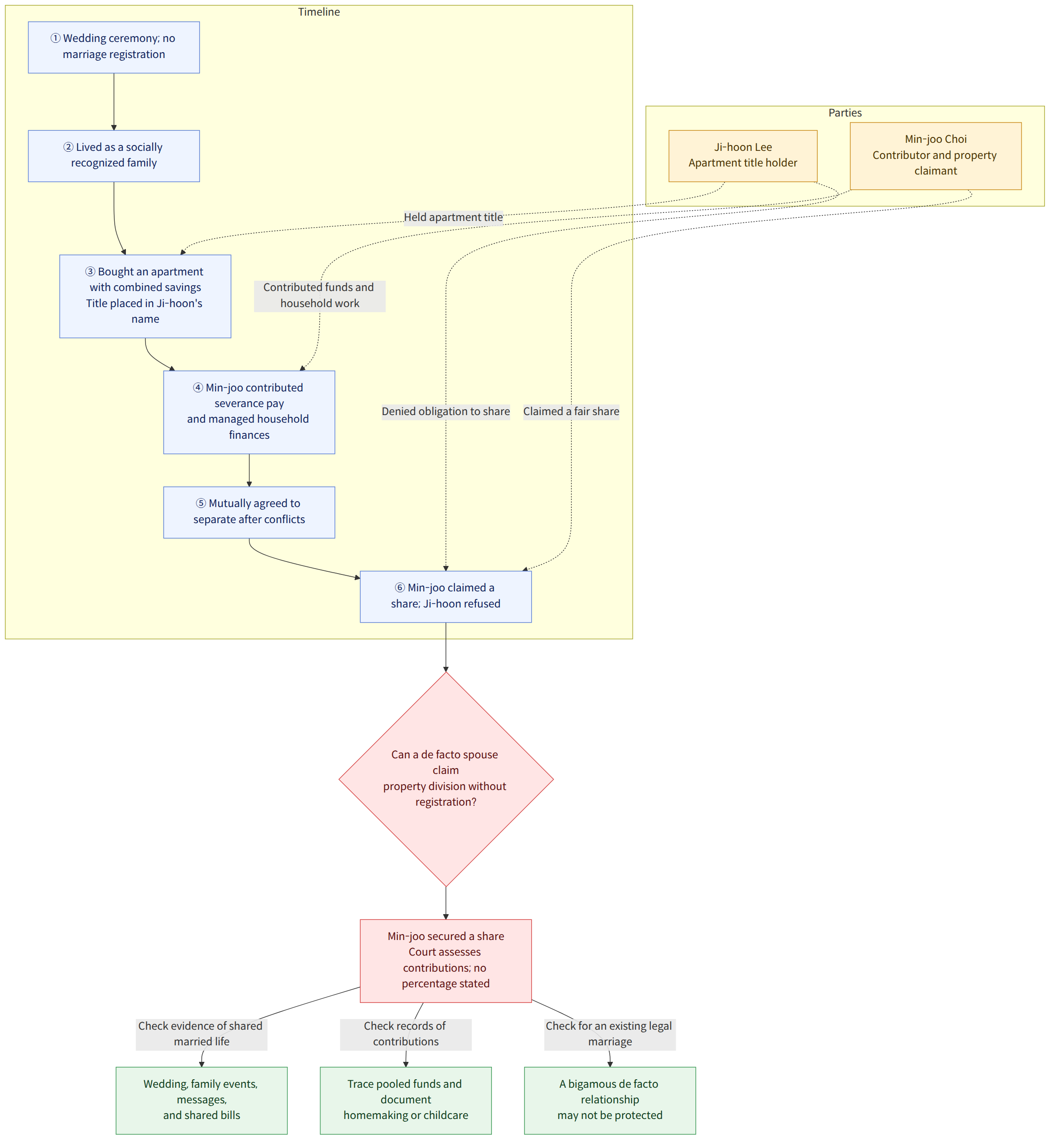
Ji-hoon Lee and Min-joo Choi lived a life that anyone would call a marriage. Seven years ago, they held a beautiful wedding ceremony in front of family and friends. However, believing that their commitment was deeper than a government filing, they never officially registered their marriage. Together, they saved diligently and eventually purchased an apartment in Ji-hoon's name using their combined savings. They spent holidays with each other's parents and functioned as a unit in every social sense.
But as time passed, irreconcilable personality clashes emerged, leading them to mutually agree to part ways. The conflict began when it came time to divide their assets. Min-joo, who had contributed her entire severance pay to the apartment purchase and managed the household finances for seven years, claimed her fair share. Ji-hoon countered, "Legally, we are strangers. This apartment is in my name, and since we aren't married, I don't owe you anything."
The Core Legal Question
Can someone like Min-joo, who lived in a de facto marriage (Common-law marriage) without official registration, exercise the right to claim property division just like a legally divorced spouse?
What Korean Law Says About De Facto Marriage
In Korea, a "de facto marriage" (Sasil-hon) is distinct from mere cohabitation. To be legally recognized and protected, it must meet specific criteria:
Requirements for De Facto Marriage1. Subjective Intent: Both parties must have a genuine agreement and intent to be married.2. Objective Substance: There must be an actual reality of marital life that conforms to social norms of a family unit.
While de facto marriages do not grant inheritance rights (which strictly require registration), they do carry several legal effects. These include the duty of cohabitation, support, and fidelity, as well as the right to claim property division upon the termination of the relationship.
How Korean Courts Approach Asset Division
Korean courts view the division of property as a way to liquidate and distribute assets that were built through the "living community" of the couple. Therefore, judicial principles dictate that if a couple lived as a functional family and jointly accumulated wealth, that wealth should be shared fairly regardless of registration.
However, there is a major caveat: Bigamous De Facto Marriages. If one party is still legally married to a third party and has not yet divorced, a subsequent de facto relationship with another person is generally not protected by law. In such cases, the court usually denies claims for property division to protect the integrity of the original legal marriage.
Applying the Law to Ji-hoon and Min-joo
Applying these principles to our couple, the resolution becomes clear:
First, since Ji-hoon and Min-joo had a wedding ceremony and lived as a couple for seven years with social recognition, they meet the criteria for a de facto marriage. Second, the apartment—though under Ji-hoon’s name—was purchased during the relationship with contributions from both parties (including Min-joo's severance pay and her management of household affairs).
Under Korean law, this apartment is considered jointly acquired property. Even though the marriage wasn't registered, the court would allow Min-joo to file a claim for property division. The court would analyze her financial contributions and her role in maintaining the household to determine a fair percentage of the apartment's value to be awarded to her.
Conclusion: What Happened, and What Should You Do?
Min-joo was ultimately able to secure her legal share of the apartment, proving that the law values the reality of a partnership over a mere certificate. If you find yourself in a similar situation, keep these tips in mind:
- Document the 'Reality' of Your Marriage: Keep evidence of your shared life, such as wedding photos, records of attending family events, messages where you refer to each other as spouses, and shared utility bills.
- Track Financial Contributions: Maintain records of how funds were pooled for major purchases. Even if you didn't provide direct cash, remember that labor-intensive contributions like homemaking and childcare are legally recognized as 'contributions' to the household wealth.
The law aims to ensure fairness. Even without a marriage license, your years of partnership and contribution carry significant legal weight.
--- This column is for informational purposes only and does not constitute legal advice. For specific legal issues, please consult with a qualified legal professional.