
1. A Human Story
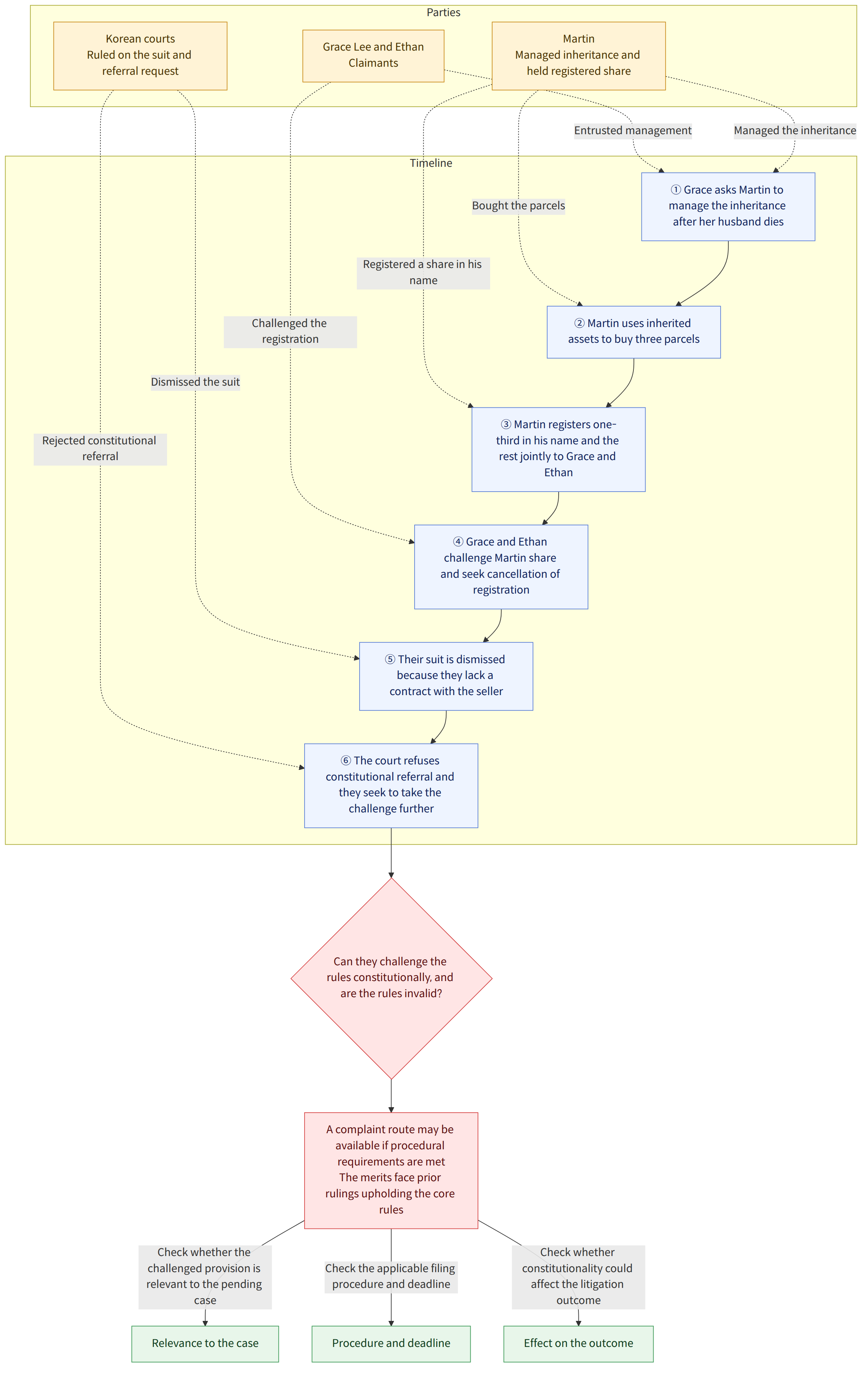
When Grace Lee’s husband died, their son, Ethan, was still a child. The family’s finances were suddenly in unfamiliar hands: Grace asked her late husband’s older brother, Martin, to manage the inheritance while she tried to rebuild their lives.
Martin used some of the inherited assets to buy three parcels of land. He said the land was meant for Grace and Ethan, but that Grace might remarry and Ethan was too young to manage property. With their tacit agreement, Martin registered a one-third share in his own name and the remaining shares jointly in Grace’s and Ethan’s names. He continued to manage the land.
Years later, Grace and Ethan challenged Martin’s registered share as a title-trust arrangement. They sought to pursue, on the seller’s behalf, a claim to cancel the registration. Their case was dismissed because they had no contractual relationship with the seller. After appealing, they asked the court to refer several provisions of Korea’s real-estate registration law for constitutional review. The court refused. They now wanted to take the constitutional fight further.
2. The Legal Question
Can Grace and Ethan bring a constitutional complaint after the court rejects their request for constitutional review—and, more importantly, are the statutory rules invalid because they make a title-trust agreement and the resulting property transfer ineffective?
The answer has two parts. Korean law provides a route to challenge a statute after a court rejects a constitutional-referral request, if procedural requirements are met. But the substantive challenge faces a formidable obstacle: the Constitutional Court has already upheld the central rules against similar constitutional objections.
3. What Korean Law Says
The Act on the Registration of Real Estate under Actual Titleholder’s Name is designed to make the person who truly owns real estate visible in the official register. Its central provisions address arrangements in which one person is the real beneficiary while another person’s name appears on the title.
Article 4(1) provides that a title-trust agreement is void. >Article 4(2), as relevant here, provides that a change in real rights to real estate made by registration pursuant to such an agreement is void.
In plain terms, the law generally does not let parties rely on a private arrangement to conceal the real owner behind someone else’s name. The precise property consequences can depend on how the purchase was structured and what the seller knew. But the basic statutory rule is that the agreement itself, and a transfer registered pursuant to it, do not gain ordinary legal force merely because the parties agreed to the arrangement.
A person whose request for constitutional review is rejected may, in appropriate circumstances, file a constitutional complaint under the Constitutional Court Act. The route is not automatic. Among other things:
- The complaint must challenge a statutory provision that is relevant to the pending case, rather than raise an abstract objection.
- The complainant must follow the applicable filing procedure and deadline after the court rejects the referral request.
- The alleged unconstitutionality must matter to the outcome of the underlying litigation; a constitutional complaint is not a general appeal from an unfavorable judgment.
The constitutional arguments commonly raised against the title-trust rules are that they interfere with private choice, property rights, and the freedom to participate in a market economy. The Constitution protects those interests, but it also permits restrictions imposed by law for public order or the public good, subject to limits on excessive interference.
4. How Korean Courts Approach This
The Constitutional Court has rejected the argument that invalidating title-trust arrangements violates the Constitution’s protection of private autonomy, property, or a market economy. Its reasoning is practical: hidden ownership can undermine confidence in the property register and facilitate conduct that the legislature has chosen to prevent.
The Court’s general approach is to ask whether the law pursues a legitimate public purpose, whether the measure is reasonably suited to that purpose, and whether the burden on individual rights is excessive in relation to the public benefit.
Applying that approach, the Court has treated the goal of ending concealed or nominee ownership as legitimate. It has also regarded denying legal effect to the trust arrangement as a suitable means of making the real-name registration system work. In its view, the public interest served by reliable ownership records outweighs the burden imposed on parties who chose to register property in another person’s name.
That does not mean every dispute about title is simple, or that every person listed in a registry necessarily wins. It means that a broad constitutional attack on the core invalidity provisions is unlikely to succeed merely because the result is harsh for the parties to a particular arrangement.
5. Applying the Law to the Case
First, the family’s arrangement appears to fit the problem the statute addresses. Martin was registered as the owner of a one-third share, while Grace and Ethan were said to be the intended beneficiaries. If the facts establish that Martin’s name was used pursuant to a title-trust agreement, Article 4’s invalidity rules become central. Their tacit agreement would not, by itself, make the arrangement legally effective under the statute.
Second, the constitutional complaint has a procedural question separate from its merits. Because the court rejected Grace and Ethan’s request for a constitutional referral while their appeal was pending, a complaint under the relevant statutory procedure may be possible if they satisfy the applicable requirements, including the filing deadline and the requirement that the challenged provisions bear on the case. They would need to show more than disagreement with the trial court: the provisions must have a genuine connection to the result they are asking the court to reach.
Third, their earlier dismissal presents a distinct obstacle. Grace and Ethan tried to exercise the seller’s claim to cancel Martin’s registration, but the court dismissed the case because they had no contractual relationship with the seller. A constitutional challenge to the title-trust provisions does not automatically answer that procedural problem. Nor does it, by itself, establish that Grace and Ethan can bring the seller’s claim on the seller’s behalf.
Finally, the constitutional arguments are unlikely to prevail. Grace and Ethan could argue that the law frustrates the family’s private wishes and threatens the property they believed was intended for them. But the Constitutional Court has already found that the public purpose behind the statutory rules justifies denying legal effect to title-trust agreements and related registrations. On the facts described, repeating a general claim of interference with private autonomy or property rights is unlikely to overcome that established reasoning.
6. Conclusion: What Happened, and What Should You Do?
Grace and Ethan may have a procedural avenue to file a constitutional complaint after the referral request was denied, provided they meet the statutory requirements and act within the applicable deadline. But the complaint is unlikely to produce a ruling that the core title-trust provisions are unconstitutional. And even if they pursue that challenge, they still must address the separate reason their property lawsuit was dismissed: whether they have a legally valid basis to assert the seller’s claim.
For anyone facing a similar dispute:
- Check the deadline and procedural route immediately. A constitutional complaint following rejection of a referral request has strict requirements; consult a Korean lawyer without delay.
- Gather evidence about the purchase and registration. Preserve payment records, agreements, messages, and documents showing who supplied the funds, what the parties intended, and what the seller knew.
- Separate the constitutional issue from the property claim. Ask counsel to identify who owns each claim, who has standing to bring it, and what remedy is legally available under the registration statute.