
1. A Human Story
When Grace Kim learned that she would not receive a municipal business-relief grant, the decision felt less like a bureaucratic setback than a judgment on the shop she had spent years building. She believed the city had applied the wrong eligibility rule and took the dispute to court, hoping to recover the grant.
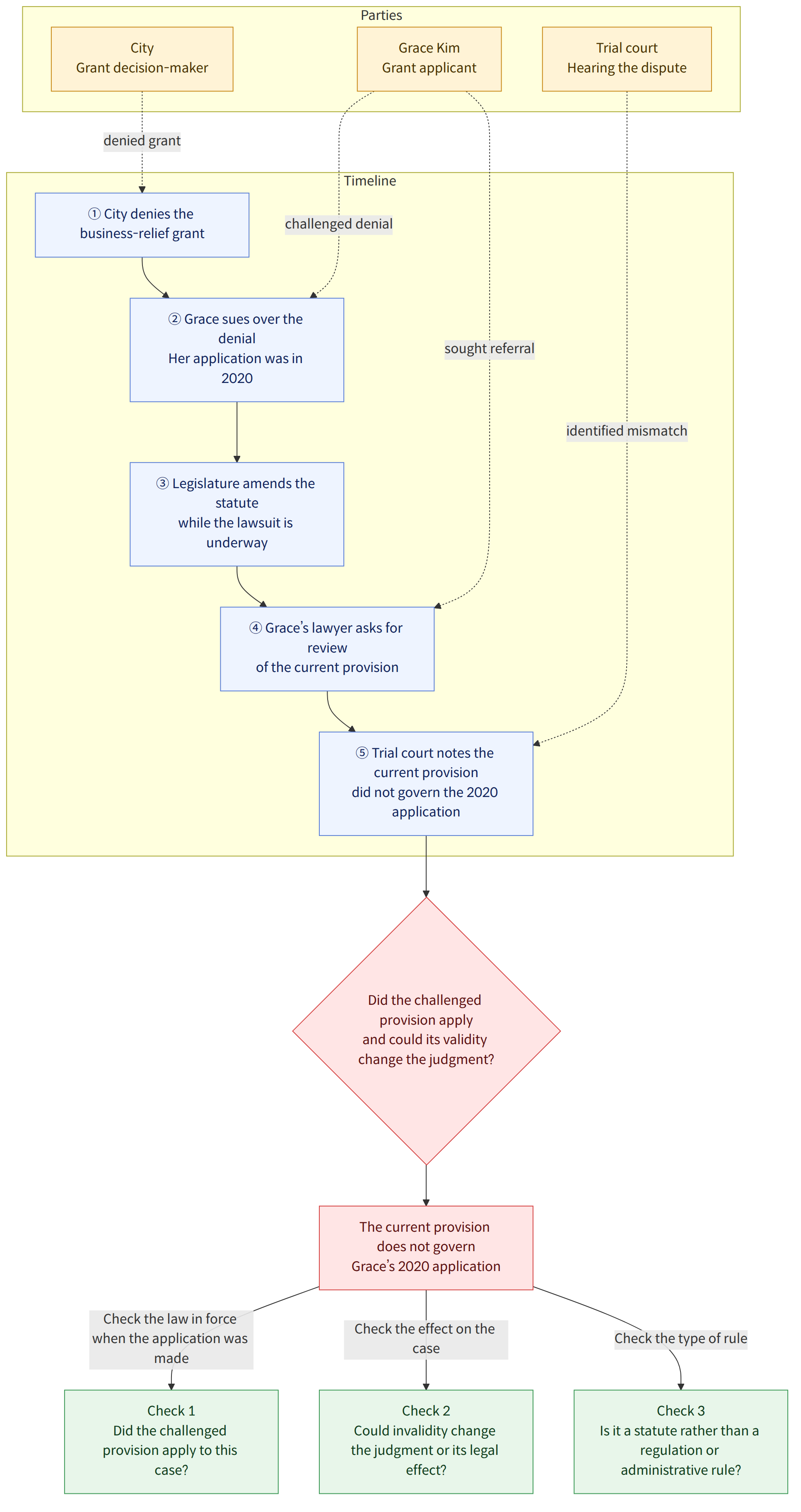
Her claim turned on a provision of the statute in force when she applied in 2020. By the time her lawsuit was underway, the legislature had amended that statute. The newer version used almost the same language, and Grace’s lawyer asked the trial court to refer that current provision to the Constitutional Court for review. Grace thought the similarity settled the matter. The court saw a more basic problem: the newer provision did not govern her 2020 application.
2. The Legal Question
Can a Korean court refer a statute for constitutional review simply because the provision resembles one involved in a lawsuit—or must the challenged provision actually apply to the case, with its validity capable of changing the judgment or its legal effect?
3. What Korean Law Says
Korean law does not provide constitutional review as an abstract opinion service. A court may refer a statutory provision to the Constitutional Court when a real case before it depends on that provision.
Under Article 41(1) of the Constitutional Court Act, when the constitutionality of a law is a prerequisite to deciding a case, the court hearing that case may refer the question to the Constitutional Court, either on its own initiative or at a party’s request.
The Constitutional Court describes the required connection as “relevance to the judgment” or “trial relevance.” In practical terms, two things must be true:
- The challenged statutory provision must apply to the case before the court. A provision from a different period, or one that governs another kind of dispute, will generally not qualify merely because it says something similar.
- Its constitutionality must matter to the court’s decision. If the provision were unconstitutional, the judgment’s outcome—or the legal meaning or effect of the judgment—must be capable of changing.
The key question is not simply whether a law raises a serious constitutional concern. It is whether deciding that concern could make a legal difference in the pending case.
The referral procedure concerns laws enacted by the legislature. It is not the route for asking the Constitutional Court to review a regulation or administrative rule. A court can assess the legality or constitutionality of such subordinate rules in the case before it, as applicable.
There is also a timing problem. If the relevant law is amended while constitutional review is pending, the challenged provision may no longer affect the underlying case. That can remove the required connection. But the Constitutional Court has recognized a limited exception: it may still decide the issue when the challenged rule raises an important, unresolved question about fundamental rights, or when a rights violation is likely to recur but is unlikely to receive timely review in another case.
A party whose request for referral is rejected may, in appropriate circumstances, bring a constitutional complaint under Article 68(2) of the Constitutional Court Act. That route does not eliminate the relevance requirement: the challenged law must still be a necessary part of deciding the original case.
4. How Korean Courts Approach This
Korean courts generally treat trial relevance as a practical test, not a formality. The Constitutional Court has said that it should ordinarily respect the referring court’s legal assessment of whether the requirement is met. It may examine the issue on its own, however, when that assessment clearly cannot be maintained.
A constitutional referral cannot proceed when the required connection to the pending case is missing; in that situation, the request is procedurally inadmissible and may be dismissed without a decision on whether the law is constitutional.
This principle explains why a constitutional claim can fail even when the alleged rights concern is substantial. A court may agree that the issue deserves attention in some setting and still conclude that the particular provision put forward does not control the case in front of it.
Courts also distinguish between a legal issue that could influence the reasoning and one that can affect the judgment’s operative result or legal consequences. The constitutional question must have a meaningful role in the case, not merely sit beside it.
5. Applying the Law to the Case
Grace’s request had to pass each part of the relevance test.
- Was there a concrete case? Yes. Grace’s grant dispute was before a court, and the court had to decide whether she qualified under the governing law. This was not an abstract request for advice.
- Was the challenged provision the law applicable to her dispute? No. Her application was governed by the version of the statute in force in 2020. The provision she asked the court to refer was the later version. The fact that the newer text looked almost identical did not make it the governing provision. The court would need to identify the earlier provision as the relevant one and consider whether that provision—not simply its later counterpart—was constitutionally decisive.
- Could the provision’s validity change the decision? This question had to be asked about the provision that actually governed Grace’s application. If the earlier rule was the legal basis for denying the grant, and finding it unconstitutional could alter the judgment or its legal effect, a properly directed challenge to that earlier rule might satisfy this part of the test. But that possibility could not cure a request aimed at a different provision that did not apply to her case.
- Did the later amendment create an exception? Not on these facts. The problem was not that a once-relevant referral had become moot during review; the later provision was never the rule governing Grace’s application. The exceptional power to decide a question after a case’s connection has ended is not a way to bypass the requirement that the correct provision be identified in the first place.
The trial court therefore had a sound procedural basis to reject the request as framed. It did not need to decide whether either version of the statute violated the Constitution. A rejection on trial-relevance grounds is not a ruling that the law is constitutionally valid; it means only that this referral did not meet the threshold for review.
6. Conclusion: What Happened, and What Should You Do?
Grace’s request to refer the later version of the statute was rejected because that provision did not govern her 2020 application. Her grant lawsuit could continue under the earlier rule, and the court would decide her claim on that basis. The constitutional question remained unanswered—not because it was necessarily unimportant, but because the provision she selected was not the one controlling her case.
For readers facing a similar issue:
- Check the exact version and effective date of the statute that governs the events in your case. Similar wording is not a substitute for showing that the challenged provision applies.
- Explain how invalidity could change the judgment or its legal effect. Connect the constitutional issue directly to the decision the court must make.
- Act promptly and document the timeline. If the statute changes or your case ends while review is pending, explain why the issue still needs a decision—and, if relevant, why it is important or likely to recur without another realistic opportunity for review.