1. A Human Story
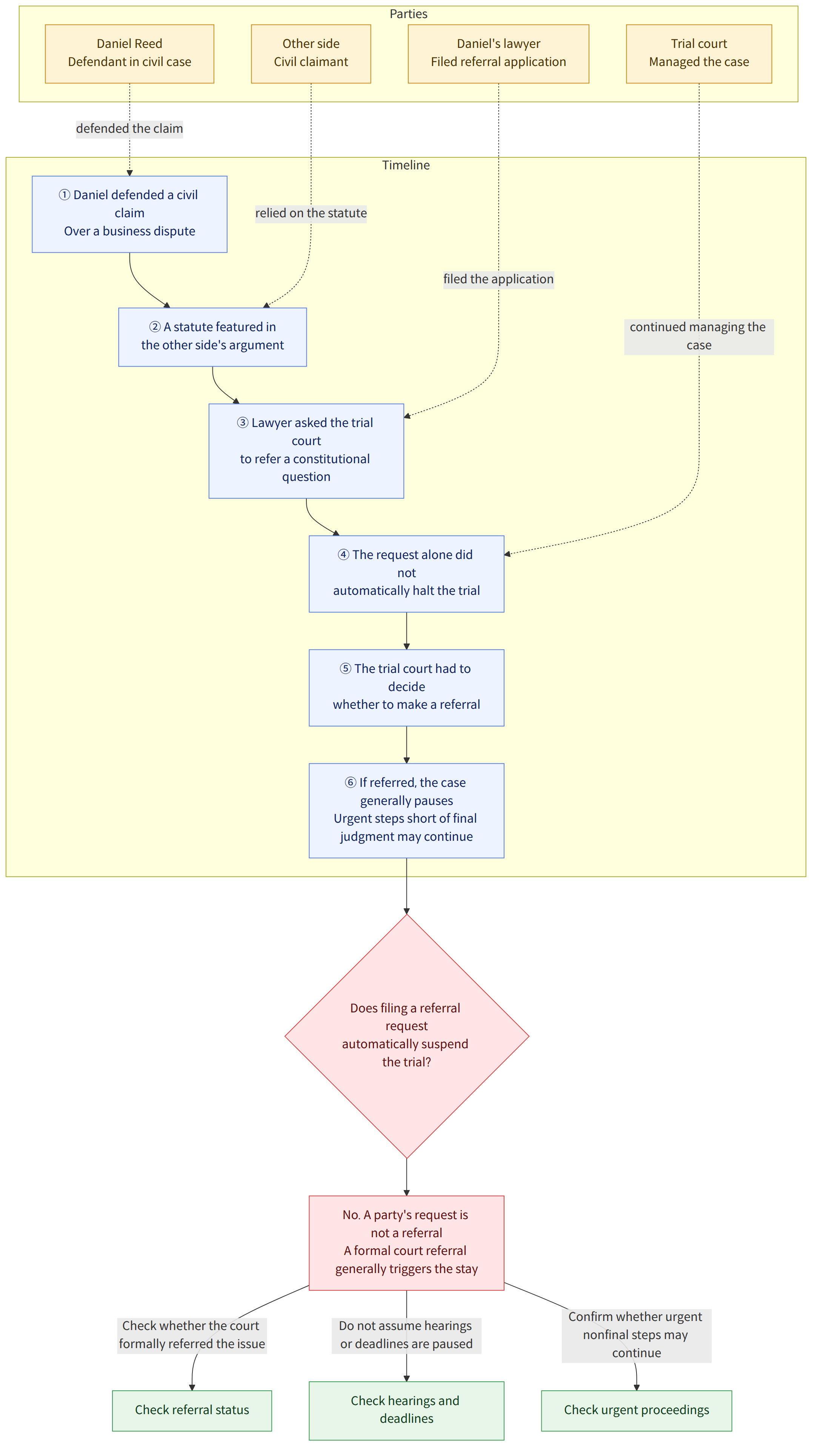
Daniel Reed, an American engineer living in Seoul, was defending a civil claim arising from a business dispute. One statute played a decisive role in the other side’s argument, and Daniel believed that the provision violated the Constitution. His lawyer filed an application asking the trial court to refer the constitutional question to the Constitutional Court.
Daniel assumed the filing would freeze everything. He had been preparing for the next hearing, but now expected the court to wait until the Constitutional Court ruled. Instead, the trial court continued managing the case. Daniel faced an uncomfortable question: had the court ignored his constitutional rights, or had he misunderstood what his application did?
2. The Legal Question
Does a party’s application asking a Korean court to refer a statute’s constitutionality automatically suspend the ongoing case?
The answer is no. The important dividing line is between a party asking the court to make a referral and the court actually making one.
3. What Korean Law Says
The Korean Constitution sets out the required number of Constitutional Court justices for certain decisions, but it does not prescribe every detail of the constitutional-review procedure. The legislature therefore has broad authority to shape that procedure.
Under the Constitutional Court Act, a litigant may ask the court hearing the case to refer a statute’s constitutionality to the Constitutional Court. But the filing of that request is not itself a court referral, and it does not automatically halt the trial.
A party’s application for referral does not, on its own, require the underlying case to be suspended. The trial court must first decide whether to refer the constitutional question.
The rule changes once the court makes a referral. Article 42(1) of the Constitutional Court Act provides, in substance:
When a court refers the question of a statute’s constitutionality to the Constitutional Court, proceedings in the underlying case are suspended until the Constitutional Court decides the question. If the court considers it urgent, however, it may continue proceedings other than the final adjudication.
In practical terms, the process has two stages:
- Application: A party asks the trial court to refer the constitutional issue. The case does not automatically stop.
- Referral: The trial court sends the issue to the Constitutional Court. The underlying case is generally suspended until the constitutional ruling, though urgent steps short of a final judgment may continue.
4. How Korean Courts Approach This
Korean courts distinguish between a litigant’s request and the court’s formal decision to refer a constitutional question. The application invites the court to act; it does not itself transfer the issue to the Constitutional Court or trigger the statutory stay.
Courts have also reasoned that, because the Constitution leaves much of the procedure for constitutional review to the legislature, the legislature’s choice not to make a party’s application an automatic ground for suspension does not exceed its constitutional discretion. In other words, the absence of an automatic pause is not, by itself, unconstitutional.
The case is generally stayed after the trial court makes the referral—not merely because a party has asked it to do so.
This approach allows the trial court to consider whether the constitutional issue genuinely needs referral while preventing every application from automatically bringing litigation to a halt.
5. Applying the Law to the Case
Daniel’s application alone did not suspend his civil case. The key question was whether the trial court had accepted his request and formally referred the challenged statute to the Constitutional Court.
If the court had only received the application—or had not yet ruled on it—the trial could continue. Daniel therefore needed to remain prepared for hearings and comply with procedural deadlines rather than assume that the case was on hold.
If the trial court decided that the constitutional question warranted referral and sent it to the Constitutional Court, the ordinary rule would be different: the underlying case would generally pause until the Constitutional Court issued its decision. Even then, the trial court could continue urgent procedural steps other than delivering the final judgment.
Daniel’s argument that the case should stop as soon as he applied would not succeed. The law does not make the application itself a suspension event, and that arrangement is not unconstitutional merely because it allows the trial court to continue while deciding whether referral is appropriate.
6. Conclusion: What Happened, and What Should You Do?
Daniel’s case did not stop when his lawyer filed the application. The trial court continued the proceedings while considering the request. Only if the court formally referred the constitutional question would the general suspension rule take effect. Daniel therefore had to keep participating in the case unless and until the court made that referral.
If you are involved in a similar case:
- Confirm the court’s action: Do not assume the case is stayed just because you filed an application. Check whether the court has actually issued a referral.
- Explain why the issue matters: Show how the challenged provision affects the outcome of your case; a constitutional objection should be tied to the legal issues the court must decide.
- Keep meeting deadlines: Continue preparing for hearings and complying with court orders unless the court confirms that proceedings have been suspended.