
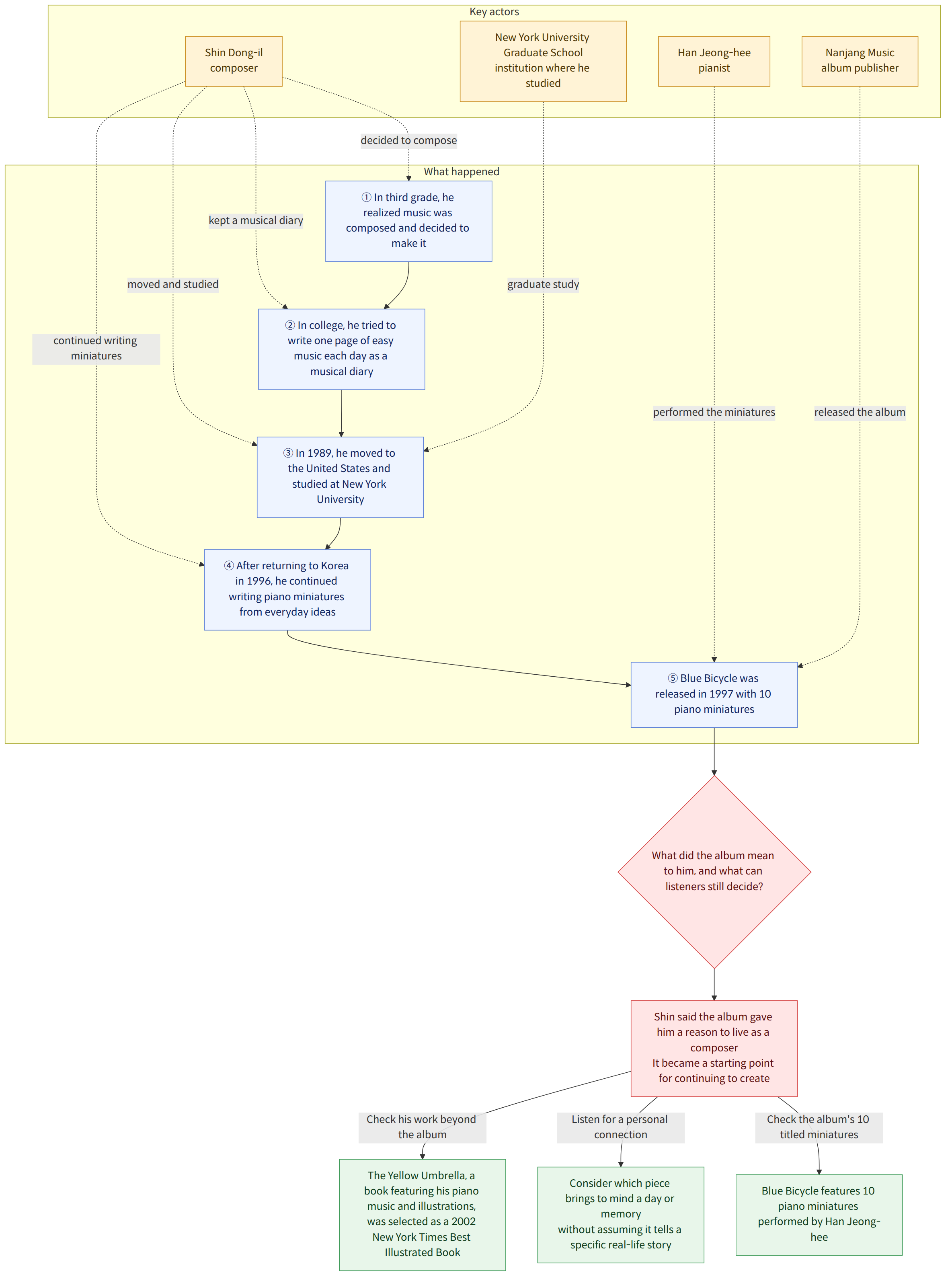
Born in Seoul in 1965, he first learned in third grade that music was composed by someone, and thought that he, too, would make music. In college, he tried to write one page of easy music every day in a music notebook and keep a diary through music. That effort led him to continue writing piano miniatures, and eventually to “Blue Bicycle,” released after he returned to Korea.
Background and context
Classical music was always playing in Shin Dong-il’s home, it is said. His father was a Korean-language teacher, and his mother was an art teacher.
His first work was an attempt to write a symphony. Around the age of ten, inspired by a toy, he conceived a large-scale work, but it did not go well. In sixth grade, he wrote a piano minuet. He said he lost the sheet music, but the piece remained in his head.
Shin Dong-il entered the composition department at Seoul National University (서울대학교) in 1984. The article explains that the composition entrance exam includes solfege (singing from sheet music), ear training (transcribing music heard into notation), piano performance, and harmony. He said he learned the notes so thoroughly that he could hum them without looking at sheet music. This experience may have provided a foundation for listening to music and understanding its structure and flow.
He moved to the United States in 1989 and studied at New York University (뉴욕대학교) Graduate School. He submitted a duet for violin and cello to a competition run by the specialist string-instrument magazine Strings, won, and received $150 in payment for publication in the magazine. The article describes this as his first earnings from composing, and says he had become a “pro” as a composer for the first time.
In the United States, he also released a work based on Silla hyangga and a solo piece for unaccompanied violin. According to the article, three hyangga songs were performed in English, with cello accompaniment and soprano vocals, and the violin solo was written with sanjo in mind. The works were regarded as an attempt to combine Eastern sensibilities with Western expressive techniques, showing that his music did not remain confined to a single style. He returned to Korea in 1996.
What this story means
Behind “Blue Bicycle” was not only an ambitious conception for a work, but also a habit of recording the seeds of short musical ideas that came to him in everyday life. Shin Dong-il explained that he jots down notes that come to him while walking or eating in a notebook. The “motif” mentioned in the article is a small musical starting point that can later develop into a theme or structure for a piece. His college effort to keep a musical diary by writing easy pieces can likewise be seen as a way to steadily turn such small ideas into music.
The musician he named as having had the greatest influence on his music was the Hungarian composer Béla Bartók. Shin Dong-il said he admired Bartók’s approach of valuing people’s actual singing and breathing over the constraints of fixed beats. This suggests that one strand of his musical outlook lies in attending to rhythms and sensibilities as they are actually heard and felt, rather than simply following traditional forms. This is an interpretation based on the interview and descriptions of his work in the article; it does not mean that all of Shin Dong-il’s works can be explained by a single principle.
“Blue Bicycle,” featuring 10 piano miniatures performed by pianist Han Jeong-hee, was released by Nanjang Music (난장뮤직) in 1997. He said the album was the work that gave him a reason to live as a composer in this country. Its significance lies not merely in the release of an album, but in the fact that it became, for the composer himself, a starting point for a life of continuing to create.
For example, readers who have a chance to listen to the album can consider which of its 10 titled pieces brings to mind a day or a memory of their own. This does not mean assuming that each piece is based on a particular real-life story. Rather, it is a way to explore through personal listening how the idea of keeping a diary through music comes across in the composer’s work.
The article says that “The Yellow Umbrella” (노란 우산), a book featuring Shin Dong-il’s piano music and illustrations by Ryu Jae-su, was selected as a “New York Times Best Illustrated Book of the Year” in 2002. The description of it as a book in which music flows through the illustrations without words shows that his work extended beyond piano albums into a form that brings together the experience of illustrations and music.
Confirmed facts and what remains unknown
Confirmed facts
- Shin Dong-il was born in Seoul in 1965, and decided in third grade that he would make music himself.
- He entered the composition department at Seoul National University (서울대학교) in 1984, moved to the United States in 1989, and studied at New York University (뉴욕대학교) Graduate School.
- A duet for violin and cello won a competition run by Strings, earning him $150 in payment for publication.
- After returning to Korea in 1996, he released “Blue Bicycle,” an album containing 10 piano miniatures, in 1997.
- Shin Dong-il named Béla Bartók as the musician who had the greatest influence on his music, and the article says “The Yellow Umbrella” was selected as a “New York Times Best Illustrated Book of the Year” in 2002.
What remains unknown
- The article does not say exactly when Shin Dong-il wrote each piece in “Blue Bicycle” or what inspired each one.
- It is also not possible to determine which category “The Yellow Umbrella” was selected in or what the selection process involved.
What readers should check
- If you listen to “Blue Bicycle,” consider how the titles of the 10 pieces relate to your experience of the music, but avoid speculating about the pieces’ compositional backgrounds as if they were facts reported in the article.
- To learn more about the significance of “The Yellow Umbrella” selection, it is important to distinguish the selection title given in the article from the category and process. This article does not provide the category or process.