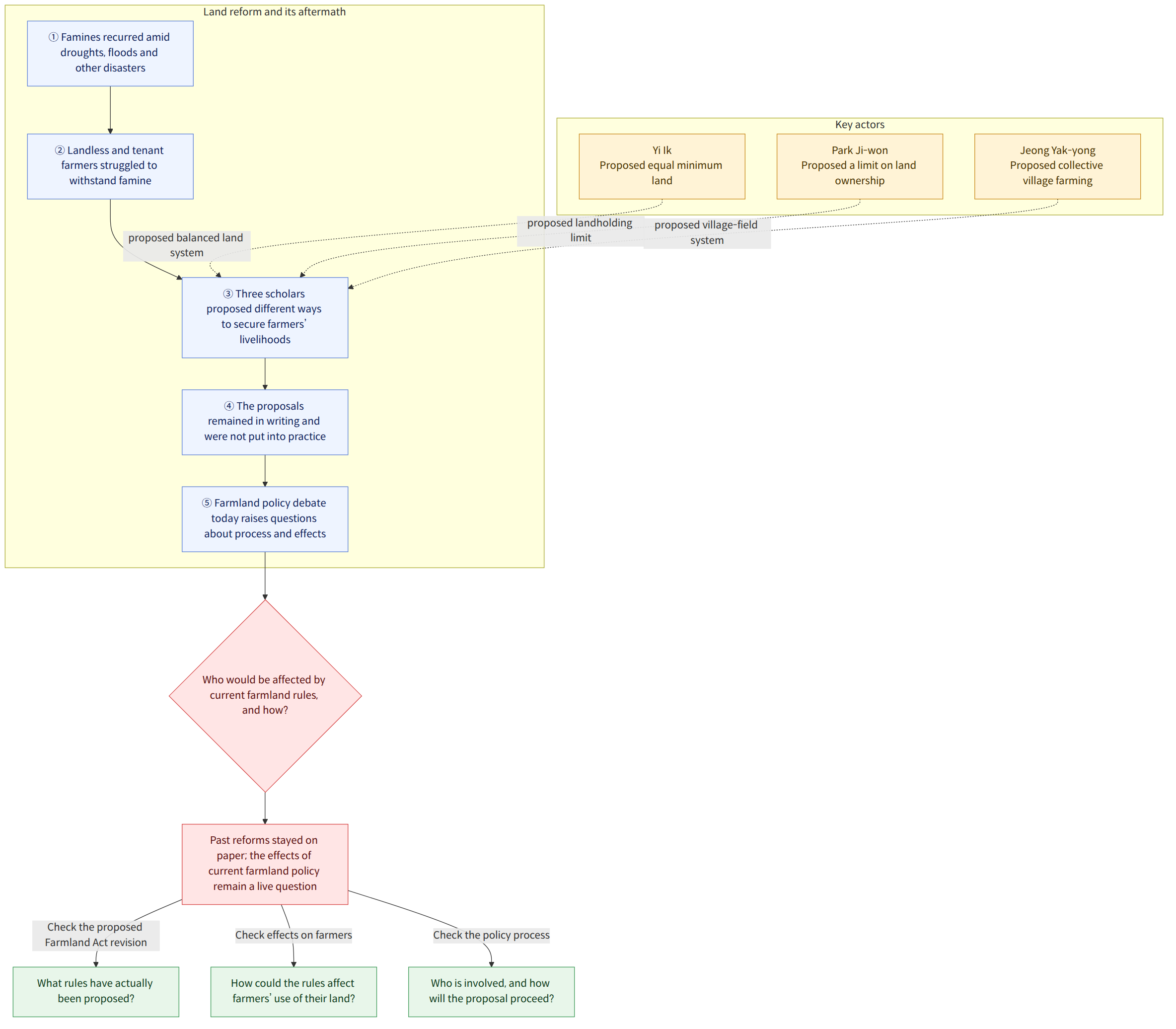
In late Joseon, famines occurred once every three to four years because of droughts, floods, and other disasters, the article reports. Many displaced people (流民, people who had left their homes and wandered from place to place) who left in search of food died of hunger while begging, the article explains, while some resorted to looting. The article says proposals for land reform emerged as a way to reduce their numbers, but assesses that the proposals of Yi Ik, Park Ji-won, and Jeong Yak-yong were never put into practice and remained only in writing.
Background and context
The starting point in the article is not just famine itself, but the question of who had land that could help them weather a famine. In “Yumin Hwanjip” (「유민환집」), in Seongho Saseol (『성호사설』), Yi Ik wrote that people who farmed on time and stored food had a way to survive even floods and droughts. By contrast, the article explains, farmers who had no land or rented small plots as tenants struggled to withstand famine.
Citing Park Ji-won’s Hanmin myeongjeonui (『한민명전의』), the article says tenant farmers handed over 70% or more of their produce to landlords and the state. It adds that some farmers, seeking to make ends meet during famines, sold their own land to landlords and became tenant farmers, and that large landowners emerged in the process. Land ownership and distribution are therefore presented not simply as property issues, but as questions of whether farmers could maintain their livelihoods where they lived.
The three Silhak scholars proposed different solutions. Yi Ik’s balanced land system (균전론), an idea to distribute land evenly, called for farmers to receive equal shares of the minimum land needed to survive—yeong-eopjeon (영업전), land granted to farmers for their livelihood—and for that land to be made unsellable. Park Ji-won’s landholding-limit theory (한전론), an idea to place a ceiling on land ownership, would recognize existing ownership while setting a limit on how much land individuals could own in the future.
In explaining Park Ji-won’s proposal, the article gives the example of setting a personal ownership limit of 5,000 pyeong from January 1, 2027. This is an example offered by the article for explanatory purposes, not a policy confirmed as being put into effect. Jeong Yak-yong’s village-field system (여전론), an idea for a village to own and cultivate land collectively, proposed that the village own the land, residents farm it together, and the harvest be divided according to the hours each person worked.
What this news means
The three proposals shared a challenge to a situation in which a small number of landlords held large areas of land, and sought to secure land that would allow farmers to make a living. Their methods differed. Yi Ik sought to guarantee everyone a minimum amount of land; Park Ji-won proposed setting a ceiling on ownership; and Jeong Yak-yong proposed collective village ownership and cultivation. From how land ownership would be distributed to how a community would be run, the proposals show that making reform a reality would have required different choices.
The article, however, links the failure to realize these proposals to the proponents’ social positions. It says Yi Ik and Jeong Yak-yong were members of the Southerners faction and the capital-based elite (경화세족, an influential group from families based in Seoul), while Park Ji-won belonged to the Bannam Park clan, and that all three were landowners. The article’s argument is that it would have been difficult for them to pursue reform in practice when doing so would have required them to give up their own land and that of their kinship groups. This is the article’s analysis; it does not provide specific confirmation of the size of each person’s landholdings or the process by which they pursued their policies.
The question left for readers today is not only what direction farmland policy should take. The article mentions a government briefing and a visit to farmland on September 30 related to a comprehensive survey of farmland, and reports that the People Power Party (국민의힘) criticized the government’s proposed revision of the Farmland Act (농지법). One way to connect the failure to implement past reform proposals with present-day policy is to look not only at who proposed a policy, but also at the actual process it goes through and whom it affects.
For example, farmers facing changes to farmland policy should not assume the outcome based only on arguments for or against the policy. They should check what rules have actually been proposed and how those rules could affect their use of land or livelihoods. This does not mean presuming the content or effects of any particular policy; it applies the question raised by the article—whether an idea leads to implementation—to current policy debates.
What is confirmed and what remains unknown
Confirmed facts
- The article connects frequent famines and the emergence of displaced people in late Joseon with problems of land and livelihoods.
- Yi Ik’s balanced land system is described as a proposal to distribute yeong-eopjeon and prohibit its sale.
- Park Ji-won’s landholding-limit theory is presented as a proposal to set a ceiling on land ownership; 5,000 pyeong is an example given in the article.
- Jeong Yak-yong’s village-field system is described as a proposal for collective village ownership and cultivation, with the harvest divided according to hours worked.
- The article claims that the land-reform proposals of all three men were never implemented.
What remains unknown
- The original article does not explain in detail how these proposals influenced the policies or discussions of the royal court at the time.
- It does not provide specific information about the three men’s actual landholdings or the process by which their proposals went unrealized.
- It is not known how the current farmland policies and politicians’ responses mentioned in the article will develop.
What readers should check
- When following debates over farmland policy, distinguish between arguments for and against a policy and the rules actually proposed and the people to whom they would apply.
- Farmers affected by a policy should check what changes it could bring to their use of land or livelihoods, and whether the decision to implement the system and the procedures have been finalized.
- When assessing politicians’ pledges or criticisms, consider not only the proposal itself but also whether methods of implementation and expected outcomes have been presented.