
1. A Human Story
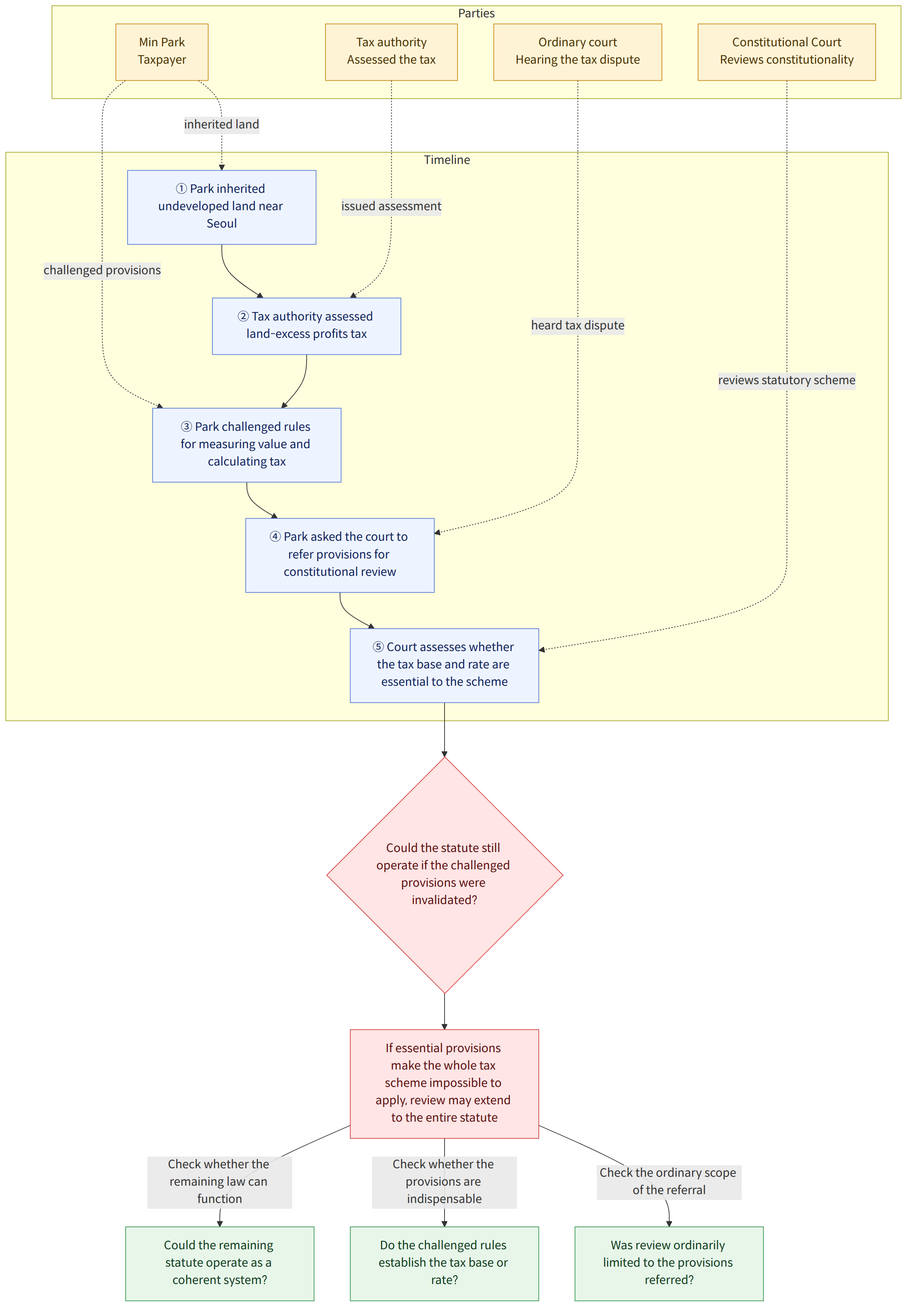
Min Park had inherited a parcel of undeveloped land outside Seoul. Years later, she received a substantial assessment under Korea’s former land-excess-profits tax system, which taxed certain increases in land value. Min believed the law’s rules for measuring land value and calculating the tax were unfair, so she asked the court hearing her tax dispute to refer several specific provisions for constitutional review.
Min expected the constitutional case to remain tightly focused on those provisions. Her question was simple: if she had challenged only part of the statute, could the Constitutional Court reach beyond her request and review the law as a whole? The answer turned not on how many provisions she named, but on whether the challenged provisions were so central that the rest of the tax system could not function without them.
2. The Legal Question
When a litigant seeks constitutional review of only certain provisions of a statute, may the Constitutional Court expand the review to the entire statute if invalidating those provisions would leave the law impossible to apply?
3. What Korean Law Says
Korea’s Constitution allows a person involved in a court case to pursue a constitutional complaint when the ordinary court refuses to refer a relevant statutory provision to the Constitutional Court. This route is commonly called a constitutional complaint under Article 68(2) of the Constitutional Court Act. The constitutional issue must matter to the underlying court case; it is not a general invitation to challenge any law a person dislikes.
As a rule, constitutional review is confined to the statutory provisions referred for review. But the rule has an important exception. Article 45 of the Constitutional Court Act permits the Constitutional Court to review the whole statute when the provisions before it are unconstitutional and, as a result, the statute as a whole could not be put into effect. Article 75(6) applies that rule to constitutional complaints under Article 68(2).
The basic rule: The Court ordinarily decides the constitutionality of the provisions referred to it. >The exception: If invalidating those provisions would make the entire statute impossible to operate, the Court may extend its review to the statute as a whole.
The exception is about the practical and legal structure of the statute, not simply the number of provisions challenged. It may apply when the provisions in question are indispensable parts of the law—for example, provisions that establish the core basis for a tax or determine its rate.
A related form of ruling is a declaration of constitutional incompatibility. Rather than simply striking a provision down at once, the Court may find that it conflicts with the Constitution while allowing its effect to continue temporarily, often to give the legislature an opportunity to amend the law or to avoid a disruptive legal vacuum. Because this kind of ruling is a form of unconstitutionality, the rules allowing review to extend beyond the referred provisions can apply to it as well.
4. How Korean Courts Approach This
Korean constitutional review balances two concerns. First, the Court generally respects the limits of the question brought before it. That keeps constitutional proceedings connected to the dispute that led to the referral and prevents the Court from treating a narrowly framed case as an unrestricted review of legislation.
Second, the Court considers whether the statute can sensibly remain in force if the challenged provision or provisions are invalidated. If the remaining rules still form a workable legal scheme, there may be no reason to review every other provision. But if essential elements disappear—so that the law can no longer be applied as a coherent system—the Court may extend the scope of review under Article 45.
The key judicial principle is functional: The Court asks whether the remaining statute could still operate, not merely whether the applicant listed every provision that might be affected.
The Court has applied this principle to the former land-excess-profits tax law. It concluded that provisions governing the tax base and the tax rate were fundamental elements of the scheme. If those provisions lost effect, the tax system could not be administered as designed. The Court therefore treated the statute as a whole as falling within the scope of review, including where the constitutional defect called for a declaration of incompatibility rather than an immediate, ordinary invalidation.
5. Applying the Law to Min’s Case
The reasoning in Min’s case would proceed in several steps:
- The constitutional issue arose in a real tax dispute. Min was challenging an assessment imposed under the statute, so the law’s validity could affect the outcome of her pending case.
- Her request identified only selected provisions. That would ordinarily define the scope of constitutional review. The Court would not automatically examine every provision in the statute merely because Min questioned the law’s fairness.
- The challenged provisions included essential parts of the tax scheme. The constitutional dispute concerned rules central to determining the taxable land value and the amount of tax. A tax cannot be calculated or collected under a system that lacks a workable tax base or rate.
- Removing those rules would disable the statute as a whole. If the core calculation provisions could not be applied, the remaining provisions would not provide a functioning substitute. The statute could not continue operating in its intended form.
- The statutory exception therefore became relevant. Under Article 45, applied to Min’s constitutional complaint through Article 75(6), the Court could extend the review beyond the provisions she had specifically identified. The same logic applied even if the Court used a declaration of constitutional incompatibility, because that disposition is a form of constitutional invalidity, though its effects may be managed differently.
This expansion would not mean that the Court had separately found every sentence of the statute unconstitutional. It would mean that the entire statute had become the object of review because its essential framework could not survive the loss of the challenged provisions.
6. Conclusion: What Happened, and What Should You Do?
Min’s challenge would not be confined to the clauses she initially named. Because the disputed rules were basic components of the former tax system, their loss of effect would leave the rest of the statute unable to operate. The Constitutional Court could therefore extend review to the statute as a whole and issue an appropriate ruling on the law in its entirety. That is a limited exception to the usual rule—not a general power to decide every issue a party might wish to raise.
For anyone considering a similar challenge:
- Explain why the provision matters to your court case. In a constitutional complaint under Article 68(2), the constitutional question must be connected to the outcome of the underlying dispute.
- Identify how the challenged rule fits into the larger statute. If you argue that review should extend further, show why the law cannot function without the provision at issue.
- Get advice on timing and remedies. A finding of unconstitutionality and a declaration of constitutional incompatibility can have different practical effects, including different treatment of the provision while the legislature responds.