
1. A Human Story
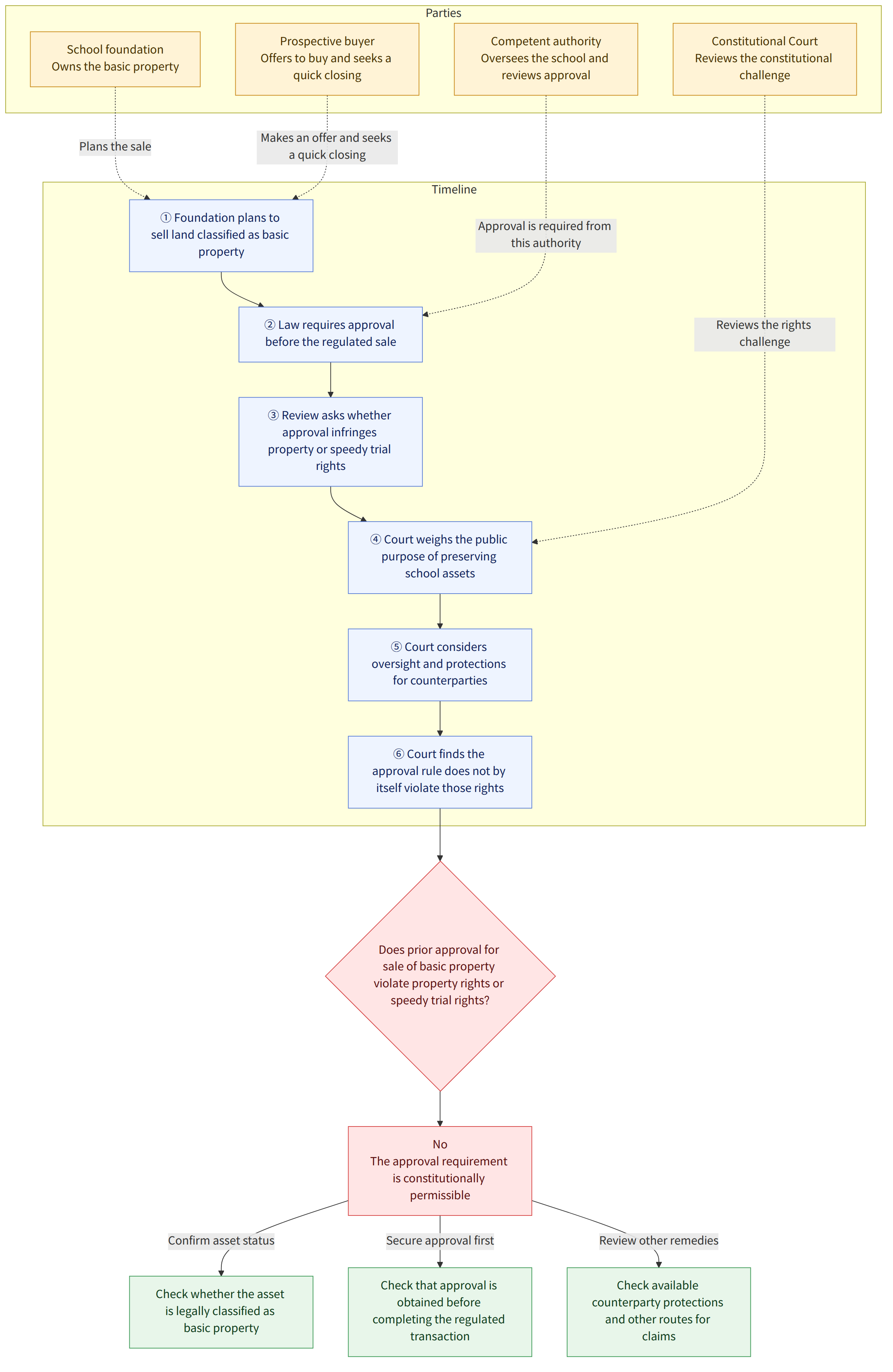
Daniel Reed, a finance director at a private-school foundation in Korea, had spent months trying to steady the school’s finances. Enrollment had fallen, maintenance costs were rising, and a parcel of land the foundation owned near the campus had become difficult to justify keeping. A prospective buyer made an offer that could help fund urgent repairs and reduce the foundation’s debts.
The sale seemed like a practical solution—until Daniel learned that the land was classified as the foundation’s basic property. Before the foundation could sell it, it needed permission from the government authority responsible for overseeing the school. The buyer wanted a quick closing. Daniel worried that the approval requirement could delay the transaction, lower the price, or leave the foundation unable to act on its own property.
2. The Legal Question
Can Korean law constitutionally require a private-school foundation to obtain approval before selling its basic property, even when the foundation believes the sale is financially necessary? In particular, does that requirement violate the foundation’s property rights or its right to a speedy trial?
3. What Korean Law Says
The Private School Act treats a school foundation’s basic property differently from ordinary assets. Under Article 28, a foundation generally must obtain approval from the competent authority before taking certain steps involving that property, including selling it. The approval requirement also covers transactions or actions such as gifts, exchanges, changes of use, and pledges of the property as security. It applies as well to certain assumptions of obligations and waivers of rights.
In plain language: a foundation cannot assume that it may freely sell property classified as basic property just because it owns it. It must first follow the statutory approval process.
The law’s aim is to preserve the financial and physical foundation on which a school operates. If core assets could be sold off without oversight, a foundation might weaken its ability to maintain the school and provide education.
The Constitutional Court has considered whether this approval requirement goes too far. It concluded that requiring approval for the sale of basic property does not, by itself, violate the foundation’s property rights or its right to a speedy trial. The Court reasoned that the competent authority is positioned to understand the foundation’s assets and financial condition, and that approval can help prevent the foundation’s basic property from being depleted.
The constitutional question is not simply whether a restriction affects the use of property. It is whether the restriction pursues a legitimate public purpose and imposes a burden that is excessive in light of that purpose.
Several practical points follow:
- Classification matters. The approval rule concerns property treated as the foundation’s basic property, so the foundation should verify the asset’s legal status before agreeing to a sale.
- Approval must come before the regulated transaction is completed. A buyer’s interest or a signed commercial understanding does not, on its own, replace the required authorization.
- The rule is not necessarily an end to all financial remedies. The Court noted the existence of arrangements intended to protect a transaction’s counterparties and other routes for pursuing claims, including enforcement against property other than the foundation’s basic property and separate relief where ordinary enforcement or an auction does not satisfy a claim.
4. How Korean Courts Approach This
In constitutional review, Korean courts weigh the public purpose of a restriction against the burden it places on the affected party. A restriction is more likely to be upheld when it serves an important public interest, is reasonably suited to achieving that interest, and does not impose an excessive burden when considered alongside available protections and alternatives.
For school foundations, the preservation of basic property carries a significant public dimension. The property supports an institution that provides education, and the authority overseeing the school may have a fuller picture of the foundation’s assets and financial position than a buyer or creditor. Requiring that authority to review a proposed sale can therefore be a rational way to guard against the dissipation of assets essential to the school’s operation.
The Court also considered the interests of people dealing with the foundation. It did not treat the approval requirement as an unqualified bar on transactions or creditor remedies. The existence of measures intended to support counterparties and of other avenues for pursuing claims helped show that the restriction was not excessive.
The argument about a speedy trial did not change the result. The approval requirement gives the competent authority a decision-making role; it does not, simply by existing, establish that the foundation has been denied timely access to a court. The Court concluded that the public purpose was weighty enough to justify the authority’s final role in deciding whether a sale of basic property should be permitted.
5. Applying the Law to the Case
Daniel’s foundation faces the precise kind of decision Article 28 regulates. Its first task is not to decide whether the buyer’s offer is attractive, but to confirm whether the land is classified as basic property. If it is, the foundation must account for the approval process before treating the sale as ready to close.
Next comes the constitutional objection. Daniel might argue that the foundation owns the land and needs the proceeds, so requiring official approval interferes with its ability to manage its property. That is a real burden. But under the Court’s reasoning, the burden is not enough on its own to make the law unconstitutional.
The approval requirement has a legitimate purpose: protecting the foundation’s financial base and, through it, the stability of the school. It is also connected to that purpose. Reviewing the foundation’s overall assets and finances can help the authority assess whether selling the land would undermine the school’s ability to operate. The authority’s role is especially relevant because the impact of selling one asset may depend on the foundation’s wider financial circumstances.
The final question is whether the process imposes an excessive restriction. The Court’s answer was no. It took account of protections for transaction counterparties and the possibility of pursuing claims through other property and legal procedures. It also regarded oversight of a sale as necessary to prevent the foundation’s basic property from being scattered or depleted.
That does not mean the foundation is guaranteed approval, or that the authority may disregard the law when deciding. It means the approval requirement itself survives constitutional review. Daniel’s foundation must pursue the statutory process; it cannot avoid that process simply by arguing that the sale is commercially sensible or that the approval requirement infringes property rights.
6. Conclusion: What Happened, and What Should You Do?
Daniel’s foundation could not complete the sale solely on the strength of its ownership or the buyer’s offer. Because the land was basic property, it needed to obtain approval from the competent authority. A constitutional challenge based on property rights or the right to a speedy trial would not, by itself, remove that requirement: the Constitutional Court has upheld the rule as a proportionate safeguard for school foundations and the public interest in education.
For readers facing a similar situation:
- Confirm the asset’s legal classification early. Do not assume that property is outside Article 28 simply because the foundation has long owned or used it.
- Build the approval process into the transaction timetable. Get specialist advice on the required application and avoid promising a closing date that assumes approval is automatic.
- Plan for the consequences of delay or refusal. Review the foundation’s financial alternatives and, if you are a buyer or creditor, understand what protections and other enforcement routes may be available.