1. A Human Story
Maya Chen had spent three years building a small restaurant-supply business in Busan. When a long-awaited customer payment was delayed, she still had a delivery to settle. Maya wrote her supplier a check drawn on her business account, hoping the incoming money would arrive before the check was presented.
It did not. The bank returned the check unpaid, and the supplier reported the matter. Maya was arrested and charged under Korea’s Act on the Regulation of Illegal Check Transactions. From her point of view, she had made a desperate attempt to keep the business moving—not set out to defraud anyone. Her lawyer considered asking the criminal court to refer the law to the Constitutional Court, arguing that punishing a failed payment was unfair, especially when people who issue promissory notes are treated differently.
2. The Legal Question
Can someone charged for issuing a check that is not paid ask a Korean court to refer the criminal provision to the Constitutional Court on the ground that it violates constitutional principles? And, more fundamentally, does the law punish ordinary inability to pay, or conduct that threatens the reliability of checks as a means of payment?
3. What Korean Law Says
The Act on the Regulation of Illegal Check Transactions contains several offenses relating to checks. In broad terms, it covers checks issued without a valid checking arrangement, checks bearing an unauthorized signature, and checks that are not paid when presented because of insufficient funds or specified banking restrictions or termination of the account arrangement.
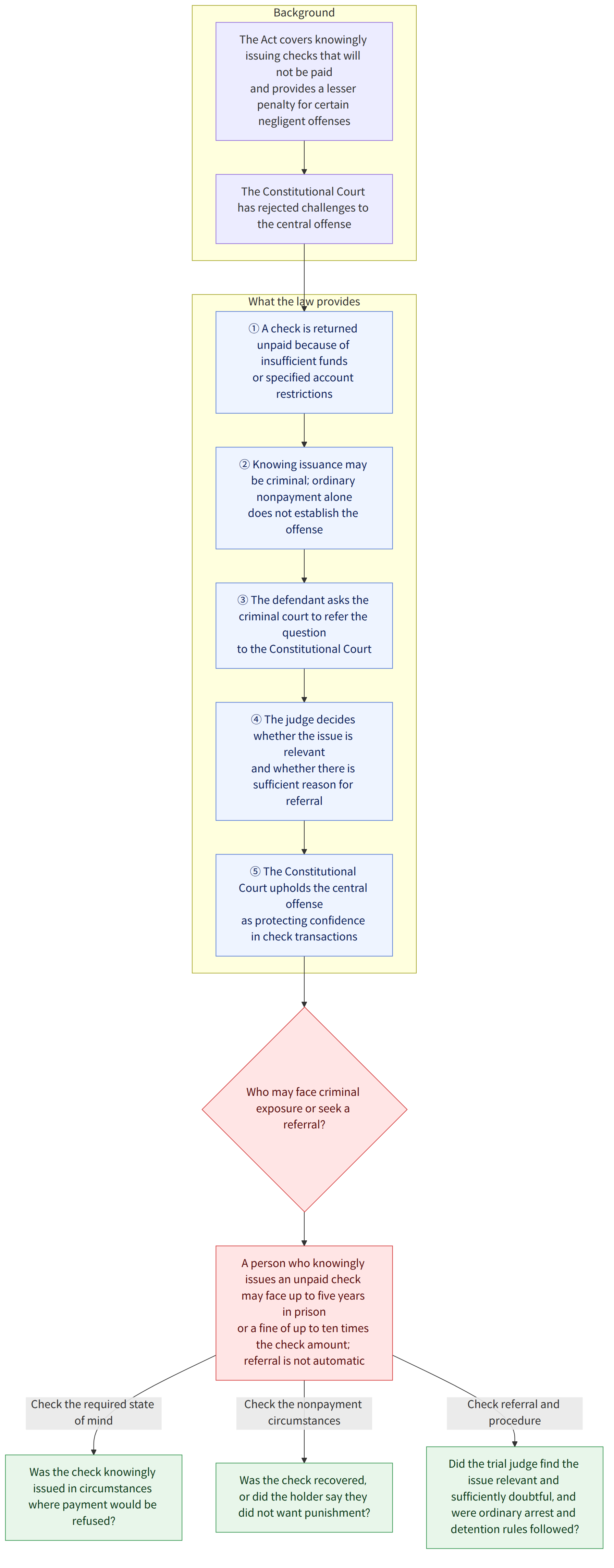
The law distinguishes intentional conduct from negligent conduct. A person who knowingly issues a check in circumstances in which payment will be refused may face a prison term of up to five years or a fine of up to ten times the check amount. A separate provision provides a lesser penalty for certain offenses committed through negligence.
The criminal provision is not simply a rule saying that every unpaid debt leads to imprisonment. The relevant question is whether the accused committed the conduct prohibited by the statute, with the required state of mind.
The statute also limits prosecution in specified cases involving nonpayment through insufficient funds or related account restrictions: if the issuer recovers the check, or the holder expressly states that they do not want the issuer punished, prosecution may not be brought for the offenses covered by that provision.
A constitutional referral is possible, but it is not automatic. A defendant asks the court handling the criminal case to refer the constitutional question. The judge decides whether the issue is relevant to the case and whether there is sufficient reason to doubt the law’s constitutionality. A defendant cannot require the trial judge to make a referral simply by requesting one.
The Constitutional Court has rejected constitutional challenges to the central offense of knowingly issuing a check that is not paid when presented. Its reasoning has addressed several principles:
- International law: The constitutional commitment to respect international law does not mean that every treaty automatically overrides domestic legislation. The Court concluded that the check offense does not amount to imprisonment merely for an inability to perform a contractual obligation. It targets conduct threatening the integrity of check transactions.
- Equality: Checks and promissory notes are both negotiable instruments, but they do different jobs. A check is intended to operate as a payment instrument, closer to a substitute for cash; a promissory note is principally a promise to pay later. The legislature may therefore treat knowingly issuing an unpayable check differently.
- Proportionality and economic freedom: The Court accepted the legislative judgment that administrative or financial penalties alone had not been sufficient to protect confidence in check transactions. It also considered that even a check used in practice as a form of credit may still circulate as a check and cannot always be distinguished by its appearance.
- Due process: A bank’s report is only a lead for investigation; it does not itself establish guilt or automatically justify detention. Any arrest or detention must comply with the ordinary criminal-procedure rules. The Court also emphasized that the offense is not punishment for nonpayment alone.
4. How Korean Courts Approach This
Korean courts generally treat the reliability of checks as a distinct public interest. Because a check is meant to be presented for payment, a person who issues one while anticipating that it will be refused can undermine trust not only between the issuer and the recipient, but also in the wider payment system.
That rationale explains why the Constitutional Court has not accepted the argument that check issuers must be treated exactly like people who issue promissory notes. The difference is not simply that one debtor is punished and another is not; it is that the instruments serve different commercial functions.
At the same time, the constitutional ruling does not dispense with the ordinary criminal trial. The prosecution must prove the legal elements of the offense. A returned check, standing alone, does not answer every question about what the issuer knew, what caused nonpayment, or whether a statutory bar to prosecution applies. Nor does a criminal charge itself make detention automatic.
The constitutional challenge and the criminal case are separate questions: the law may be valid, while the prosecution still has to prove that the accused violated it.
5. Applying the Law to the Case
Maya’s lawyer can ask the trial court to refer the provision to the Constitutional Court. The request can point to international human-rights protections, the different treatment of checks and promissory notes, and concerns that criminal sanctions may be excessive. But those arguments face a substantial obstacle: the Constitutional Court has already considered and rejected closely related constitutional objections to the provision.
The court would likely focus on the accepted distinction between the instruments. Maya used a check to pay a supplier. Even if she privately hoped the check would function like short-term credit, it remained a check capable of being presented and circulated. The law’s purpose is to protect the reliability of that payment mechanism, not to guarantee that every commercial debt is paid.
The next question is what Maya knew when she issued the check and why it was not paid on the presentation date. If the evidence shows that she anticipated payment would be refused and issued it anyway, the prosecution may seek to establish the intentional offense. If the case instead concerns negligence, the statute provides a separate, less severe route. The precise charge and the evidence supporting it matter; a business failure or later cash-flow crisis does not, by itself, prove what Maya knew at the time of issuance.
The supplier’s position also matters. If the supplier expressly states that they do not want Maya punished, the statutory restriction on prosecution may apply to the relevant offense. Merely accepting repayment, negotiating, or expressing sympathy should not be assumed to have the same effect as an express statement. Maya’s lawyer should clarify the holder’s position and preserve any written communication.
Finally, the fact that Maya was arrested does not prove that the arrest was lawful or that she is guilty. Whether detention is justified is determined under criminal-procedure rules, separately from the constitutionality of the check law. The bank’s report may have prompted an investigation, but it cannot substitute for evidence in court.
6. Conclusion: What Happened, and What Should You Do?
In Maya’s fictional case, the trial judge refuses to refer the provision, relying on the Constitutional Court’s established reasoning that the law protects the distinct payment function of checks and does not punish debt alone. The criminal trial continues. Because the evidence shows that Maya knew payment was likely to be refused when she issued the check, and the supplier has not expressly opposed punishment, the court finds the statutory offense proven. The constitutional challenge does not itself erase the charge—but neither does the bounced check alone establish guilt in every case.
For anyone facing a similar situation:
- Get legal advice promptly. Ask counsel to review the charge, the evidence about your knowledge when the check was issued, and whether the holder has expressly said they do not want punishment.
- Keep the records. Preserve bank statements, messages, payment arrangements, and communications with the holder; these may help explain the circumstances of issuance and nonpayment.
- Treat a constitutional referral as a legal argument, not a guaranteed escape route. The trial judge controls referral, and the core constitutional objections have already been rejected; focus also on the evidence and the procedural protections in your individual case.