The 2020 American film The Old Guard follows a secret team of immortals who appear whenever human civilization is in danger to protect people and civilization. Kim Seong-gon reads the film’s characters and relationships as symbols reflecting war and conflicts over race and ethnicity, gender, religion, and East and West. He argues that protecting civilization requires choosing coexistence and reconciliation over confrontation.
Background and context
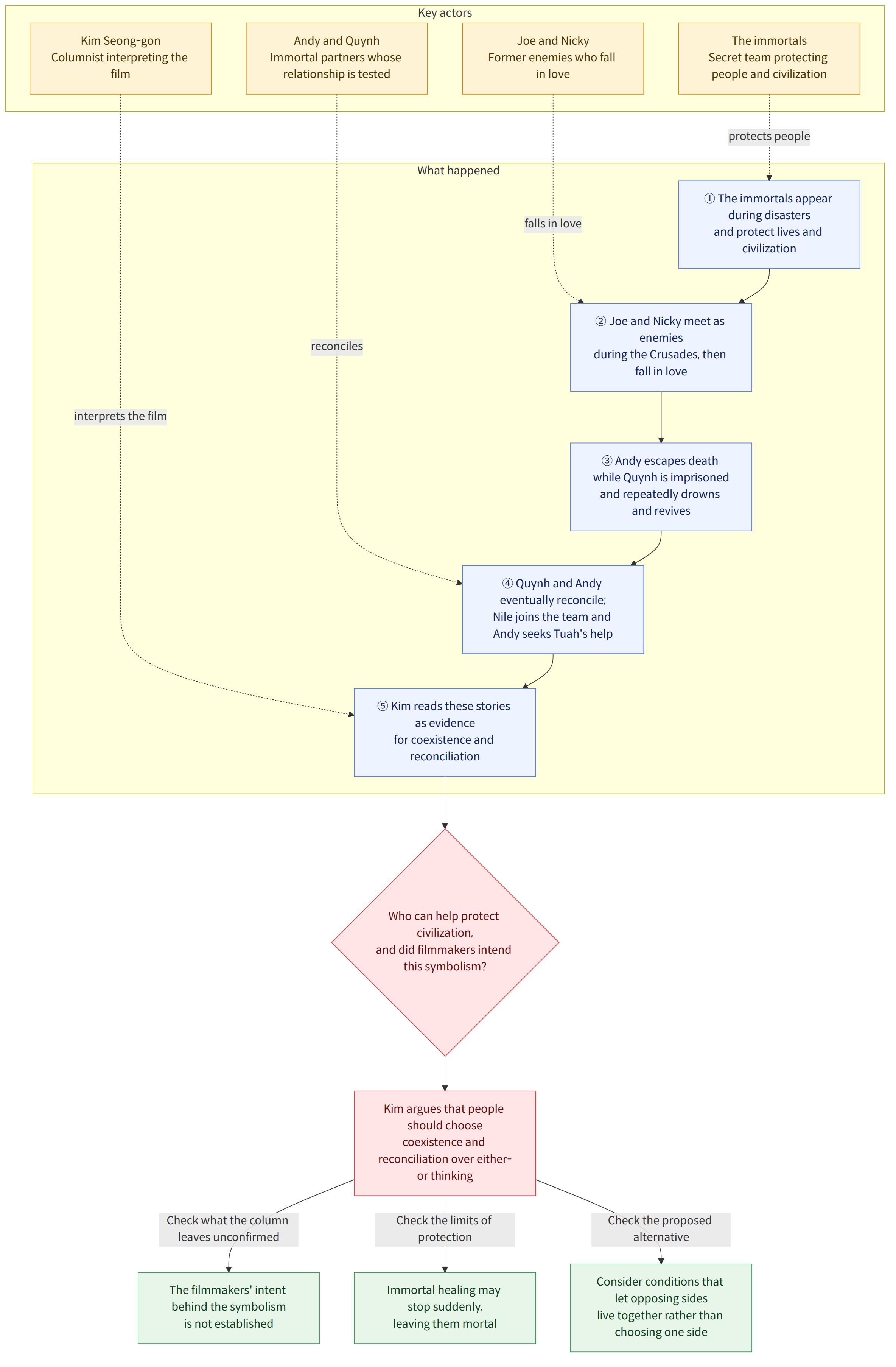
The film’s four immortal warriors have appeared during historical disasters to protect lives and civilization. The column explains that descendants of the people they save go on to help save the world in later crises, by developing treatments for epidemics or preventing wars through skilled diplomacy. The immortals’ role, then, is presented as going beyond a single rescue: they preserve the possibility that future generations will continue to protect civilization.
The team’s leader, Andy, is Andromache of Scythia and, according to the column, is at least 6,000 years old. Scythia is described as an ancient region north of the Black Sea that extended from what is now Ukraine and southern Russia to the Altai Mountains in Asia. Based on this background, Kim interprets Andy as representing Eastern Europe and Central Asia.
Andy’s teammate Booker lives in Paris, and the column suggests that he may represent Western Europe. Joe and Nicky first meet as enemies during the Crusades but fall in love. The column reads them as a symbol of hope that Christianity and Islam, despite their antagonism, can be reconciled. The film also features Nile, an African American woman and Marine who later joins the team. Kim interprets her as a symbol of a Black woman who must confront racial and male prejudice.
Another immortal, Quynh, is captured alongside Andy on charges of witchcraft. According to the column, Andy escapes death, but Quynh is locked inside an iron maiden and thrown into the sea. As an immortal, Quynh repeatedly drowns and revives for about 500 years. The guilt Andy feels for failing to save Quynh, and the pair’s eventual reconciliation after a misunderstanding, are interpreted in the column as revealing the closeness and precariousness of relations between East and West.
The film’s settings span not only Paris, London, and Rome, but also Seoul, Jakarta, South Sudan, and Afghanistan. In Seoul, Andy visits her old friend Tuah, who has extensive knowledge of immortals, and gets help dealing with the crisis she faces. Bringing stories from different regions and characters together within one team connects with the column’s theme of coexistence among cultures and religions.
What this means
The column’s central focus is not the fantasy premise of immortality itself, but the conflicts the immortals symbolize. Kim interprets war, divisions over race, ethnicity, gender, and religion, and conflict between East and West as threats to human civilization. In particular, the story of Joe and Nicky, who fall in love despite having once been enemies, and Andy and Quynh, who resolve their misunderstanding and reconcile, is read as showing that hostility need not be permanent.
This is Kim Seong-gon’s interpretation of the film. The original text does not establish whether the filmmakers intended the symbolism described in the column.
The column also points out that the immortals’ healing ability is not guaranteed to last forever. It can stop suddenly, leaving them mortal and unable to protect human civilization. Kim connects this premise to the idea that people should not rely solely on someone else’s protection. Protecting civilization, in this interpretation, is not something to leave to those with special abilities; it also depends on the choices people make in addressing conflict.
The direction the column proposes is to abandon “either-or thinking” (the view that only one of two options can be chosen) and accept the possibility of “both.” Rather than choosing between Christianity and Islam, capitalism and socialism, or East and West, it argues for finding ways for different systems and civilizations to coexist and reconcile. For example, if a reader encountering a conflict feels that supporting one side is the only possible choice, the column suggests considering the conditions under which opposing sides could live together. This is notable as an argument for changing the framework through which we view conflict, rather than for offering a specific solution.
What is confirmed and what remains unknown
Confirmed facts
- The column describes The Old Guard as a film about a secret team of immortals who have saved human civilization whenever it has faced a crisis.
- Andy is Andromache of Scythia, and the column says she is at least 6,000 years old.
- Joe and Nicky meet as enemies during the Crusades and later fall in love; Quynh repeatedly drowns and revives in the sea for about 500 years.
- Kim Seong-gon interprets the film’s characters and events as symbols of various social and cultural conflicts, and argues for coexistence and reconciliation.
- Kim Seong-gon is described as an emeritus professor in the Department of English Language and Literature at Seoul National University (서울대학교) and a visiting scholar at Dartmouth College (다트머스대). The column states that its views are those of the author.
What remains unknown
- It has not been established whether the filmmakers intended the character-specific symbolism and interpretations of conflict presented in the column.
- The column argues that coexistence and reconciliation are necessary, but does not offer specific procedures or policies for resolving individual real-world conflicts.
What readers should consider
- It is important to distinguish the film’s plot from the column’s symbolic interpretation. The characters’ backgrounds are presented as part of the film’s setting, while the claim that a character represents a particular region or group is presented as Kim Seong-gon’s interpretation.
- Readers can consider whether the column’s conclusion offers a solution that can be applied to any conflict, or whether it is instead a perspective that encourages imagining coexistence beyond confrontation.
- It is important not to conflate the author’s views with the filmmakers’ intentions. The original text does not say whether the filmmakers intended the symbolism in question.