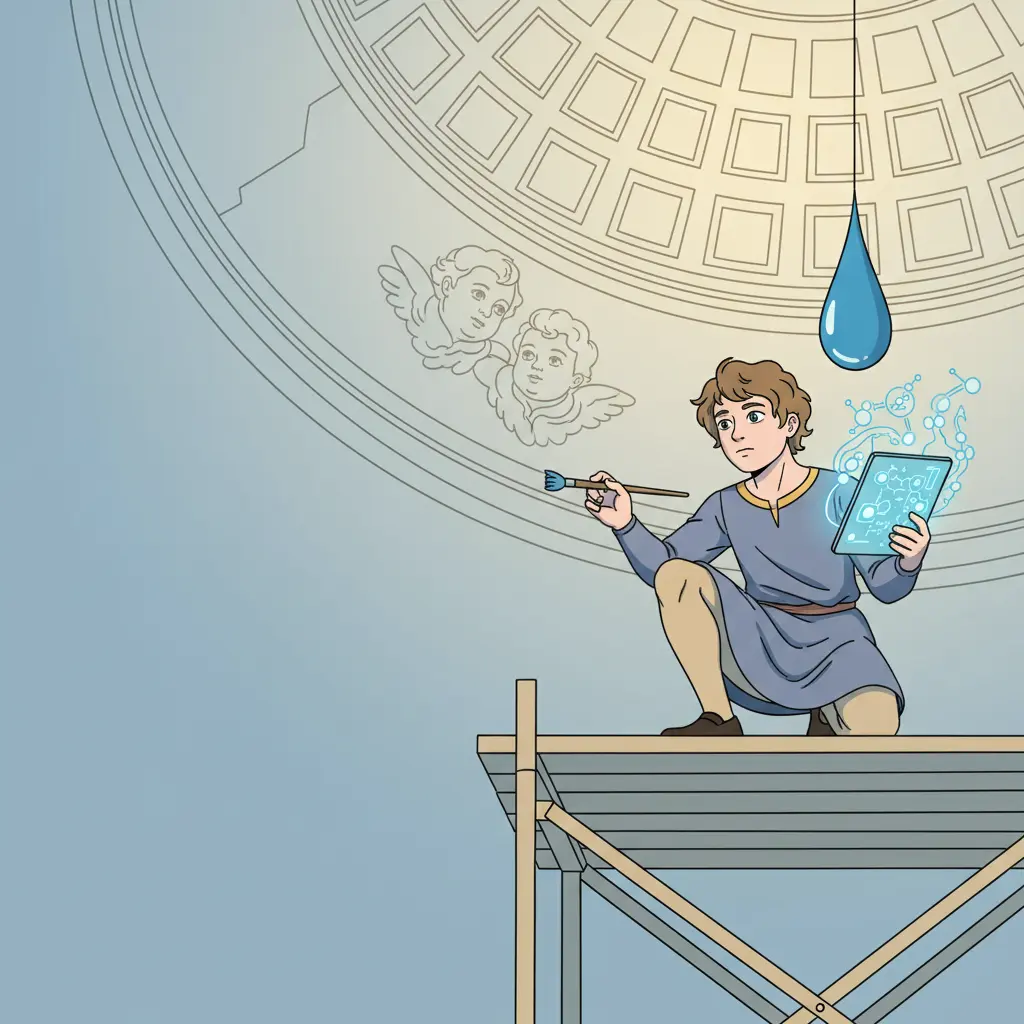
The Genius Who Defied Gravity
In the Vatican's Sistine Chapel, Michelangelo's masterpiece stands as a testament to human art. For over 500 years, historians and scientists wondered how he could paint high above his head without paint dripping onto himself or the floor below.
Researchers at KAIST (Korea Advanced Institute of Science and Technology) have now solved this puzzle using fluid mechanics (the study of how liquids move).
The Secret Balance of Physics
The team conducted experiments using brushes and paints similar to those used in the 16th century. The secret lies in the delicate balance between viscosity (the thickness or stickiness of a liquid) and surface tension (the force that holds the surface of a liquid together).
"When a liquid tries to fall from a brush, the internal sticky force and surface tension hold it back against gravity."
- Viscosity Control: If paint is too thin, it runs; if too thick, it cannot be spread smoothly.
- Surface Tension: This acts like an invisible skin that keeps the paint droplets attached to the brush bristles.
- Gravity Defiance: The research quantified the exact threshold (limit) where the liquid stays stable even when upside down.
From Renaissance Art to 3D Printing
This discovery is more than just an art history lesson. The principles found by the team are vital for modern 3D printing (technology that builds objects layer by layer) and precision coating industries.
In 3D printing, keeping the liquid material from dripping is essential for creating high-precision parts. Just as Michelangelo needed his paint to stay put, modern engineers need their materials to remain in place during assembly.
Future Impact
These findings will be applied to high-tech fields like micro-robot manufacturing and advanced painting techniques. Scientists have now built a mathematical bridge between 16th-century artistry and 21st-century engineering.