1. A Human Story
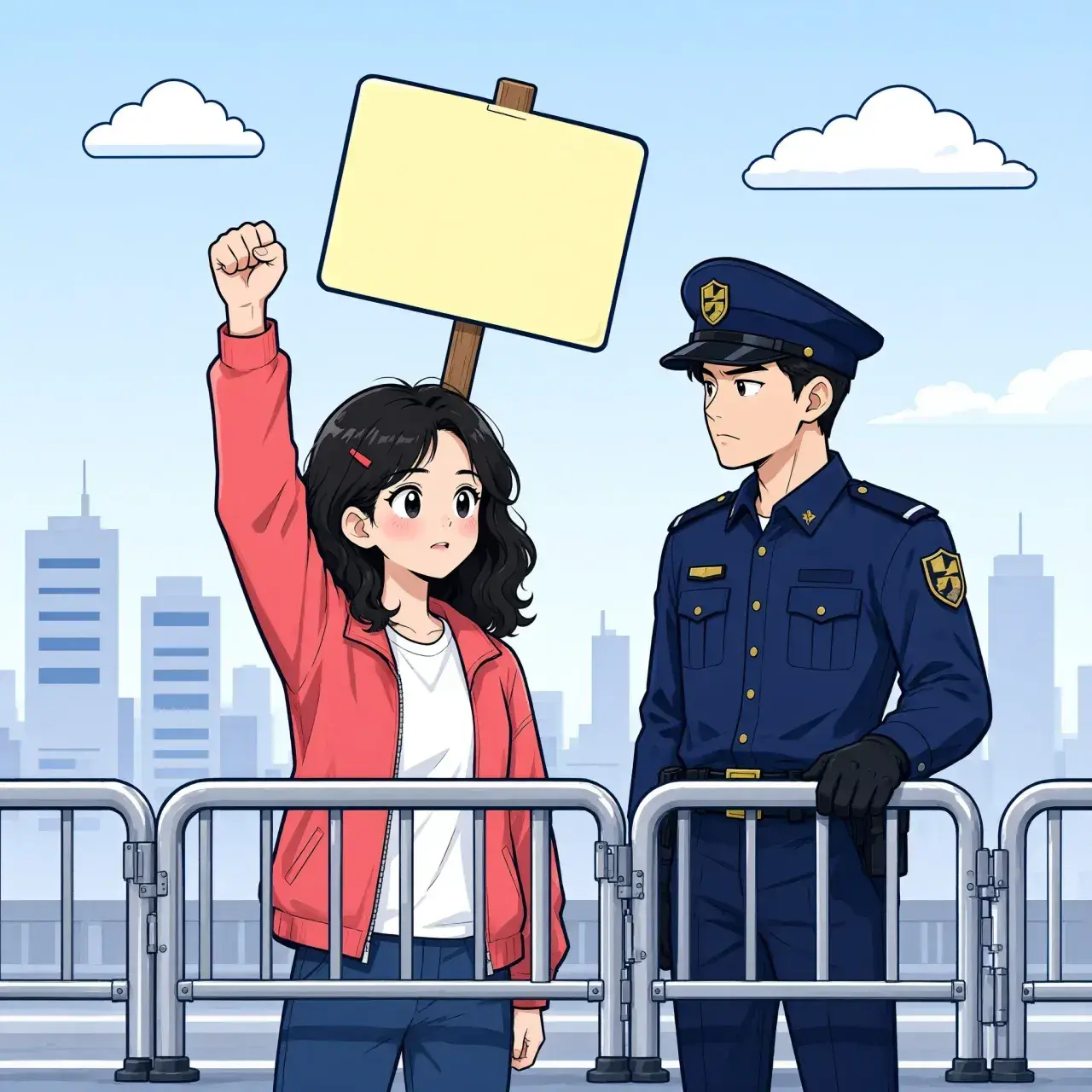
When Daniel Lee joined a peaceful demonstration in downtown Seoul, he expected chants, banners, and a long walk—not a criminal charge. The police had placed a cordon around part of the route. As the crowd pressed forward, Daniel stepped over the marked boundary to get closer to the government building. An officer warned him to move back. Daniel stayed on the other side for several minutes, convinced the line was an attempt to silence the protest.
Weeks later, Daniel learned that he could face punishment for crossing the police line. He wondered whether the boundary itself was lawful: if the Constitution protects peaceful protest, could the police criminalize a demonstrator for stepping beyond a cordon?
2. The Legal Question
The central question is whether Korea’s Assembly and Demonstration Act may constitutionally authorize police to set a “maintenance line” around an outdoor gathering—and punish a participant who, despite a police warning and without a justifiable reason, crosses or otherwise interferes with that line.
3. What Korean Law Says
The Constitution protects freedom of assembly. That protection matters especially to groups whose views may have little access to other public platforms. But an assembly brings people together in shared spaces, so the exercise of that freedom can intersect with public safety, traffic, and the rights of others.
The Assembly and Demonstration Act seeks to protect lawful assemblies while maintaining public order. It defines a maintenance line as a boundary marker—such as a belt, barrier, or road marking—set around an assembly or along a march route to protect the gathering, preserve order, or allow traffic to flow smoothly.
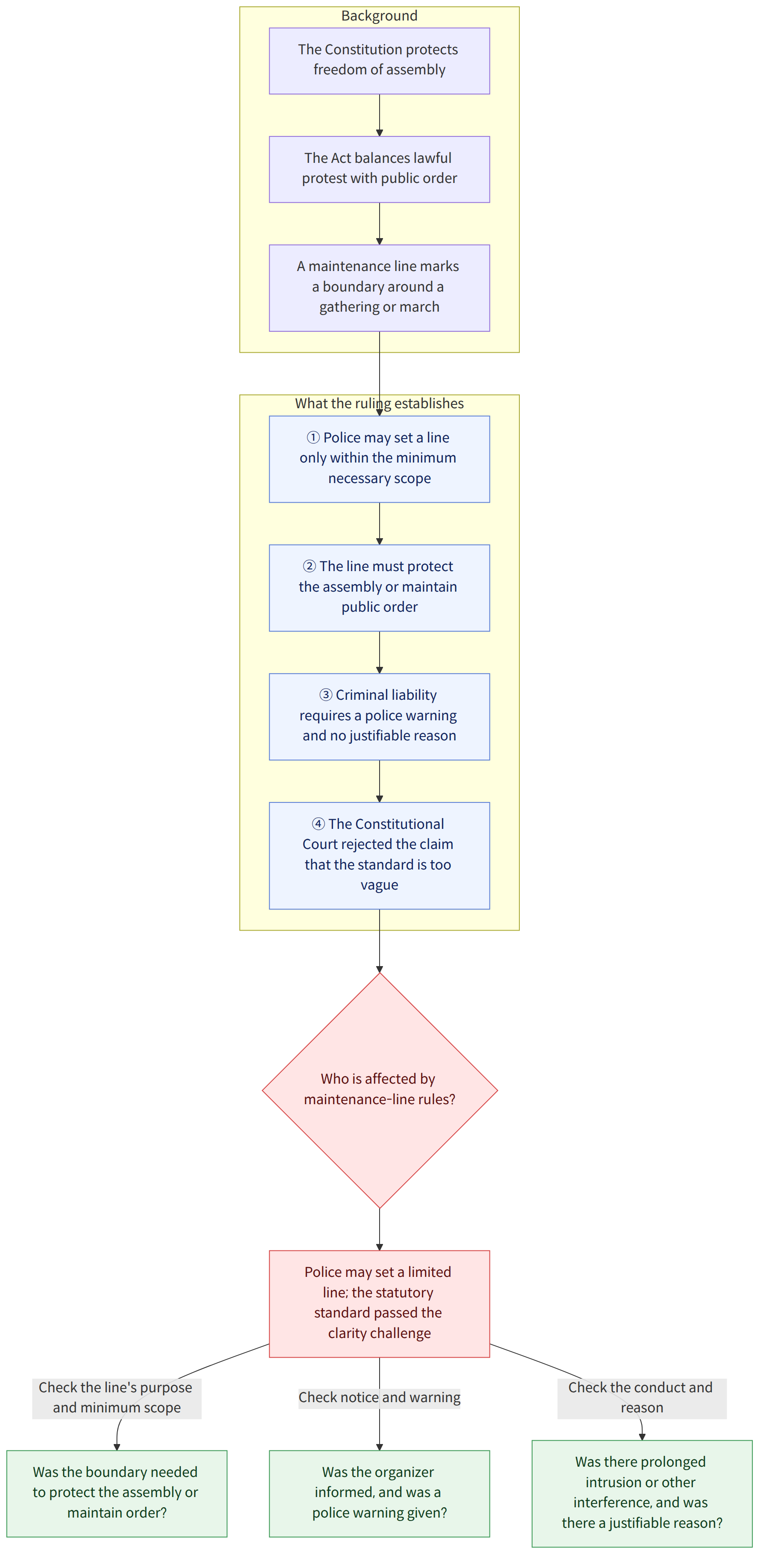
The Act authorizes police to set a maintenance line “within the minimum scope” considered necessary to protect an assembly or demonstration and maintain public order.
The law’s criminal provision, as relevant to the issue here, imposes a penalty of up to six months’ imprisonment or a fine of up to 500,000 won, or detention or a minor fine, for a person who, despite a police officer’s warning and without a justifiable reason, intrudes across the line for a considerable time, damages, conceals, moves, or removes it, or otherwise impairs its effectiveness.
Several safeguards and limits follow from this framework:
- The line must serve a legitimate purpose. It is meant to protect a lawful assembly and maintain order—not to suppress the message or prevent the assembly from taking place.
- Its scope must be minimal. Police should set it only as far as reasonably needed to protect participants, prevent physical clashes, preserve public access, or keep traffic moving.
- The organizer must be informed. The law provides for notice to the assembly’s organizer or contact person. Written notice is the general rule, although oral notice may be used when a line is newly established or changed at the scene.
- A warning matters. Criminal liability under the provision requires a police warning. A brief or accidental crossing, by itself, does not necessarily satisfy the statutory conditions.
- There must be no justifiable reason. The statute does not make every act of crossing an automatic offense; the circumstances and the participant’s reason matter.
The constitutional standard is not that police may draw any boundary they choose. The line must be limited to what is needed to protect the assembly and maintain public order.
4. How Korean Courts Approach This
Korean courts must weigh two interests: the practical ability to hold and attend a demonstration, and the need to prevent disorder, danger, or serious disruption to the public. The freedom of assembly is a core democratic right, but it is not exercised in isolation from other people’s rights and public safety.
The Constitutional Court has accepted that police need some flexibility. Organizers cannot always predict every detail of a gathering in advance, and conditions may change at the site. A boundary that is reasonable in one location may be unnecessary or excessive in another. For that reason, the statute does not prescribe a single distance or a fixed measurement for every assembly.
That flexibility is not unlimited. The phrase “minimum scope” is understood in context: police may use only the area needed to allow the reported assembly to proceed lawfully, protect participants, and address concrete concerns such as traffic flow or potential physical clashes. Notice and a warning also help participants understand where the boundary is and what conduct may expose them to punishment.
On that basis, the Constitutional Court rejected the argument that the statutory standard was too vague to satisfy the Constitution’s requirement that criminal laws be clear. That conclusion does not mean every police line is automatically lawful, or that every person who crosses one is guilty. The specific line and the specific conduct still have to be assessed against the statutory limits.
5. Applying the Law to the Case
Daniel’s situation has to be examined step by step.
- Was the police line serving a lawful purpose? If the cordon marked the outer boundary of the notified demonstration or helped protect participants, maintain public access, or prevent a clash, it could fall within the Act’s purpose. If it was placed to keep demonstrators unreasonably far from their intended gathering or to obstruct the protest itself, that would raise a serious question about whether it went beyond the law.
- Was the line limited to the minimum necessary area? The location and size of the gathering, the available space, the route, traffic conditions, and any concrete safety concerns all matter. A broad or arbitrary boundary cannot be justified merely by labeling it a maintenance line.
- Was the boundary adequately communicated? The organizer should have received notice, subject to the rules allowing oral notice when a line is established or changed at the scene. Daniel’s own awareness is also relevant to understanding what happened, but notice to the organizer and compliance with the statutory process remain important to evaluating the line.
- Did Daniel receive a police warning? The officer’s warning is a required part of the offense described in the Act. The prosecution would need to establish that a warning was given and that Daniel had an opportunity to respond to it.
- Did Daniel’s conduct meet the remaining elements? The provision addresses an unjustified intrusion lasting a considerable time, as well as damaging, moving, concealing, removing, or otherwise impairing the line. If Daniel merely crossed briefly and immediately returned, that would differ materially from remaining beyond the boundary for several minutes after a warning. His reason for crossing would also need to be considered.
On the facts in this story, Daniel crossed the line, was warned, and remained there for several minutes without an apparent justification. If the cordon itself was properly placed within the minimum necessary scope, those facts could support a finding that he violated the Act. But the constitutional ruling does not erase the prosecution’s burden to prove each element, nor does it prevent Daniel from challenging an excessive or improperly established line.
6. Conclusion: What Happened, and What Should You Do?
Daniel’s constitutional objection, standing alone, would not succeed: Korean constitutional law permits a narrowly tailored maintenance line, and the statutory phrase “minimum scope” has been treated as sufficiently clear. Because Daniel stayed beyond the boundary for several minutes after a warning, he could be punished if the line was lawful, the intrusion was unjustified, and the prosecution proved the required facts. The answer might be different if the crossing was momentary, the warning was absent, Daniel had a justifiable reason, or the police had drawn an unnecessarily broad line.
For anyone facing a similar situation:
- Document the details promptly. Preserve video, photographs, witness contacts, and any notice or warning; record where the line stood and how long the alleged breach lasted.
- Do not assume every cordon is lawful—or that crossing one is harmless. Ask whether the line was necessary and properly communicated, and comply with a clear police warning while contesting an excessive restriction through legal channels.
- Get advice before giving a detailed statement or accepting a penalty. The location, duration, warning, justification, and purpose of the line can all affect the outcome.