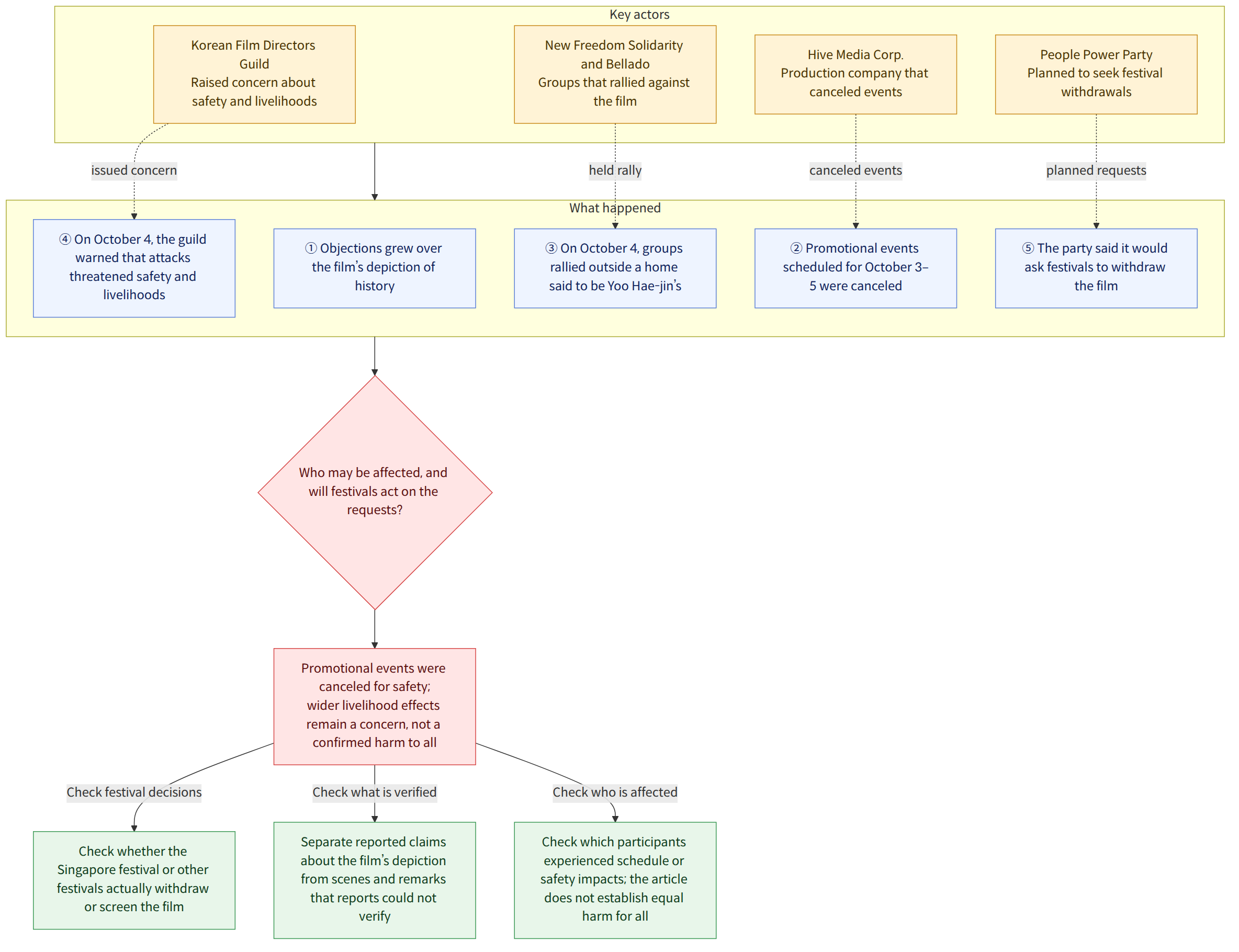
On October 4, 2026, the Korean Film Directors Guild (한국영화감독조합, DGK) expressed concern that the controversy surrounding the film ‘Assassin(s)’ was escalating from criticism of the work into attacks seeking to prevent its creators from working on future projects. The guild said films can be criticized, but targeting participants’ everyday lives and livelihoods, or demanding that they never make a similar film again, goes beyond criticism of the work. Earlier, a protest rally was held outside actor Yoo Hae-jin’s home, and reports said events including promotional appearances at theaters were canceled with the safety of the actors and crew in mind.
Background and context
The controversy stemmed from objections to the film’s depiction of history. According to reports, ‘Assassin(s)’ concerns the shooting of First Lady Yuk Young-soo. Political backlash grew after claims were made that the film portrayed former President Park Chung-hee as having been involved in the incident. However, the reports provided do not make it possible to verify the film’s specific scenes or the full set of remarks that triggered the controversy.
On October 4, about 50 members of conservative groups New Freedom Solidarity (신자유연대) and Bellado (벨라도), among others, held a rally outside a house in Seoul’s Seongbuk District said to be actor Yoo Hae-jin’s home, according to an unofficial police estimate. They demanded that the film’s screening be halted, that the production team and actors apologize, and that they promise to prevent a recurrence. Another conservative group also called for the film to be withdrawn and for an apology outside the production company’s offices. Reports linked the rally outside the actor’s home and criticism from politicians to concerns for the actors’ safety.
Production company Hive Media Corp. (하이브미디어코프) canceled official events scheduled for October 3–5, including promotional appearances at theaters, citing safety and the need to ensure the events could proceed smoothly. The DGK said that, before this, the Korean Film Producers Association (한국제작자협회) and the Korean Film Producers Guild (한국영화프로듀서조합) had also expressed concern that political attacks were putting participating artists’ safety at risk. The People Power Party (국민의힘) said it would send a letter in the names of all its lawmakers asking the Singapore International Film Festival (싱가포르국제영화제) to withdraw the film as its opening feature. Reports said the party also planned to request withdrawals from other international film festivals. These reports concern plans or stated intentions to make requests and should be distinguished from the festivals’ actual decisions or whether the film will be screened.
What this news means
The central issue in this controversy is not whether criticism of a film should be allowed. The DGK itself acknowledged that creators can be criticized for their work. The question is what happens when criticism moves beyond examining the content and choices in a work and targets a creator’s or actor’s private life or livelihood: the consequences may extend to personal safety and the possibility of making future work.
The actors and production team involved in the film experienced actual changes to their schedules, such as the cancellation of public events. As controversy over a work intensifies, there is a possibility that pressure will extend to the everyday lives of individuals unrelated to the film, or that opportunities to meet audiences will diminish because of safety concerns. The issue also draws attention to the possibility that creators may find it difficult to separate criticism of one work from their subsequent creative activities. However, this impact is an interpretation based on the guild’s concerns and the reported event cancellations; it cannot be assumed that all participants experienced the same harm.
For example, if a viewer believes the film’s interpretation of history is inaccurate, they can criticize it by referring to its scenes or expressions. But if that criticism leads to a rally outside a particular actor’s home or actions targeting their livelihood, it may go beyond a debate about the work and affect an individual’s safety and everyday life. That is the concern raised in this case.
The DGK said that protecting an environment in which creators can continue creating while accepting criticism is an important foundation for the future of Korean cinema.
Confirmed facts and what remains unknown
Confirmed facts
- The DGK issued a statement on October 4, 2026, concerning the controversy over ‘Assassin(s)’.
- The guild argued that criticism of a work should be distinguished from attacks that undermine creators’ personal lives and livelihoods.
- According to reports, a rally was held outside actor Yoo Hae-jin’s home, and the production company canceled official events scheduled for October 3–5, including promotional appearances at theaters, with safety in mind.
- Reports said the Korean Film Producers Association and the Korean Film Producers Guild also expressed concern about political attacks that put participating artists’ safety at risk.
- The People Power Party said it would send a letter in the names of all its lawmakers asking the Singapore International Film Festival to withdraw the film as its opening feature.
What remains unknown
- What specific remarks triggered the controversy, and what is the full context of the film’s depiction of history?
- Who were all the organizers and participants in each attack and rally, how many people took part, and how many rallies were held?
- What is the specific list of canceled promotional appearances and Busan International Film Festival (부산국제영화제) programs, and what were the reasons for each cancellation?
- How did the festivals, including the Singapore International Film Festival, respond to requests to withdraw the film?
What readers should check
- When encountering claims or quotations about the film, readers should distinguish between the film’s actual scenes, reported claims and assessments by politicians.
- For event cancellations and festival screenings, it is useful to distinguish reported requests or plans from the actual decisions of the organizers.
- Considering whether the target of criticism is the work itself or participants’ private lives and livelihoods can help readers assess the difference between criticism of a work and pressure aimed at individuals.
References
- Other coverage consulted: hani.co.kr
- Other coverage consulted: hani.co.kr