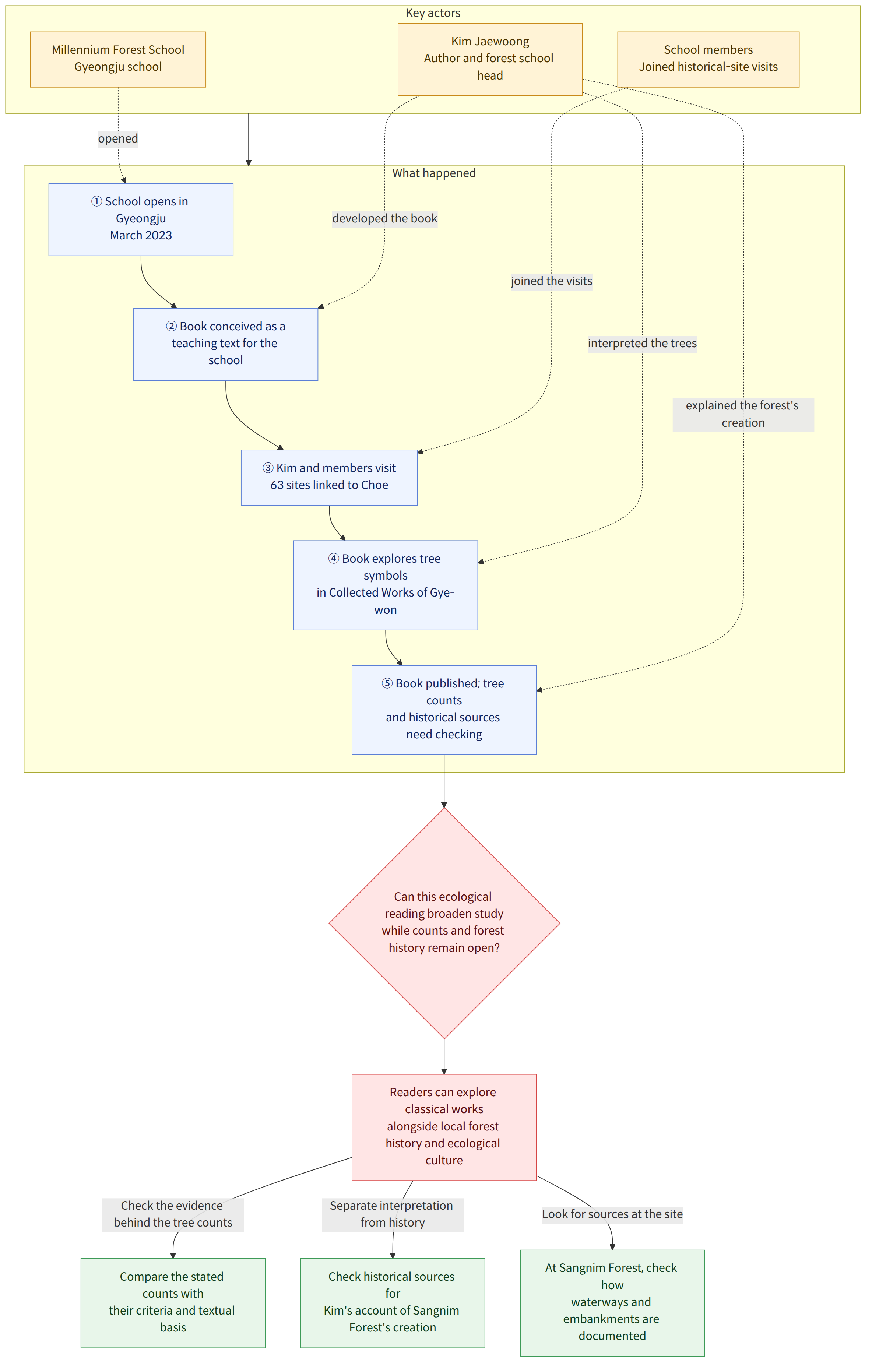
Kim Jaewoong, head of the Millennium Forest School (천년숲학교), has recently published Reading Choe Chiwon’s Trail of Refined Living Through Trees. The book explores the trees and their symbolism in Collected Works of Gye-won (계원필경), drawing on visits with school members to 63 sites associated with Choe Chiwon’s life and literary work. Kim says that Choe diverted a waterway and built embankments in Hamyang before planting trees and creating Sangnim Forest (상림).
Background and context
The Millennium Forest School is a school Kim opened in Gyeongju in March 2023; according to the article, it has 40 members. The book was conceived as a teaching text for the school, and members visited 63 historical sites and places where Choe’s literary works were written. Their travels were not limited to South Korea. Kim said that in November last year he and school members also visited the Choe Chiwon Memorial Hall in Yangzhou, Jiangsu Province, China, and the Ssangnyeobun tomb in Gaochun District, Nanjing.
Collected Works of Gye-won is an important clue to Kim’s approach to Choe’s literature from the perspective of ecological culture. He says the collection mentions 34 species of trees, totaling 135 trees. The main trees cited in the article are 27 mulberry trees, 18 cinnamon trees, 14 bamboo plants, and 10 each of pine and willow. It also lists six oak trees, five tea plants, five plum trees, four peach trees, and four junipers.
The trees are read not merely as background or as a list of plants, but as vehicles for literary meaning. Kim interprets the cinnamon tree as Choe’s favorite tree, representing the aspiration to pass the civil service examination as well as loyalty and integrity. He says pine and bamboo likewise appear as symbols of maintaining one’s principles and integrity amid changes in the world. These are Kim’s literary interpretations, however, and should be distinguished from the basis for the tree counts given in the article.
What this news means
The approach proposed by the book is less about treating classical works as sources that directly answer today’s environmental problems, and more about examining how people in the past represented nature through symbols and imagination. By focusing on the kinds of trees mentioned and how they appear, readers can explore not only the literary works but also the places and local forests connected to them. The book is notable for extending the study of classical works beyond literature, history, and philosophy to include ecological culture.
Kim cites the creation of Sangnim Forest in Hamyang as one of Choe’s ecological contributions. According to Kim, Choe diverted a waterway and built embankments to prevent flooding, then planted trees. This account encourages readers to see a forest not just as scenery, but as a place connected to waterways, disaster response, and the lives of the local community. However, the account of the specific process of creating Sangnim Forest and Choe’s role in it is presented in the article as Kim’s explanation; historical sources would need to be consulted to verify it historically.
For example, visitors to Sangnim Forest could go beyond appreciating the forest before them and examine how information about the waterways and embankments is presented on site and what sources that information is based on. This approach considers the symbolism of trees in literature alongside the actual history of the forest, while distinguishing interpretation from verified fact.
Kim presented a paper approaching Choe’s literature through ecological cultural imagination at the 2023 academic conference “Choe Chiwon and Buddhism,” held at the Choe Chiwon Literature Museum (최치원문학관). He said that the museum was left with only its frame after a fire last March, and that Gounsa Temple (고운사) also suffered damage to several of its halls and its temple forest. Kim also expressed his hope that trees mentioned in Collected Works of Gye-won could be planted around Gounsa to create a walking route that would help people understand Choe through ecological culture.
What is confirmed and what remains unknown
Confirmed facts
- Kim Jaewoong has recently published Reading Choe Chiwon’s Trail of Refined Living Through Trees.
- The Millennium Forest School opened in Gyeongju in March 2023 and, according to the article, has 40 members.
- Kim said that he and school members visited 63 sites associated with Choe Chiwon’s life and literary work.
- Kim says that 34 species of trees, totaling 135 trees, appear in Collected Works of Gye-won, and offers interpretations of their symbolic meanings.
- Kim provided accounts of the creation of Sangnim Forest and the damage to the Choe Chiwon Literature Museum and Gounsa Temple.
What remains unknown
- The article does not state which edition or counting criteria were used to determine the types and numbers of trees in Collected Works of Gye-won.
- The article alone does not establish which historical sources support interpretations of the creation of Sangnim Forest and historical sites associated with Choe Chiwon.
- The article does not cover the recovery of the Choe Chiwon Literature Museum and Gounsa Temple after the fire damage.
What readers can check
- When citing the number of trees in Collected Works of Gye-won, check whether the edition and counting criteria are provided.
- When visiting Sangnim Forest or historical sites associated with Choe Chiwon, look into which historical sources inform the interpretations presented on site.
- When reading the literary symbolism of trees, distinguish among the expressions in the works, Kim’s interpretations, and verifiable historical facts.