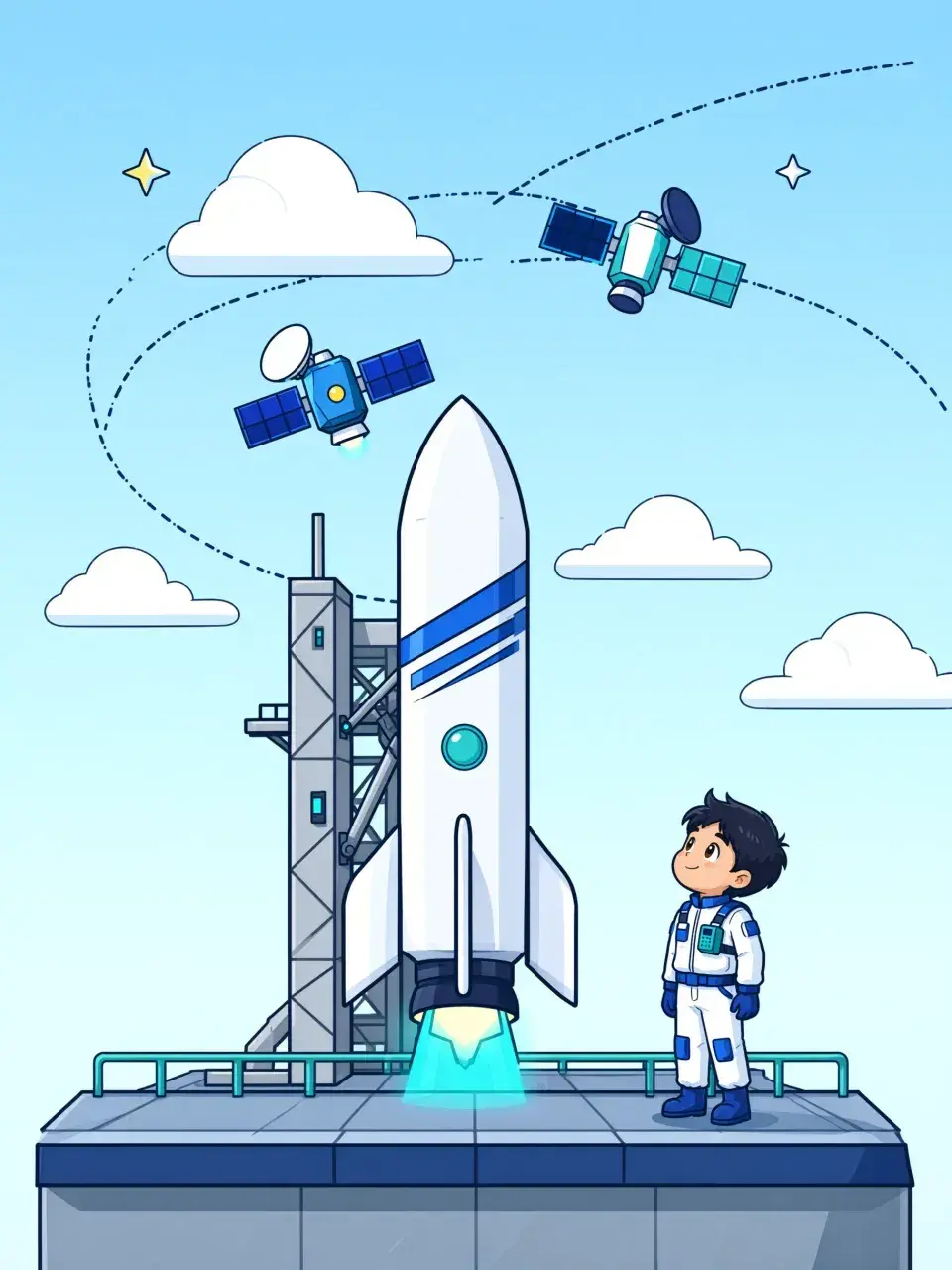
Nuri (누리호) is preparing for its fifth launch on October 7, 2026. According to the Korea Aerospace Administration (한국항공우주청, KASA), the launch is scheduled for around 12:25 p.m. at the Naro Space Center (나로우주센터) in Goheung, South Jeolla Province. The exact time is expected to be decided that morning. The goal of this launch is to place 15 satellites into orbit.
Background and context
The payload consists of five NEONSAT satellites and 10 CubeSats, including satellites that are part of the first nanosatellite constellation to be launched in South Korea. Five NEONSAT satellites, numbered 2 through 6, are scheduled to be carried aboard. Thus, this is both a launch in Nuri’s launch schedule and a plan to send 15 satellites of different types on a single launch.
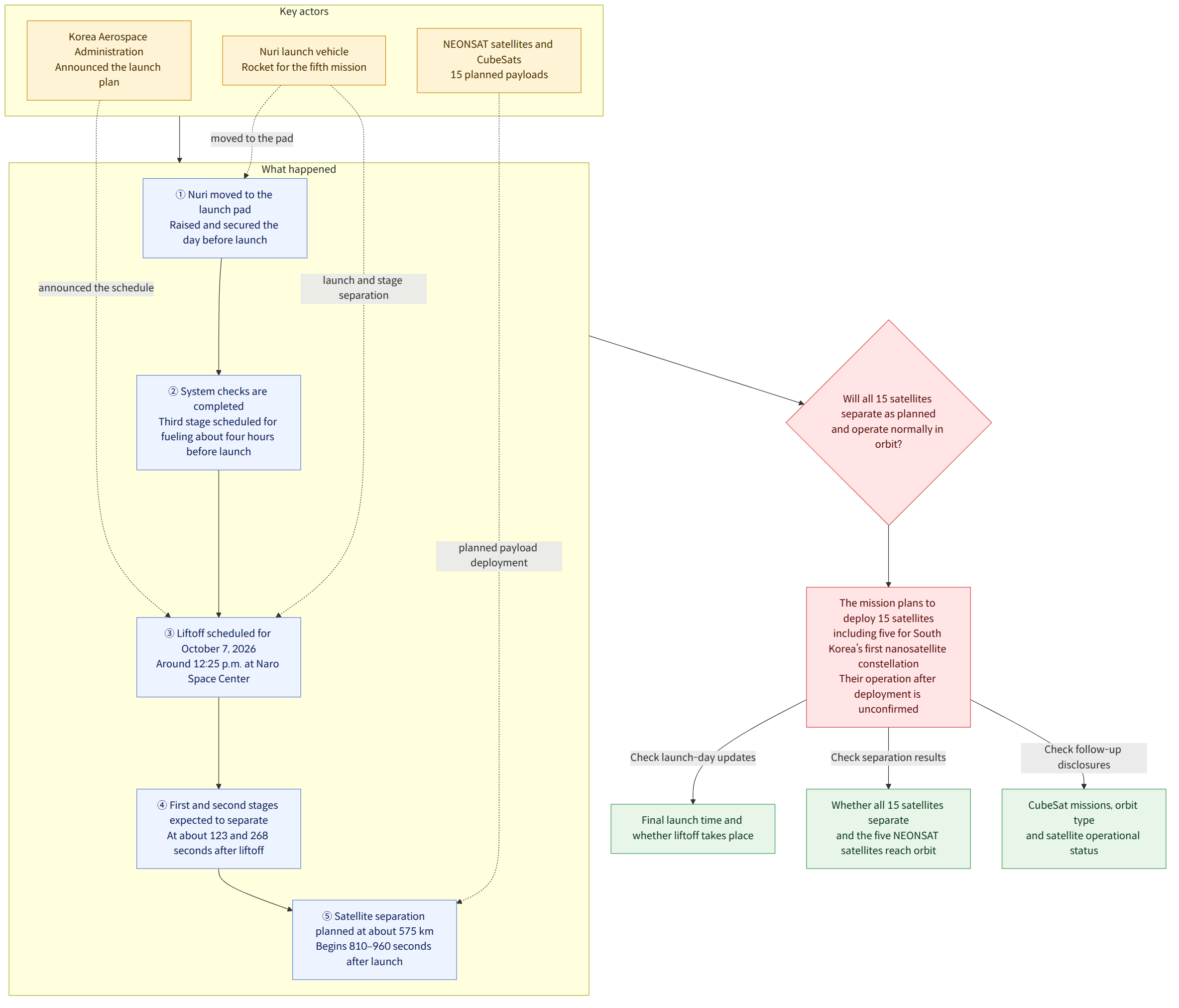
After system checks are completed, kerosene fuel and liquid oxygen oxidizer are scheduled to be loaded into the third-stage rocket about four hours before launch. After liftoff, the first and second stages are expected to separate at about 123 seconds and 268 seconds, respectively. Satellite separation is reported to be scheduled to begin about 810–960 seconds after launch at an altitude of about 575 km. The five NEONSAT satellites are planned to separate one after another at intervals of 35–40 seconds.
On Tuesday, the day before launch, Nuri was moved from the assembly building at the Naro Space Center to the launch pad, where it was raised vertically and secured. This illustrates how preparations for a space launch vehicle proceed through transport, raising, checks, and fueling.
What this means
The point of note in this plan is that Nuri’s fifth launch and the deployment of 15 satellites into orbit are taking place together. The mission involves not only the launch vehicle’s liftoff but also separating the planned satellites in the intended order and at the intended times. Therefore, assessing the actual outcome will require checking not only whether the launch took place, but also whether satellite separation proceeded as planned.
With five NEONSAT satellites that will form part of a nanosatellite constellation included in the payload, the launch is also significant as a mission to send satellites belonging to the first such constellation to be launched in South Korea into orbit. However, the launch plan alone does not confirm whether the satellites will carry out their missions or how the constellation will actually operate.
For example, if the launch proceeds as scheduled, the five NEONSAT satellites are planned to enter orbit as part of the constellation, while the 10 CubeSats will also be separated. However, the reports available at this point do not provide information about each satellite’s mission or whether it will operate after deployment.
What is confirmed and what remains unknown
Confirmed facts
- Nuri’s fifth launch is scheduled for October 7, 2026.
- The launch site is the Naro Space Center in Goheung, and the scheduled time is around 12:25 p.m.
- The payload consists of 15 satellites in total: five NEONSAT satellites and 10 CubeSats.
- Satellite separation is planned to begin about 810–960 seconds after launch at an altitude of about 575 km.
What remains unknown
- The exact launch time and the actual launch outcome cannot be confirmed from the reports alone.
- The individual names and missions of the 10 CubeSats have not been provided.
- The target altitude has been reported, but the specific type of orbit has not been confirmed.
- It is not known whether the satellites will operate normally after being placed into orbit.
What readers should look for
- The final launch time announced on launch day and whether the launch actually takes place should be checked.
- After launch, readers can look separately at the separation results for all 15 satellites and whether the five NEONSAT satellites were placed into orbit.
- If follow-up information becomes available, it is worth checking whether the CubeSats’ individual missions, the type of orbit, and the satellites’ operational status have been disclosed.
References
- Other coverage consulted: koreatimes.co.kr
- Other coverage consulted: m.koreaherald.com