
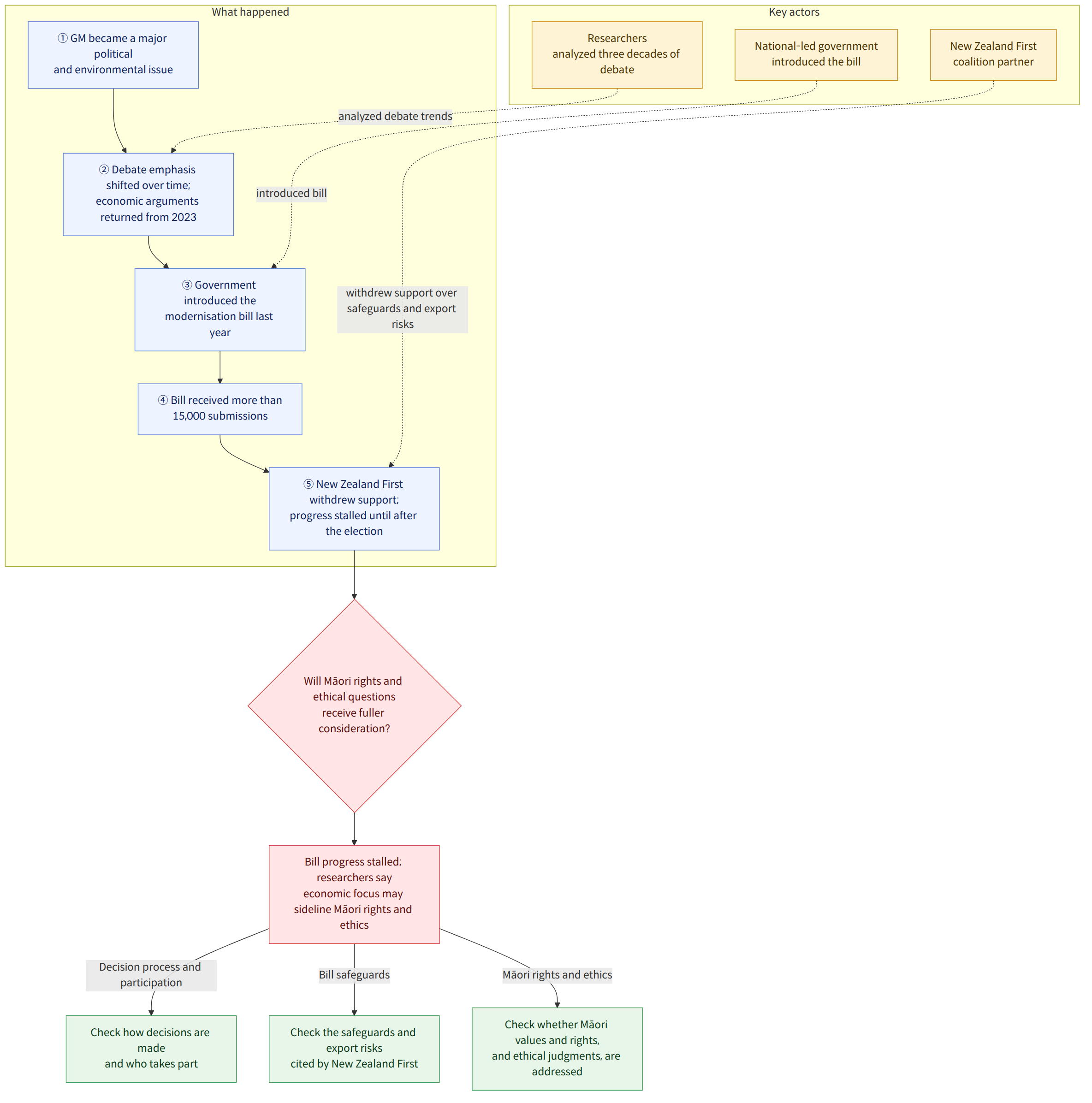
A bill to modernize the regulation of genetic technology in New Zealand received more than 15,000 submissions last year, but its progress stalled after coalition partner New Zealand First (뉴질랜드 퍼스트당) withdrew its support, saying there were not enough safeguards and that there could be risks to exports. Further action was deferred until after the election. Researchers who analyzed more than 1,600 texts about GM debates over the past 30 years say that Māori rights and ethical questions received relatively little attention compared with arguments about economic benefits and risks.
Background and context
Genetically modified (GM) organisms were a major political and environmental issue in New Zealand 25 years ago. The debate led to the establishment of a Royal Commission of Inquiry (왕립 조사위원회), and a protest march of 20,000 people took place in central Auckland. The “Corngate” controversy also saw allegations that the government had concealed the possibility of growing GM corn.
Although the technology has advanced considerably, researchers say the arguments surrounding it have remained remarkably familiar. They analyzed more than 1,600 related texts from the past 30 years, most of them news articles. However, the original source does not specify the exact period covered, the range of publications, or the research methods used in the analysis.
The focus of the debate has shifted over time. In the 1990s and early 2000s, GM supporters emphasized economic benefits and the cost of missing out on the technology, while critics warned that it could threaten New Zealand’s “clean, green” image and harm trade. Critics’ economic concerns continued in later years, but the arguments made by supporters did not remain focused on economic viability throughout all 30 years.
According to the researchers’ analysis, supporters moved away from economic arguments in the 2010s and emphasized potential benefits such as addressing climate change, pest control, medical applications, and poverty reduction. From 2023, however, economic arguments returned to the center of the case for regulatory reform. Environmental and social benefits are still cited, but the researchers’ concern is that focusing on economic benefits and risks may push other questions into the background.
What this news means
The issues in the bill debate are not limited to whether regulation should be tightened or loosened. It is also necessary to consider how decisions should be made, through what processes, and who should take part. The researchers say that treating regulation simply as a question of whether there should be “more” or “less” of it leaves less room to examine these questions.
In particular, the researchers say that Māori values and rights have received relatively little attention in the debate over the past 30 years. Their analysis explains that Māori perspectives were occasionally raised by critics in the past but were rarely taken seriously by supporters. The researchers also suggest that this may be starting to change, but the original source does not establish exactly what has changed.
Ethical questions have also not been discussed adequately. The source reports that in situations where ethics might have been expected to take center stage, such as the disbanding of the Bioethics Council (생명윤리위원회) in 2009, in-depth discussion was limited. Supporters have also argued that it would be unethical not to use the technology given its social and environmental benefits, but the researchers point out that such arguments do not adequately examine the ethical issues.
For example, if debate continues to focus mainly on the bill’s economic benefits and export risks, it will be important to assess separately whether Māori values and rights, and the ethical judgments involved in applying the technology, are receiving sufficient attention. This does not mean that the bill has been found to violate Māori rights; rather, it means that the researchers argue that questions that have been relatively absent from the debate should be included in a broader discussion.
What is known and what remains unclear
What is known
- More than 15,000 submissions were made to the bill to modernize the regulation of genetic technology, introduced by a National-led government (국민당 주도 정부) last year.
- The bill’s progress stalled after New Zealand First withdrew its support, citing insufficient safeguards and possible risks to exports, and further action was deferred until after the election.
- Researchers analyzed more than 1,600 texts related to GM over the past 30 years, most of them news articles.
- Researchers concluded that Māori values and rights, and the ethical and moral implications of GM, received relatively little attention in the debate.
What remains unclear
- The exact period covered by the texts, the range of publications, and the methods of analysis are not given in the original source.
- No date has been given for when the bill will be discussed again after the election.
- The specific safeguards and measures to address export risks sought by New Zealand First have not been established.
What readers should look for
- When following the bill’s future progress, readers can check whether a date and process have been announced for taking it up again after the election.
- When reviewing the bill or related discussions, readers can look at whether the safeguards have been explained in detail, alongside economic benefits and export risks.
- It is also worth checking whether Māori values and rights, and the ethical implications of GM, are actually included in the discussion, and who is able to contribute.