Canadian poet, essayist and translator Anne Carson received the Nobel Prize in Literature at age 76. The article’s opening places her award alongside the box-office records set one after another that same year by Christopher Nolan’s film The Odyssey. The two differ in their approaches, media and critical reception, but share an effort to bring ancient Greece to contemporary audiences in new ways.
The Nobel Committee described Carson’s genre-crossing body of work as “bold and original.” Carson has reworked classical material not only in poetry, essays and translation, but also in stage works and collaborations. A key to understanding her work is that she does more than recast ancient stories in contemporary forms: she also chooses what to reveal and what to leave in translation.
Background and context
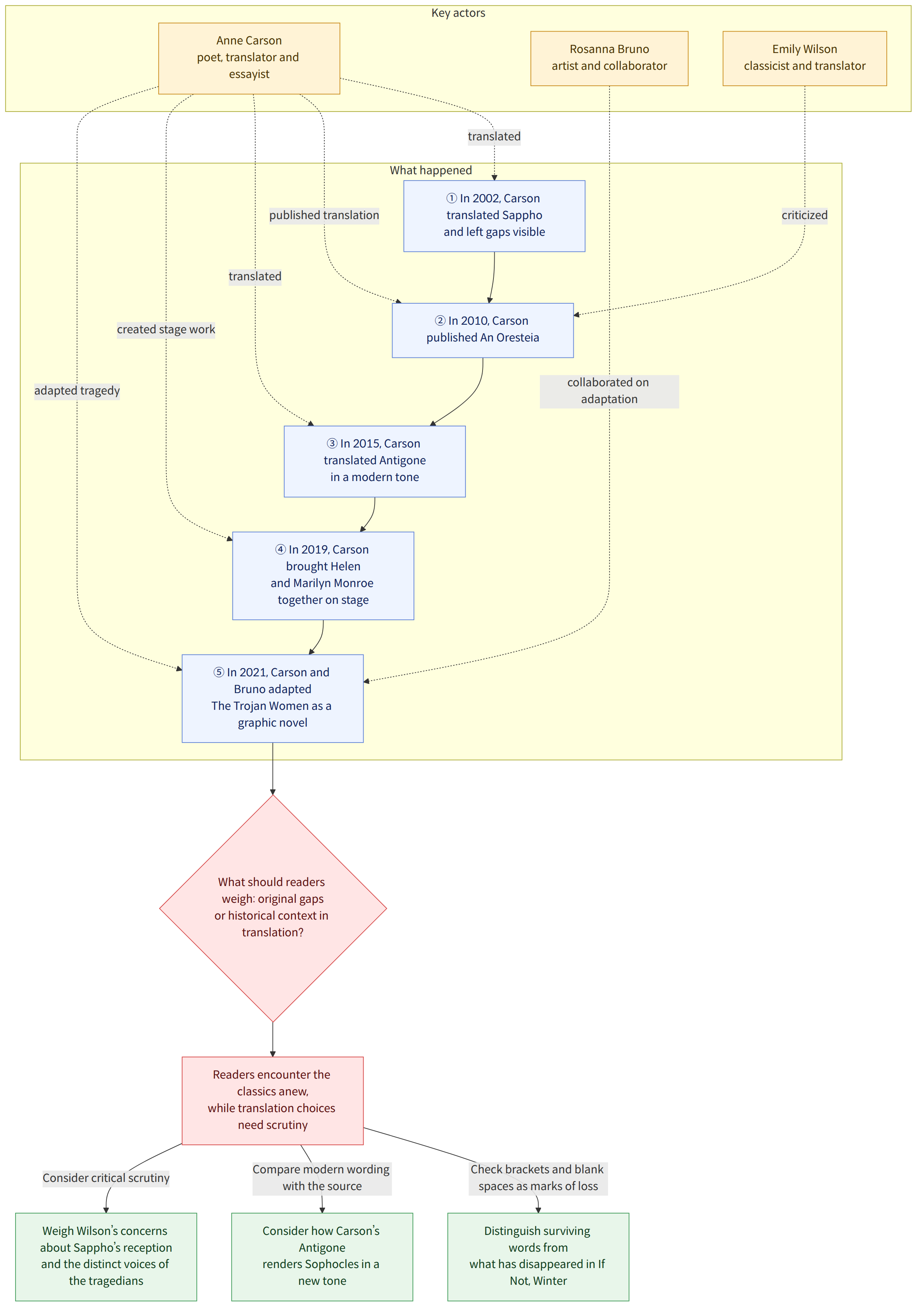
In her 2019 stage work Norma Jeane Baker of Troy, Carson brings Helen of Troy and Marilyn Monroe together. The work explores the destructive power of beauty, putting an ancient figure and a modern popular image on the same stage. By linking Helen and Monroe, it encourages contemporary audiences to consider classical stories alongside cultural images familiar to them.
Carson’s 2015 translation of Antigone is based on Sophocles’ tragedy but adds a modern tone. The production toured internationally. Two passages cited in the article show the difference in tone. Richard C. Jebb rendered Creon’s lament along the lines of “I, in miserable anguish,” while Carson translated it as “Now I am perfectly mixed up with pain.” In Jebb’s translation, Antigone says she has no home on earth or in the underworld; in Carson’s version, she describes herself as “a new and strange kind of in-between.”
Carson has also recast ancient tragedy in entirely different media. In 2021, she and artist Rosanna Bruno adapted Euripides’ The Trojan Women as a graphic novel. The original was first performed in 415 BCE. In 2025, Carson read her poetry on an album by indie rock band Leostatic. The fact that translation, performance, drawing and music are different forms shows that Carson does not confine the classics to a single mode of transmission.
What this means
Carson’s work broadens the boundaries between classical translation and creative writing. Choosing modern expressions in Antigone and bringing the ancient Helen together with Marilyn Monroe in Norma Jeane Baker of Troy are different from simply rendering an original text as it is. But neither do they simply turn ancient works into stories about the present. Readers may encounter the classics through familiar modern language and images while also considering the differences that remain between them.
This approach is especially clear in the 2002 translation of Sappho, If Not, Winter. Of Sappho’s surviving works, only one poem, the Hymn to Aphrodite, remains intact. Carson marked torn or obscured passages with square brackets and blank spaces. Rather than concealing damage to make the text easier to read, she left what had disappeared visible on the page.
In the introduction to her translation, Carson wrote that square brackets represent “a free space for the imagination to adventure in.”
Readers of classical fragments must distinguish between the words that remain and those that have disappeared, and can consider whether a translator’s interpretation might be mistaken for part of the original. For example, readers of If Not, Winter can understand that the square brackets and blank spaces are not merely editorial decoration, but marks of loss in the text’s transmission.
Not all of Carson’s translations have been assessed in the same way. Emily Wilson, a classicist and translator, noted that Carson did not add possessive pronouns or definite articles absent from the Greek original. Wilson also criticized Carson for not adequately reflecting the effects of Sappho’s gender and sexual orientation on how later generations received her work. Wilson further judged that the voices of the three tragedians—Aeschylus, Sophocles and Euripides—were not sufficiently distinct in An Oresteia, published in 2010.
The questions raised by Carson’s work, then, go beyond whether the classics can be made contemporary. They also concern how much of the original’s empty spaces a translator should leave, and how much historical context important to readers today should be incorporated into a translation. Carson’s formal experiments can open up new ways of reading the classics, but they also show why critical scrutiny is needed of how those choices handle the original voices and the history of their reception.
What is known and what remains unknown
What is known
- Anne Carson is a Canadian poet, essayist and translator who received the Nobel Prize in Literature at age 76.
- The Nobel Committee described Carson’s genre-crossing body of work as “bold and original.”
- Carson has connected ancient literature with contemporary media in a range of forms, including a translation of Antigone, a graphic-novel adaptation of The Trojan Women and poetry readings on a band’s album.
- If Not, Winter makes visible the fragmentary transmission of Sappho’s work, and Carson marked damaged or obscured passages with square brackets and blank spaces.
What remains unknown
- What was the specific deliberative process through which the Nobel Committee selected Carson?
- Which of Carson’s works had the greatest influence on the decision to award her the prize?
What readers can check
- When reading translations of Sappho, looking at what the square brackets and blank spaces indicate can help distinguish the text that has been transmitted from parts that have not been restored.
- When comparing translations, as with Antigone, readers can check whether the same passage has been rendered in different tones. Differences in wording show how a translator’s choices can affect a reader’s understanding of a character.
- When encountering the classics in a graphic novel or stage work, checking how the original was adapted can make it clearer where the source text and a modern interpretation meet.