A book club built around reading aloud
At first glance, the members of Cheongmihoe might seem much younger than their ages: the ten participants are in their 60s and 70s. They credit exercise and reading as part of how they stay active, but the group is about more than maintaining a routine. Since 2020, members have gathered twice a month in Anseong, a city in South Korea’s Gyeonggi Province, to read, talk, write, draw and explore places connected with books.
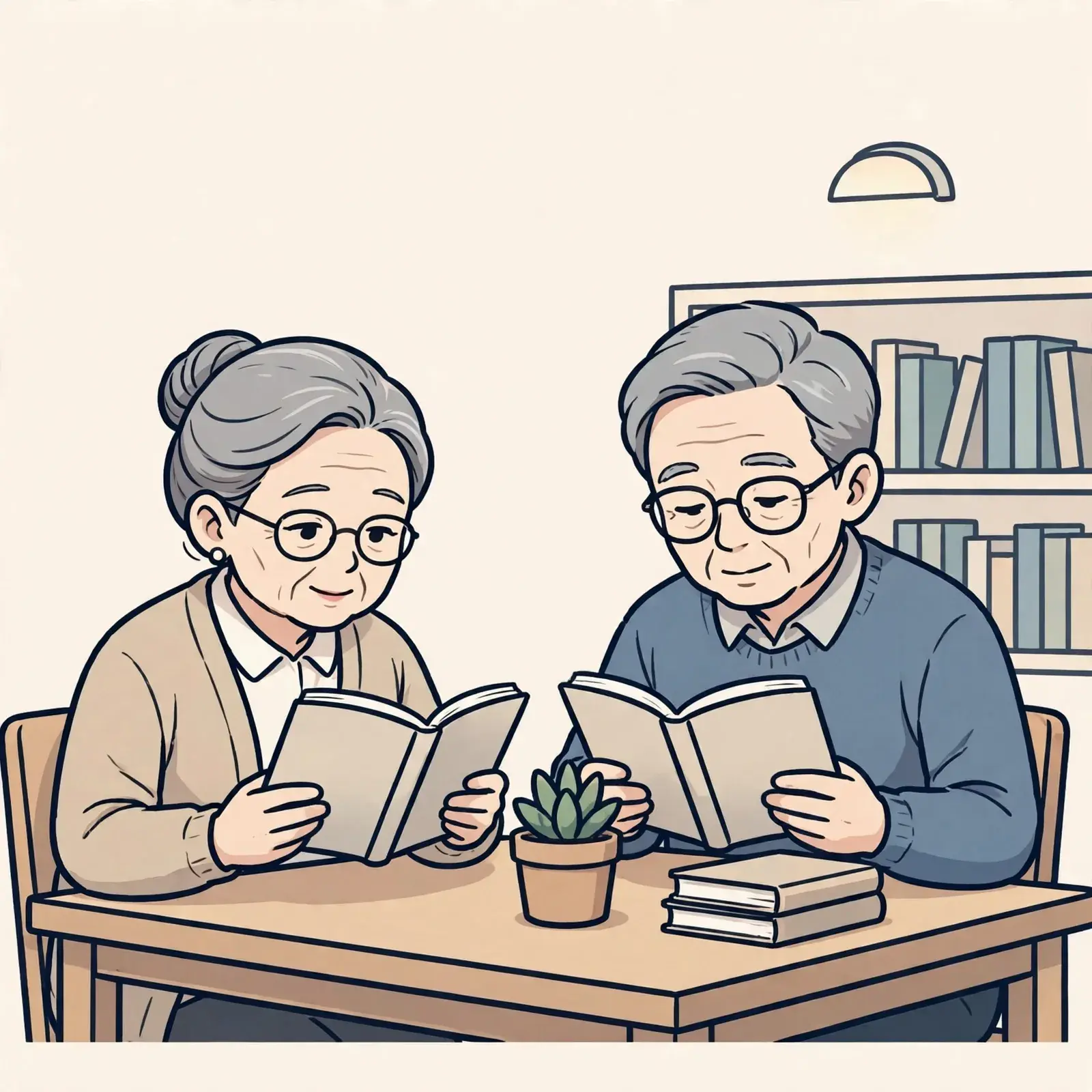
At a recent meeting at Iljuk Library, the members divided into two groups. One read Choi Jae-cheon’s Lessons in Hope, while the other read 77 Pieces of Life Wisdom Stolen from Schopenhauer’s Library. They took turns reading the books aloud, sometimes standing to stay alert or to ease discomfort while sitting.
“If you go to a library, people keep telling you to be quiet, and you can even get sleepy while reading,” member Kim Myeong-sun joked. “When you read aloud, you can’t fall asleep. Your turn is coming.”
For Choi Yong-seok, reading aloud is “reading with your ears.” Listening to another person gives members time to consider what an author is saying and how they themselves respond. The shared pace also makes reading a group activity, rather than something each person does alone.
From the page to everyday life
After an hour of reading, the group moved naturally into discussion. One conversation focused on climate change after a member described how extreme summer heat had affected the cattle raised by her family. She said one animal’s weight fell from about 900 kilograms to 690 kilograms after it stopped eating as much during the hot weather.
The experience made the effects of climate change feel immediate, she said, and the book’s message about taking action stayed with her. She now tries to use less plastic and reuses plastic bags after washing and drying them. Other members discussed viruses, changes in the climate and the relationship between people and nature.
The exchange was thoughtful rather than combative. Members spoke openly while making room for different opinions, an approach that can be difficult when people have spent years surrounded by familiar views. In this group, a book offers a shared starting point for discussing issues that can otherwise feel too personal or abstract.
- A story or idea can prompt members to connect a larger issue with an experience from daily life.
- Listening to different interpretations lets readers test their own assumptions without having to agree on everything.
- Regular conversation gives people a reason to meet and participate, not simply to finish a book.
A community after retirement and relocation
Most Cheongmihoe members moved to the countryside from cities such as Seoul and Incheon. Their reasons varied: some wanted to leave behind busy urban life, some came to farm or raise livestock, and others relocated because of work. Starting a new chapter in an unfamiliar place can make it harder to find a social circle, and the book club became a point of connection.
Cho Seong-il, who worked as a librarian before retiring and moving to Anseong with her husband, said the group has helped with concerns that can accompany aging, including health worries, loneliness and a loss of self-esteem (a person’s sense of their own worth). Members share ideas, laugh together and comfort one another, she said.
She also values what the group does not revolve around. In some gatherings of older people, conversations can become focused on children or money, she observed. At Cheongmihoe, the shared reading gives members another subject to explore and a way to get to know one another beyond status or family achievements.
“We read together, share what we think, laugh a lot and comfort one another,” Cho said. “I think that helps build our self-esteem.”
Reading aloud, creativity and confidence
The club’s activities extend beyond books. Members have performed a play in the library’s small auditorium, learned to play the ocarina (a small wind instrument) and held a modest concert. They also volunteer to read to children and visit literary museums and local bookshops.
The members are preparing an exhibition of their own writing and artwork, scheduled for October 23 and 24. Such projects give participants a chance to make something together and share it with the wider community. They also show how a reading group can become a place for learning and creative work, rather than a meeting that ends when the final page is turned.
Member Lee Seung-hyeon said she believes reading aloud and talking with others stimulate areas of the brain associated with memory, including the frontal lobe (a region involved in planning and thinking) and the hippocampus (a region important for forming and recalling memories). That was her personal understanding, not a medical assessment, but she said the group’s activities make members feel mentally engaged. She added with pride that the club has tried theatre and music as well as reading.
Books can open difficult conversations
A passage from the book about Schopenhauer prompted a discussion about being alone. Kim Myeong-sun recalled a line suggesting that people can offer only so much to one another and that, in the end, each person is alone. Rather than treating the sentence as a simple conclusion, the members used it to talk about what solitude means at different stages of life.
Park Hyeon-ju said that after retirement, she realized how often she had shaped her life around other people’s expectations. She now finds freedom in paying more attention to herself. Another member said she enjoys time alone, while Baek Seong-ho admitted that solitude can frighten him.
Baek described waking in the early hours and worrying about how he might face death, including the possibility of dying alone. He said it was the first time he had voiced that fear. The group’s conversation gave him room to share something deeply personal without reducing the discussion to a quick reassurance or easy answer.
A space to listen without rushing to judge
That kind of exchange is one way a reading group can support relationships: a book provides a subject to begin with, while members’ responses reveal experiences they might not otherwise discuss. The aim is not to solve every fear. It is to listen, recognize that people can feel differently and make room for an honest conversation.
Couples can discover one another again
Cheongmihoe has also changed how one married couple sees each other. Choi Yong-seok and his wife, Park Hyeon-ju, attend together. Choi moved to Anseong for work 16 years ago and spent about a decade living between home and the workplace, describing that period as almost monastic; he read on his own before his wife later joined him in the city.
When he first came to the club five years ago, he said, he was mainly doing it to accommodate his wife. Reading the same books and discussing them changed that. He began to see how little he had understood about her values and how she viewed the world, despite their many years together.
“When you read the same book and talk about it, you learn, ‘Oh, this is how this person sees things,’” Choi said. “Understanding why someone acts the way they do can also reduce conflict.”
His experience points to a broader benefit of shared reading: people can discover what others think by asking about their responses to the same story or idea. For couples, friends or neighbors, the book becomes a common reference point—much like looking at the same map while realizing that each person may see a different route.
Growing older without getting stuck in one’s own views
Choi compared a book club to a mirror. As people grow older, he said, they can become more fixed in their own opinions; reading and discussing books helps them notice both their own assumptions and the ways other people think differently. That does not mean every disagreement disappears, but it can make it easier to approach another person with curiosity instead of certainty.
The members’ story suggests that a regular reading circle can serve several purposes at once: it offers structure to the week, creates friendships, invites creative participation and gives people a setting in which to talk about aging, relationships and fear. Its benefits do not depend on everyone reading at the same speed or reaching the same conclusion. The simple act of showing up, taking a turn and listening can be enough to keep people involved.
For Choi, the choice facing older people is whether to become someone who insists only on personal opinions or an adult who stays open to other people’s experiences. He believes that reading together can influence that choice. Cheongmihoe’s members continue to meet because, for them, books are not merely objects to finish; they are a way to stay connected, curious and attentive to one another.