
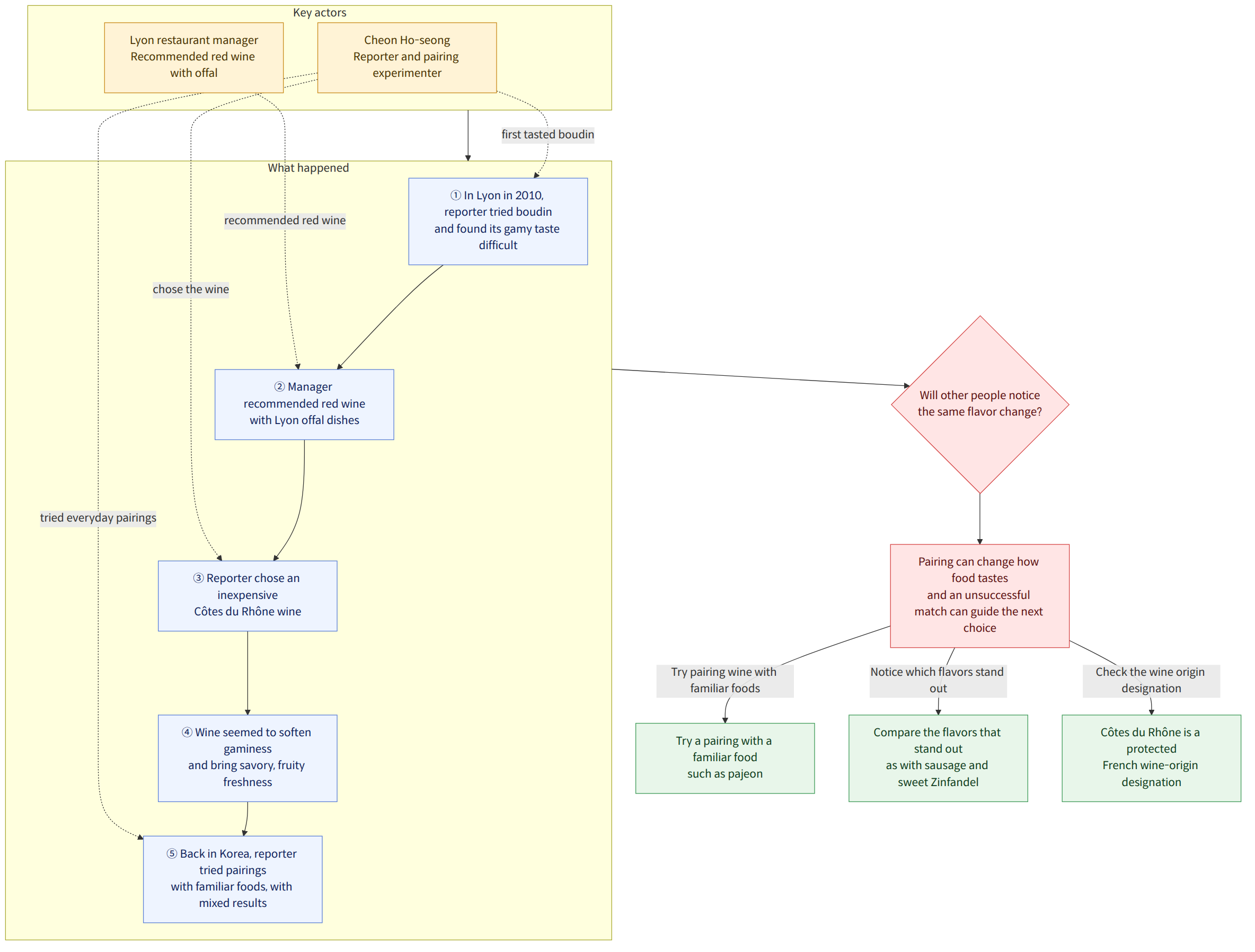
Reporter Cheon Ho-seong first tasted boudin, a French dish made with rabbit offal, at a restaurant in Lyon, France, in 2010. He recalled that eating it with wine changed the dish’s flavor.
The article recounting this experience was part of Cheon Ho-seong’s “Wine Today, Too” (천호성의 오늘도 와인) column series. It was published on October 4, 2026, and revised at 8:41 a.m. that same day. Rather than treating wine solely as a formal drink for special occasions, the article focuses on drinking it with food and noticing how the flavors change.
Background and context
Before eating boudin, offal dishes were unfamiliar to the reporter. He wrote that his first bite had the gamy taste typical of processed meat, and that drinking water did little to make the flavor go away. The restaurant manager then recommended that he try Lyon’s offal dishes with red wine.
The reporter chose an inexpensive glass of wine from the Côtes du Rhône region. The article explains that Côtes du Rhône is both a place name and a protected wine-origin designation officially designated by the French government. It also notes that the name refers to wine produced across a broad region around the Rhône River and the Rhône Valley.
The reporter described the wine’s peppery and cinnamon-like aromas as masking the offal’s gaminess and leaving a savory flavor. He went on to describe a fruitiness and freshness like biting into a handful of wild raspberries, as well as a pungent green aroma, like that of a fruit wine aged in a wooden barrel, that seemed to complement the rosemary in the boudin. The experience can be understood not as the offal dish itself changing, but as the combination of food and drink changing his impression of it.
What this story means
The point of the story is not to lay down a rule that a particular wine must go with a particular food. After returning to Korea, the reporter used money from his part-time job to buy 10,000-won bottles of wine at the supermarket and drink them with dinner. He tried pairings with familiar foods, serving a crisp Sauvignon Blanc white wine with pajeon and an astringent Cabernet Sauvignon with pork head meat.
Pairing means putting food and drink together and considering how their flavors work in combination. The reporter’s experience shows that a wine served alongside an unfamiliar food can change how off-putting that food seems. But not every combination was enjoyable. He said that when he paired salty grilled sausage with sweet Zinfandel, both the saltiness and sweetness stood out, making both difficult to swallow.
This experience may therefore help ease the pressure to find the “right wine.” A pairing that does not work can be as useful as one that does, providing a guide for the next choice. For example, if the aroma of offal dishes is usually too strong for you, you could see how your own palate responds when you try one with red wine. That is only a possibility suggested by the reporter’s experience, however; there is no basis to conclude that everyone would perceive the same change in flavor.
What is confirmed and what remains unknown
Confirmed facts
- The reporter first ate boudin made with rabbit offal at a restaurant in Lyon in 2010, when he was a university student.
- At the time, he found boudin’s gamy taste difficult to handle and ordered an inexpensive glass of wine from the Côtes du Rhône region at the restaurant manager’s recommendation.
- He wrote that the boudin tasted of spices and savory notes, with fruitiness and freshness, when eaten with the wine.
- He described pairing pajeon with Sauvignon Blanc, pork head meat with Cabernet Sauvignon, and grilled sausage with Zinfandel after returning to Korea.
- The article explains that Grenache has aromas of dry scrubland herbs in southeastern France, while in Spain’s Aragón it has aromas of red fruit and sweet spices such as licorice.
What remains unknown
- The article does not identify the producer or vintage of the Côtes du Rhône wine the reporter drank with the boudin in Lyon.
- The name of the restaurant he visited at the time is also not given.
- The article alone cannot establish whether other people would experience the change in flavor in the same way as the reporter.
What readers can consider
- If you want to start experimenting with wine pairings, you can explore how flavors work together with familiar foods mentioned in the article, such as pajeon or pork head meat, rather than waiting for a special meal.
- A pairing that does not work need not be viewed only as a failure. As in the reporter’s experience with sausage and Zinfandel, thinking about which flavors stood out can offer a clue for your next attempt.
- It is best not to assume what a wine will taste like based on the grape variety alone. In the article, Grenache is described differently depending on where it is grown, with aromas ranging from herbs to red fruit and sweet spices.