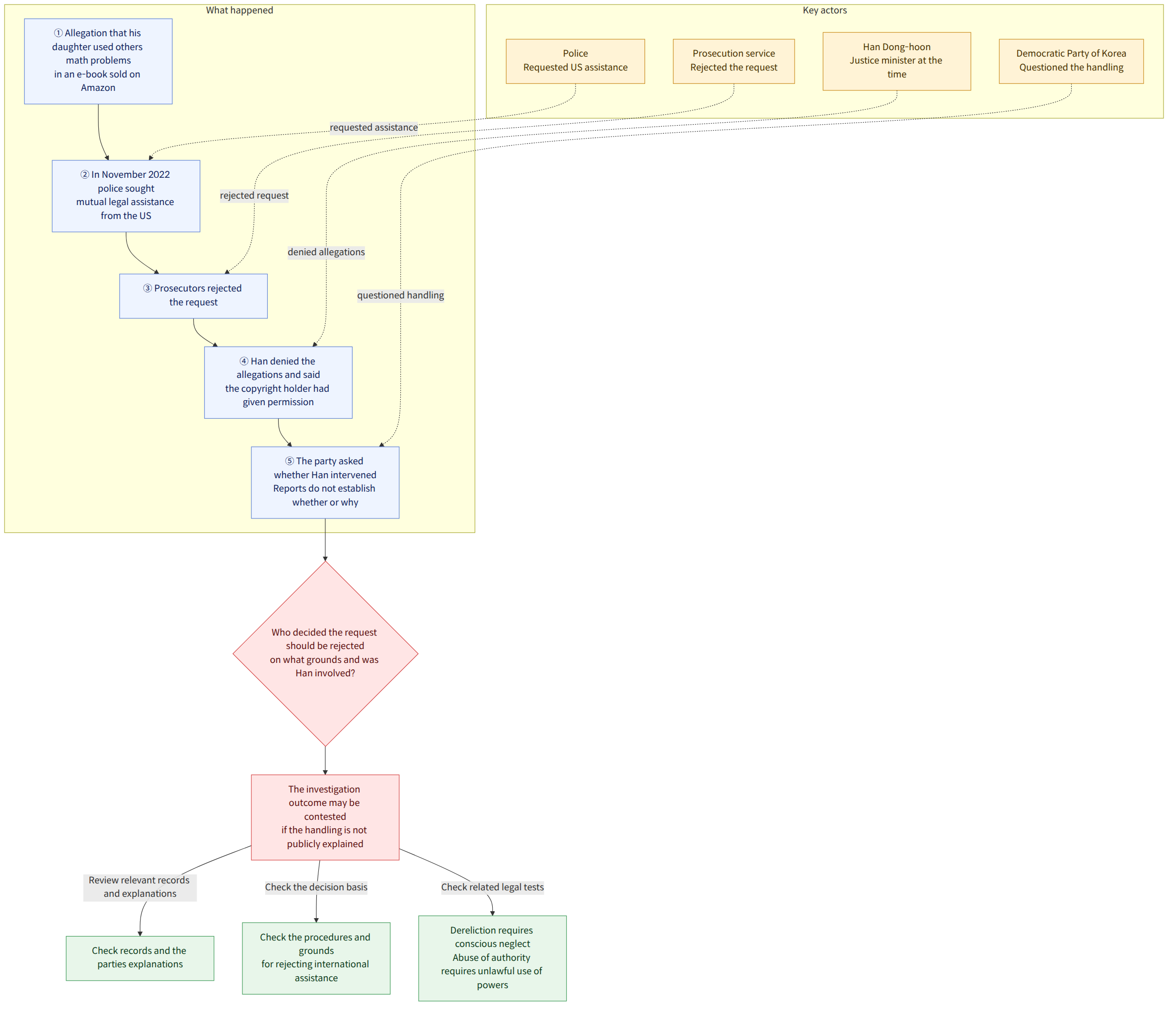
The Democratic Party of Korea called for the truth to be established about whether independent lawmaker Han Dong-hoon intervened in the investigation into allegations that his daughter had fabricated credentials. According to the party, in November 2022, when Han was minister of justice (법무부 장관), police requested mutual legal assistance (국제사법공조), a procedure for requesting evidence or information across national borders, from the United States to investigate the case involving his daughter, but the prosecution service (검찰) rejected the request. Han denied the allegations, saying the copyright holder had given permission.
Background and context
The allegation at issue is that Han’s daughter used math problems created by someone else to make an e-book and sold it on Amazon in the United States for $0.99. Allegations of a violation of the Copyright Act (저작권법) were raised, and Han said on Facebook that he had permission from the foreign copyright holder. The allegation and the parties’ claims conflict, and the reports do not show how investigators verified whether the copyright holder had given permission.
Park Seong-jun, the Democratic Party’s chief spokesperson, asked why prosecutors had halted the investigation, questioning whether the prosecution service had itself stifled the investigation or Han had exerted pressure. Lee Ju-hee, the party’s floor spokesperson, said prosecutors had blocked the way and police had closed the case without referring it to prosecutors (불송치), citing insufficient evidence. She suggested that the finding of no wrongdoing cited by Han might have been the result of the investigation being obstructed. These are concerns raised by the Democratic Party; they do not establish that Han intervened.
Han said that at the confirmation hearing the Democratic Party had merely filed a complaint and that there had never been anything to warrant concern, describing the party’s claims as “delusional.” He also said that the amount for which Democratic Party leader Kim Min-seok had been convicted in two past cases of violating the Political Funds Act (정치자금법) was 920 million won. Kim has maintained that those cases were politically motivated targeting by a politically driven prosecution. He has countered that the 200 million won case involved holding the candidate responsible for failing to issue receipts for donations to the central party, while some of the 720 million won in the other case was borrowed money and some was received for housing and living expenses. The dispute over the allegations has also spilled over into a war of words targeting the two sides’ past cases and political responsibility.
What this news means
The issue is not only the substance of the allegations, but also what procedures and grounds the investigative agencies used to reject the request for international assistance, and whether the minister at the time was involved in that process. Because questions have been raised about the exercise of authority by a public official in a case involving a family member, the credibility of the investigation’s outcome itself could become contentious if the handling of the case is not publicly explained. Conversely, the fact that the request was rejected alone does not establish that the minister applied pressure or unlawfully intervened.
For example, if evidence shows that the minister was involved in handling the case, the scope of that involvement, the exercise of actual authority, and any impact on the officials responsible could become relevant to determining accountability. If, on the other hand, no ministerial involvement is established and there were separate procedural grounds for rejecting the request, explaining those grounds and the basis for the decision could be important to resolving the questions. In either case, rather than drawing conclusions from the claims in the reports alone, the relevant records and the parties’ explanations need to be reviewed.
Related legal framework and support information
A crime related to the duties of a public official cannot be established merely because a decision appears “inappropriate.” According to an internal legal guide, the key question in the crime of dereliction of duty (직무유기죄) is whether the official consciously neglected or abandoned their duties, not whether they were simply negligent or handled their duties inappropriately. Abuse of authority (직권남용)—the unlawful exercise of a public official’s powers—also requires examination of whether general official authority was exercised unlawfully and whether the official caused another person to act contrary to their authority, role, standards, or procedures.
Therefore, the fact that a request for investigative assistance was rejected does not, by itself, establish dereliction of duty or abuse of authority in this case. The facts must first be established, including who decided to reject the request, what authority and procedures governed the decision, and whether the minister was briefed or involved. These are issues that arise when the general standards in the legal guide are applied to the allegations; they do not constitute a finding that any particular person committed a crime. (Internal material L1)
Differences in how the reports covered the issue
Both reports said that prosecutors rejected the police request for international legal assistance from the United States, and covered the Democratic Party’s call for the circumstances to be clarified and Han’s denial. However, one report focused on statements by spokespeople Park Seong-jun and Lee Ju-hee, Han’s counterargument, and the dispute concerning Kim Min-seok. The other added the Democratic Party’s claim that the official who approved the decision and the procedures for reporting to the minister or recusing him should be examined, as well as calls from others for an explanation. These are differences in the scope of the reports and the statements they quoted; they do not establish why the request was rejected or whether Han was actually involved.
What is known and what remains unclear
What is known
- On October 10, 2026, the Democratic Party called for the facts to be established about the investigation into Han’s daughter and the rejection of the request for international legal assistance.
- The Democratic Party said that police requested international legal assistance from the United States in November 2022, but prosecutors rejected the request.
- Han countered that he had permission from the copyright holder and that there had never been anything to warrant concern.
- According to reports, police closed the case without referring it to prosecutors, citing insufficient evidence.
What remains unclear
- Whether Han actually intervened in the investigation or the rejection of the request for international legal assistance, or exerted pressure.
- The specific reasons prosecutors rejected the request and what records document their decision.
- What evidence and procedures were used to establish whether the copyright holder had given permission and to reach the outcome of the investigation.
What readers should check
- Distinguish between the claim that “the request was rejected” and the confirmed facts about “who rejected it and why.” It is difficult to draw conclusions about involvement before the decision-maker and the grounds for the decision are made public.
- Check for subsequent explanations about whether the minister was briefed or recused, and for the record of the decision to reject the request. The Democratic Party has called for these procedures to be clarified, and the reports did not provide records that resolve those questions.
- When legal terms such as dereliction of duty or abuse of authority are used, consider not only whether the handling of the case was inappropriate but also whether the specific elements of each offense have been established.
References
- How far does criminal liability extend for offenses related to public officials’ duties?
- Other coverage consulted: chosun.com