
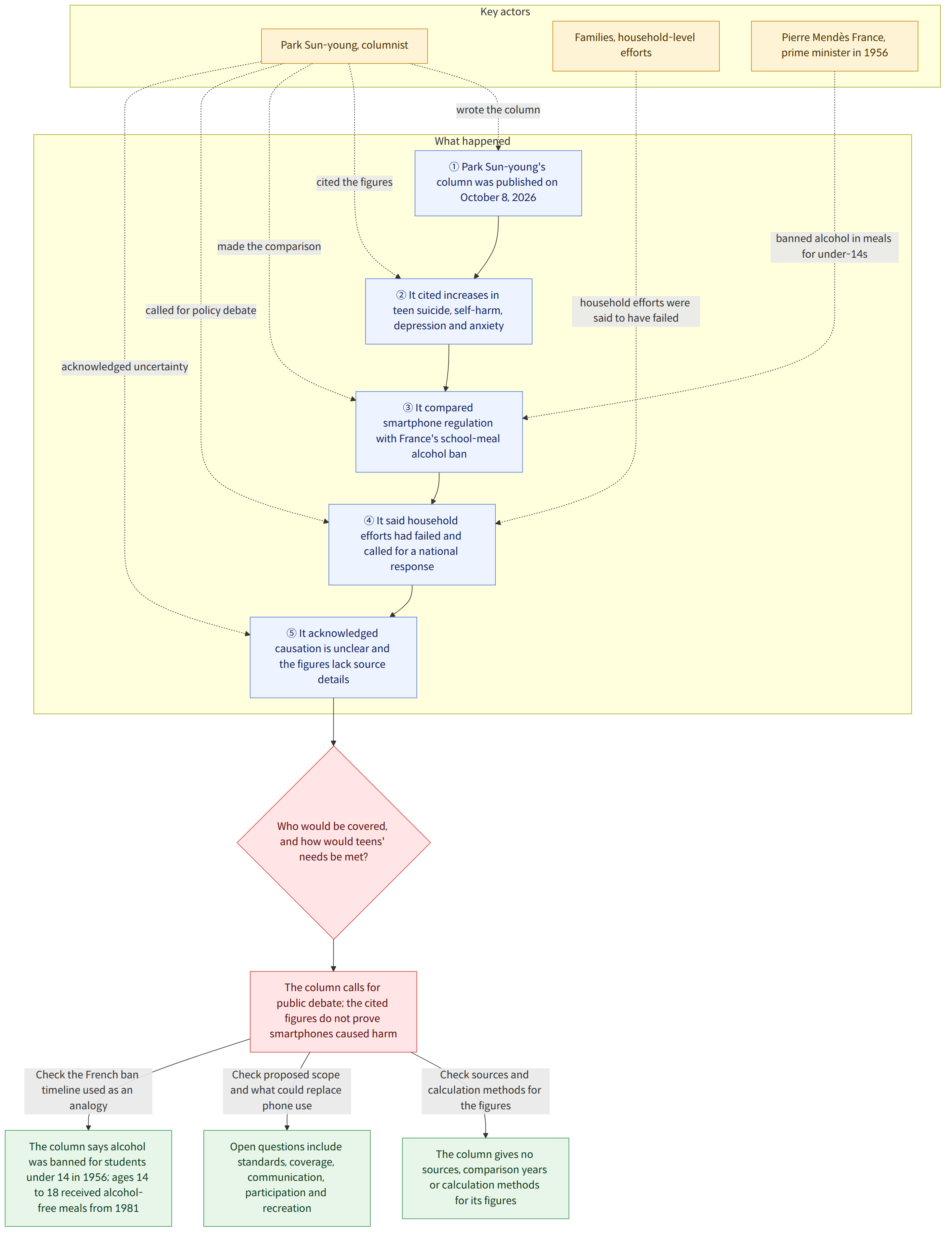
Published on October 8, 2026, Park Sun-young’s column examined the connection between teenagers’ smartphone use and mental-health problems. It argued that families alone cannot address the issue and called for national-level regulation and policy debate. The column used the phased ban on alcohol in school meals in France as an analogy for smartphones. It also cited increases in the teenage suicide rate, self-harm and suicide attempts, and depression and anxiety disorders, but did not provide the sources or calculation methods for those figures.
The increases cited in the column raise important concerns, but they do not, by themselves, prove that smartphone use caused mental-health problems.
Background and context
The column said that red wine was served with elementary school meals in France until 1956. It went on to say that then-Prime Minister Pierre Mendès France banned alcohol in school meals for students under 14 in 1956, while students aged 14 to 18 did not receive alcohol-free meals until 1981, just after François Mitterrand became president. The example served as an analogy supporting the column’s argument that practices once considered normal or beneficial can, over time, be viewed differently from the perspective of protecting children and teenagers.
The column identified 2009 as the year smartphones were launched in South Korea and said that children who had their first-birthday celebrations then are now in their final year of high school. This timeline highlights how deeply smartphones have become embedded in teenagers’ lives as they grow up. However, alcohol at school meals in France and smartphone use today are different issues, so the historical analogy does not scientifically prove the mental-health effects of smartphones.
The figures cited in the column are a 104.7% increase in the teenage suicide rate over 10 years and a 553.1% surge in self-harm and suicide attempts. It also said that the number of patients with depression rose 55.6% over five years and anxiety disorders increased 42.2%. However, the column does not identify the sources for any of the four figures, the years or age ranges compared, or the periods covered by the increases in self-harm and suicide attempts and anxiety disorders.
What this news means
The column’s argument can be read not as a conclusion that smartphones have been proven to cause mental-health problems among teenagers, but as a call to discuss a public response rather than leaving a serious issue to the control of individual families. Park Sun-young acknowledged the counterargument that a causal relationship between smartphones and mental health has not been clearly established. Nevertheless, she said attempts to regulate use at the household level had failed and argued that a national response through legislation and policy was needed. This is the column’s viewpoint; the original text does not propose specific regulatory measures or explain their likely effects.
Those affected could include not only teenagers and their families, but also schools and institutions that design policy. If regulation is debated, the discussion should consider not only limits on teenagers’ smartphone use but also how their needs for communication, participation, and recreation would be met afterward. The column itself stresses the need to discuss what would fill the space left by smartphones. The issue, therefore, could involve not only whether to ban or restrict use, but also who would be covered, what standards would apply, and how the results would be assessed.
For example, if a school or policymaker were to consider reducing smartphone use in a particular setting, one possible approach would be to examine both the effects of the measure on teenagers’ communication and participation and any changes in mental-health indicators. This is only an example of a possible approach to consideration; it does not mean the column proposed a specific pilot program or evaluation plan. The column said that several countries had already begun regulating smartphone use, but did not identify which countries or what regulations they had introduced.
What is established and what remains unknown
Established facts
- Park Sun-young’s column was published on October 8, 2026.
- The column said that France banned alcohol in school meals for students under 14 in 1956, while students aged 14 to 18 did not receive alcohol-free meals until 1981.
- The column cited a 104.7% increase in the teenage suicide rate over 10 years, a 553.1% increase in self-harm and suicide attempts, a 55.6% increase in the number of patients with depression over five years, and a 42.2% increase in anxiety disorders.
- Park Sun-young presented the counterargument that a causal relationship between smartphones and mental-health problems among teenagers has not been clearly established, and argued for a national response.
What remains unknown
- What are the sources and calculation methods for the cited mental-health figures, and which years and age groups were compared?
- Over what periods were the increases in self-harm and suicide attempts and anxiety disorders measured?
- What specific research evidence supports a causal relationship between smartphone use and teenagers’ mental health?
- Which countries have introduced the regulations mentioned in the column, and what do those regulations entail?
- If a national response is adopted, who would be subject to restrictions, what would their scope be, and how would teenagers’ communication, participation, and recreation be supported?
What readers should check
- When encountering statistics, it is important to check their sources, the years and age ranges compared, and the denominator used to calculate the increase. Putting figures based on different criteria side by side can lead to a mistaken understanding of what has changed.
- Claims about smartphone use and mental-health problems should distinguish between increases that occur at the same time and a causal relationship. The column itself also presents the counterargument that a causal link has not been clearly established.
- If the regulatory debate becomes more concrete, it is worth considering not only whom the restrictions would apply to and how they would work, but also how teenagers’ communication, participation, and recreation would be ensured afterward and how the policy’s effects would be assessed.