The original-ticket collectible for the film “Assassin(s)” has drawn criticism for evoking the scene in which Yuk Young-soo was shot. According to reports, the ticket, produced and distributed by Megabox, is designed so that, when its transparent panels are overlaid, bullet holes appear over the Taegeukgi, a podium, and a figure who appears to be Yuk Young-soo. As the film faces controversy over historical distortion, the collectible’s design has also become a subject of debate, prompting calls from political figures for the tickets to be destroyed and for an official apology.
Background and context
Reports say the ticket’s design brings to mind the incident on August 15, 1974, when Yuk Young-soo was fatally shot. At the time, Moon Se-gwang, a Korean resident of Japan, shot at former President Park Chung-hee, and Yuk was killed by a bullet during the incident. The core criticism is that a scene recalling this historical event has been recreated as a visual effect in a collectible product.
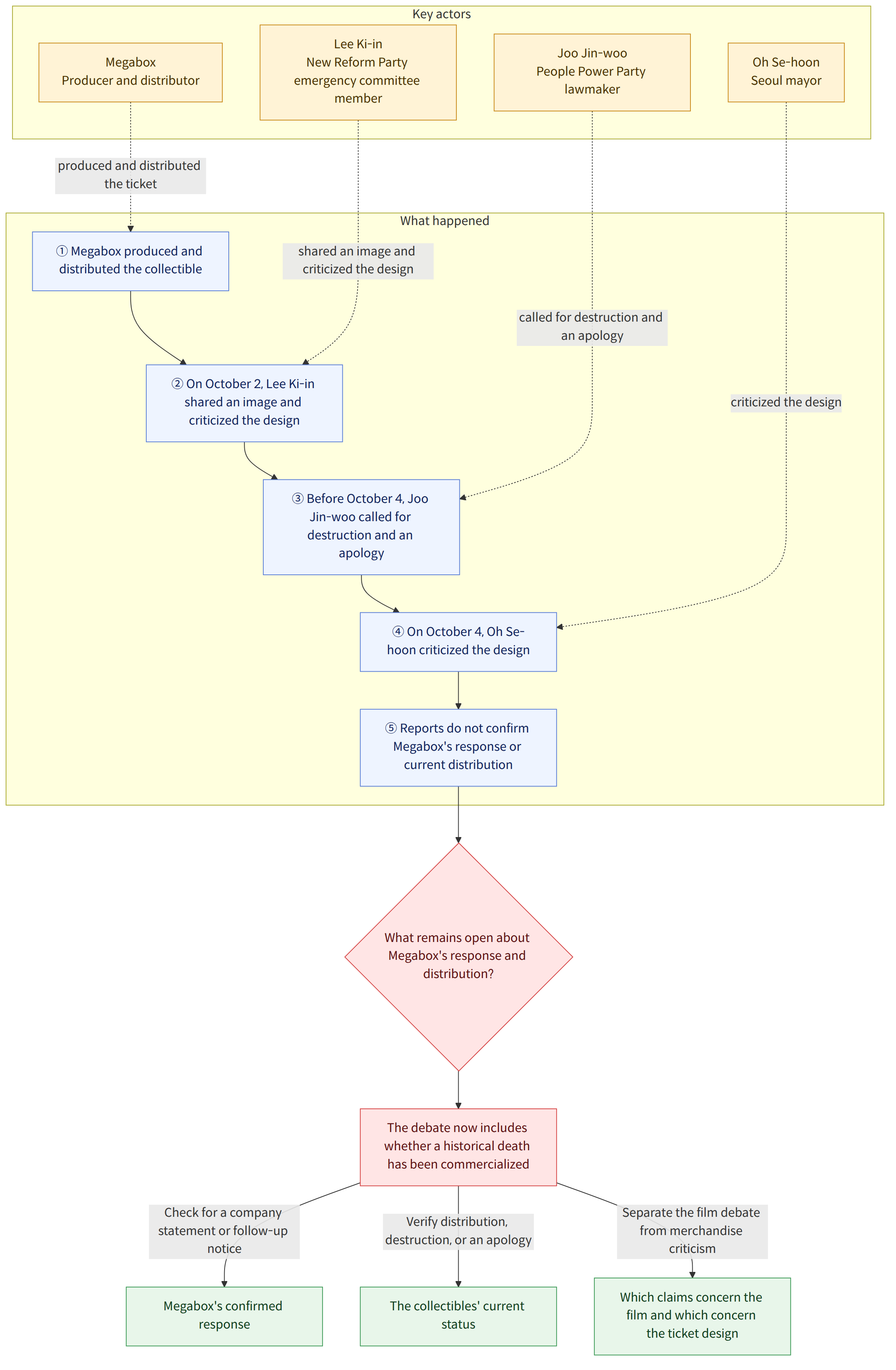
On October 2, Lee Ki-in, an emergency committee member of the New Reform Party (개혁신당), shared an image of the ticket and criticized its design, saying it seemed to make viewers complete the scene of the shooting with their own hands. On October 4, Seoul Mayor Oh Se-hoon criticized the bullet-hole ticket on Facebook, saying the commercial conduct had gone too far. He asked whether even the moment when Yuk lost her life at a Liberation Day ceremony had to be turned into merchandise.
The previous day, Joo Jin-woo, a lawmaker from the People Power Party (국민의힘), called on Megabox on Facebook to destroy all the collectibles and issue an official apology. These remarks show political opposition to the design, but the fact that criticism was voiced should be distinguished from whether Megabox actually destroyed the tickets or apologized.
What this news means
The controversy is notable because debate over the film’s historical interpretation has extended to the design of its merchandise and the company’s response. For viewers, a ticket can be a keepsake that helps them remember a film. In this case, however, critics say that the act of overlaying the panels itself creates an experience that seems to recreate the moment a real person was shot. The issue could therefore extend beyond whether the product can be made to an assessment of how a historical death has been commercialized.
Conversely, viewers who find the design disturbing, or people who remember the incident, may see the same collectible as something that reopens a wound. This is a possible interpretation; the reporting provided does not confirm the reactions of actual viewers or the bereaved family.
The company’s response could become the next stage of the debate. Calls for the tickets to be destroyed and for an apology have been made publicly, but the reporting confirms only that these demands were made. Megabox’s position and whether the tickets are still being distributed need to be verified separately.
Confirmed facts and what remains unknown
Confirmed facts
- Reports say Megabox produced and distributed original-ticket collectibles for the film “Assassin(s).”
- The ticket was described as having a design in which, when its transparent panels are overlaid, bullet holes appear over the Taegeukgi, a podium, and a figure who appears to be Yuk Young-soo.
- Emergency committee member Lee Ki-in shared an image of the ticket on October 2 and criticized its design.
- Seoul Mayor Oh Se-hoon criticized the design on October 4, and lawmaker Joo Jin-woo called for all the tickets to be destroyed and for an official apology.
What remains unknown
- What position has Megabox stated in response to criticism of the production and distribution?
- How many tickets were produced and distributed, and are they still being distributed?
- Has Megabox destroyed the collectibles or issued an official apology?
What readers should check
- Check whether Megabox has issued a statement or follow-up notice.
- Do not assume the tickets are still being distributed or have been destroyed or recalled based only on criticism or demands; look for confirmed information.
- The debate over the film’s historical depiction and the criticism of the collectible’s design are connected, but it is worth distinguishing the facts and claims underlying each.