1. A Human Story
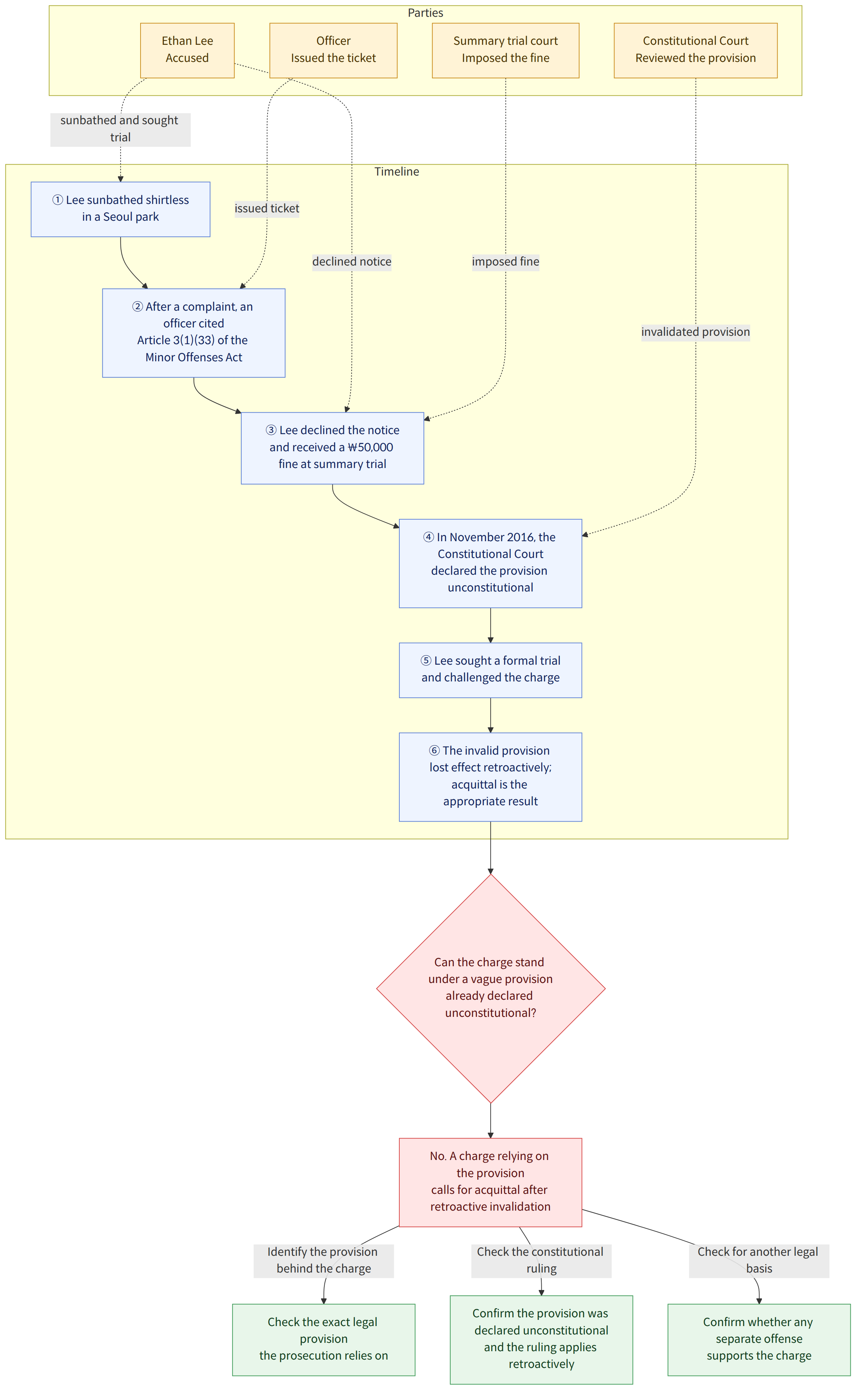
On a mild spring afternoon in Seoul, Ethan Lee spread a towel on a patch of grass in the small park outside his apartment building. He had come out to catch some sun. With few people nearby, he took off his shirt and lay back, expecting nothing more than a quiet break.
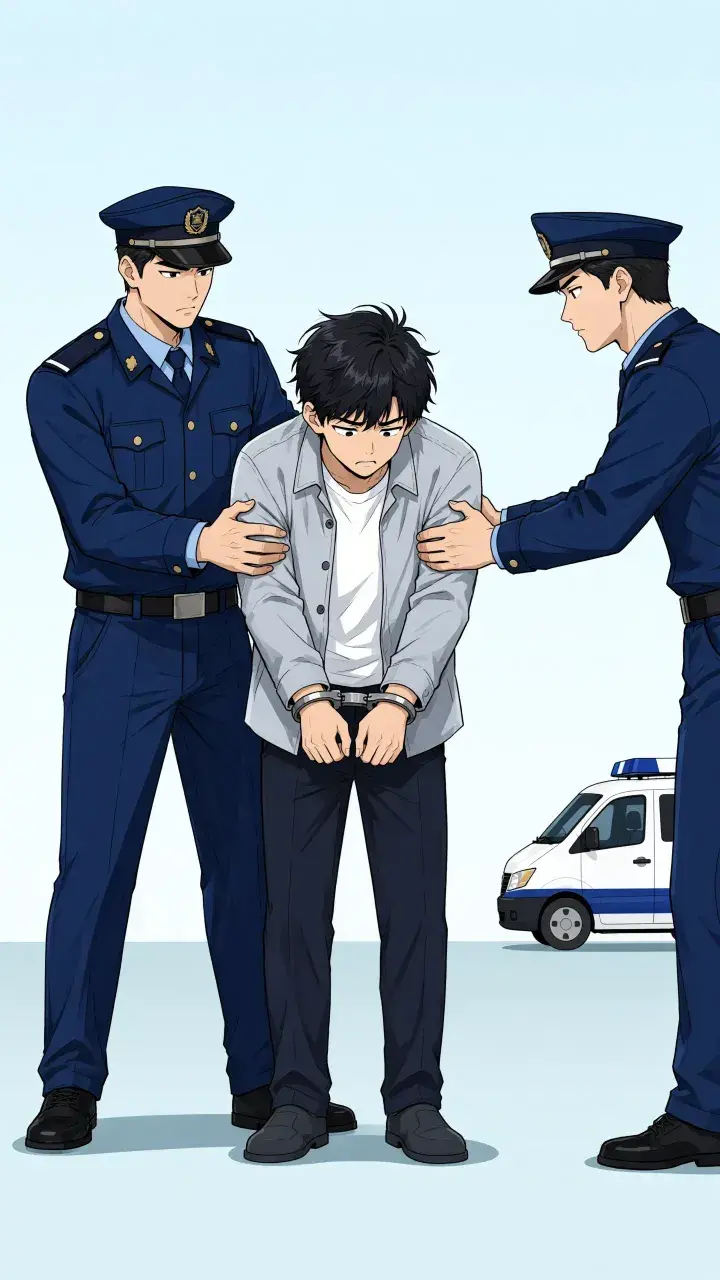
A passerby complained. An officer later issued Ethan a ticket under a provision of the Minor Offenses Act that punished people who exposed themselves in public in a way that caused others shame or discomfort. Ethan believed that sitting shirtless in the park was not “excessive” exposure. He declined to pay the administrative notice, and the matter went to a summary trial. The court imposed a ₩50,000 fine.
Ethan then sought a formal trial and argued that he had committed no crime. He also wondered whether the law itself was too vague to be enforced. That question would prove decisive: the Constitutional Court had already struck down the provision he had been accused of violating.
2. The Legal Question
Could Ethan challenge the constitutionality of the public-exposure provision in his formal trial—and, after the provision was held unconstitutional, should he be acquitted of the charge?
3. What Korean Law Says
The provision at issue was Article 3(1)(33) of the Minor Offenses Act, in the version amended in 2012. It covered a person who, in a place visible to many people, publicly exposed the body “excessively” or exposed areas “that should be covered,” causing another person a feeling of shame or discomfort. The possible penalties included a fine of up to ₩100,000, detention, or a minor monetary penalty.
The constitutional problem was not simply whether a particular person’s conduct was offensive. It was whether the law described the prohibited conduct clearly enough for people to understand what could lead to criminal punishment.
Korea’s Constitution protects the principle of legality in criminal law: conduct and penalties must be established by law, and the law must be sufficiently clear. A person should not have to guess whether ordinary conduct crosses an uncertain criminal boundary, nor should enforcement turn on an official’s or bystander’s unbounded personal judgment.
In November 2016, the Constitutional Court ruled the provision unconstitutional. It found that its central expressions left too much uncertainty:
It was difficult to determine what it meant to expose the body “excessively” or which areas were “places that should be covered.” Whether exposure caused “shame or discomfort” could vary from person to person, and that reaction could not reliably clarify the other terms.
The Court also concluded that clearer drafting was realistically available. For example, lawmakers could identify prohibited body areas, either specifically or by illustrative examples, rather than relying on open-ended phrases.
The ruling mattered for pending cases as well as future conduct. Under Article 47(3) of the Constitutional Court Act, a provision declared unconstitutional loses its effect retroactively. Where a prosecution depends on that provision, the conduct is treated as no longer constituting a crime under it, and the appropriate result is an acquittal.
4. How Korean Courts Approach This
Korean courts assess criminal laws against the constitutional requirement that prohibited conduct be described with enough precision. The standard does not demand that legislation anticipate every possible factual detail. But it does require a workable boundary that ordinary people can understand and that courts and enforcement officers can apply consistently.
When the meaning of a criminal prohibition depends on subjective reactions—such as whether someone feels shame or discomfort—that reaction cannot, by itself, supply a clear legal boundary if the conduct being prohibited is also undefined.
Courts also distinguish between two questions: whether the accused’s behavior was socially objectionable, and whether the law clearly made that behavior a crime. Even if someone complains, the complaint cannot cure an unconstitutional lack of clarity in the statute.
Once the Constitutional Court invalidates the legal provision on which a pending charge rests, the trial court must give effect to that ruling. It cannot uphold a conviction simply because an officer issued a notice or a lower court earlier imposed a fine.
5. Applying the Law to the Case
Ethan’s case follows the constitutional ruling’s logic step by step:
- The charge depended on the challenged provision. The fine was imposed because Ethan was alleged to have violated Article 3(1)(33), not because of a separate offense.
- The law left the crucial boundary uncertain. “Excessively” exposed, “areas that should be covered,” and causing “shame or discomfort” did not give a sufficiently clear answer to whether taking off a shirt in a public park was criminal.
- A bystander’s reaction could not settle the legal question. A person might feel embarrassed or uncomfortable, while another might not. That subjective difference could not substitute for a clear description of prohibited conduct.
- The provision was declared unconstitutional. The Constitutional Court’s decision applied to the very statutory language used to prosecute Ethan.
- The invalidation applied retroactively. Because the provision lost its force retroactively, Ethan’s pending formal trial could not result in a conviction under it. The earlier ₩50,000 summary-trial fine did not preserve the statute’s validity.
Ethan could therefore raise the constitutional issue in the formal proceedings. In practical terms, the decisive point was no longer whether every observer considered his sunbathing appropriate. It was that the legal provision supporting the charge had been struck down and could not sustain the prosecution.
6. Conclusion: What Happened, and What Should You Do?
At his formal trial, Ethan should be acquitted of the charge under the invalidated provision. The constitutional ruling removed the legal basis for convicting him, including in a case still before the courts. That conclusion is limited: it does not create a general right to expose oneself anywhere or prevent enforcement under a different, valid law where the facts support it.
If you face a similar case, keep these practical points in mind:
- Identify the exact statutory provision cited in the notice or charge; the legal outcome can depend on the specific law involved.
- Raise the constitutional ruling promptly in any pending proceedings and provide the court with the relevant decision and charge documents.
- Do not assume a disputed ticket disappears automatically. Observe deadlines, seek legal advice if needed, and confirm the procedural steps required to challenge the notice or judgment.