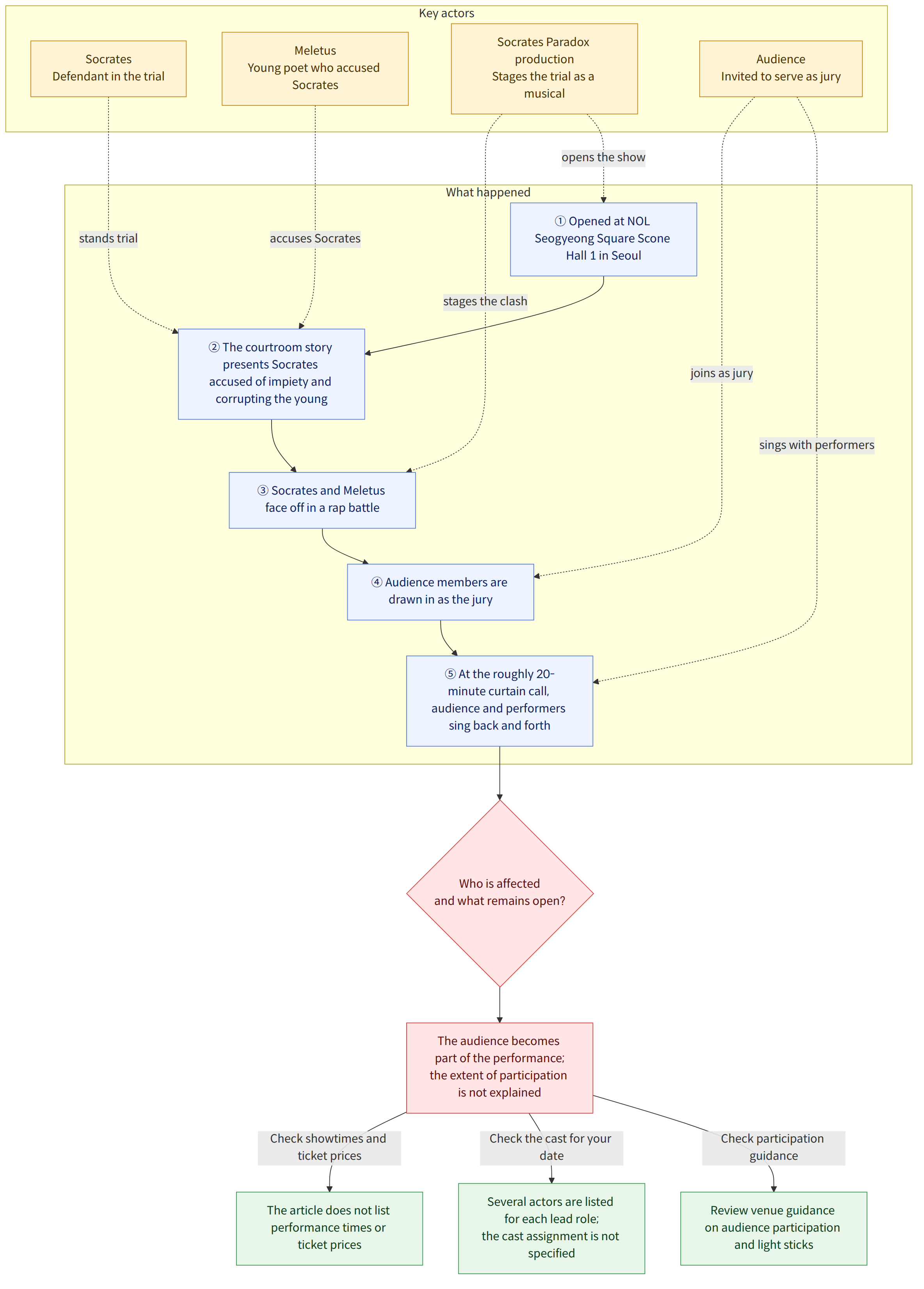
The musical “Socrates Paradox” brings an ancient Athenian trial to the stage as a rap battle. Opening on the 10th of last month at NOL Seogyeong Square Scone Hall 1 (놀 서경스퀘어 스콘 1관) in Jongno-gu, Seoul, the production unfolds the courtroom clash between Socrates and Meletus, the young poet who accused him, through music and audience participation. The show runs through November 29.
Background and context
The production begins with Socrates standing trial in an Athenian court. According to the article, Socrates was accused of not believing in the gods worshipped by the city and of corrupting the young, and the citizen jury found him guilty. He rejected his students’ offer to help him escape and drank the hemlock.
Meletus was not the only accuser: the politician Anytus and the orator Lycon also took part in the actual prosecution. The article also notes that the trial took place after the defeat in the Peloponnesian War and the end of the reign of terror by the “Thirty Tyrants,” when democracy had been restored. Rather than delving deeply into this complex political background, the production condenses the story into a face-off between Socrates and Meletus, foregrounding the pace of the debate and the musical thrill.
Onstage, microphones set before columns and a beat turn courtroom arguments into the language of performance. The role of Socrates is played by Jeong Min, Kim Do-bin, Jo Pung-rae, and Moon Gyeong-cho, while Meletus is played by Choi Ho-seung, Hwang Min-su, Lee Jong-seok, and Lee Jun-woo. Kim Ki-young, Kwon Oh-deuk, Park Hee-tae, Bae Hye-jin, Lee Yeo-jin, and Kim Ye-na support the contest between the two characters as the chorus.
What this means
In this production, the audience is not simply watching a trial. The show calls the audience the “jury” and draws them into the proceedings.
Rap conveys the tension and rebuttals of the debate in a fast rhythm, but the lyrics may come so quickly that they can be hard to follow. Lyrics displayed on monitors on either side of the stage can help the audience keep up with the dialogue. For example, audience members concerned about the speed of the rap can follow the debate by reading the lyrics on the monitors.
The production sets weighty philosophical questions to familiar musical forms and an interactive staging. The line presented as something Socrates said before drinking the hemlock—“It is easy to avoid death. What is difficult is to avoid wickedness”—encapsulates the question the show poses. Which should one choose: preserving one’s life or living rightly? That question need not remain confined to the choice made by an ancient figure; it can also be directed at the audience.
The article reports that the curtain call lasts about 20 minutes, during which audience members wave light sticks and sing back and forth with the performers. The audience, invited to serve as the jury during the show, thus becomes a participant engaging with the performers by the end. This format is notable because it can expand the experience beyond one in which the stage and auditorium remain separate, turning it into an experience of singing and responding together.
Confirmed facts and what remains unknown
Confirmed facts
- The production opened on the 10th of last month at NOL Seogyeong Square Scone Hall 1 in Jongno-gu, Seoul.
- It depicts the courtroom clash between Socrates and Meletus as a rap battle.
- It calls the audience the jury and displays the song lyrics on monitors on either side of the stage.
- The curtain call lasts about 20 minutes, and the audience is reported to wave light sticks and sing back and forth with the performers.
- The show runs through November 29.
What remains unknown
- The article does not give performance times or ticket prices.
- It is not clear how the cast is assigned for each performance.
- The article does not explain in detail how audience participation works during the show or how much the audience can participate in the curtain call.
What readers should check
- Anyone considering booking should check the performance time and ticket price for their preferred date separately. The article does not provide this information.
- Since several actors are listed for the roles of Socrates and Meletus, it is also a good idea to check the cast for the performance you plan to attend.
- Since audience participation and light sticks are mentioned, prospective ticket buyers can review the guidance on how participation works at the venue.