
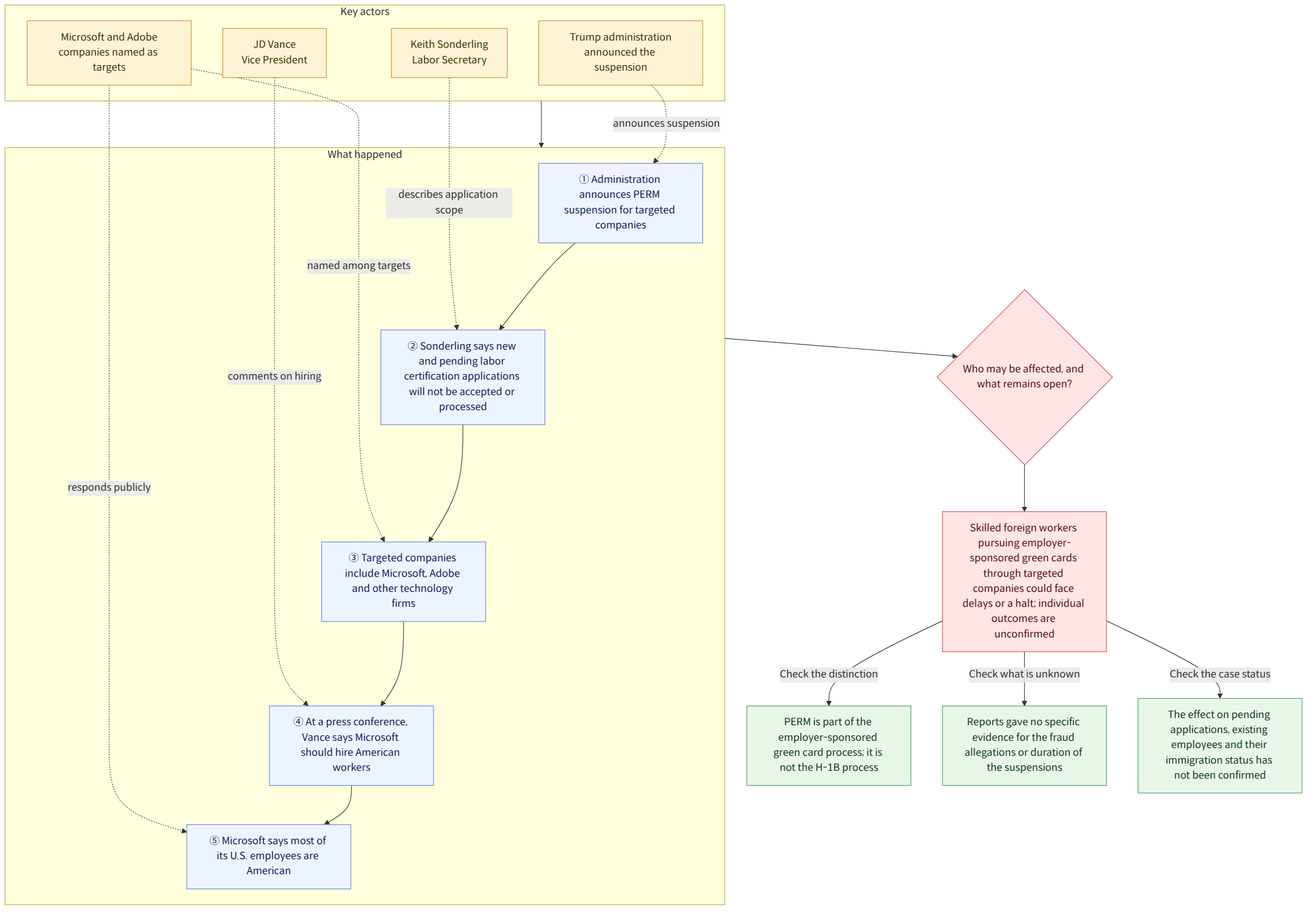
The Trump administration said it was suspending major technology and information technology companies, including Microsoft and Adobe, from a process used by skilled foreign workers to obtain green cards, and that it would not accept new or pending applications for permanent labor certification involving those companies. The government accused the companies of fraudulently using the system. The companies targeted also include Capgemini, Cognizant, HCL, Infosys, Tata and Wipro.
The action targets an employment-related process required for foreign workers applying for U.S. permanent residency. It should not be broadly interpreted as a halt to H-1B visa issuance or all hiring of foreign workers. Reports did not provide specific evidence for the allegations against the companies or the duration of the suspensions.
Background and context
Permanent labor certification (PERM) is a labor certification system used in the employer-sponsored green card process. According to reports, U.S. Labor Secretary Keith Sonderling said the government would not accept either new applications involving the targeted companies or applications already pending. In other words, the action could affect not only people seeking to file new applications but also those whose applications are already in progress.
H-1B visas are for highly skilled occupations that employers may have difficulty filling with qualified U.S. workers. H-1B visas and PERM are not the same process, so suspending green card labor certification applications does not in itself mean that all H-1B visa applications have been halted. According to reports, nearly three-quarters of approved H-1B visas were issued to workers from India.
At a press conference, Vice President JD Vance said Microsoft should hire American workers. Separately, he said the government would investigate nine universities, including Harvard, Yale and Stanford, over allegations that they were using a program that allows international students to enter the United States to lower the wages of American workers. The university investigation and the suspension of companies’ PERM applications are separate matters, and reports did not give any findings from the university investigation.
What this news means
Skilled foreign workers seeking green cards through the targeted companies could face delays or a halt in the employment-based green card process. However, it has not been confirmed what will happen to applications currently in progress or how existing employees’ immigration status or employment might change. Nor can it be concluded from this announcement alone that the same restrictions apply to H-1B status extensions or existing employees’ visas.
Companies may face the added burden of reviewing not only their hiring plans but also green card applications already in progress. For example, a foreign employee at a targeted company who is pursuing an employer-sponsored green card may need to find out whether the government’s announcement that it will not process pending applications applies to their application. This is a possible impact, not an indication that individual outcomes have already been determined.
Microsoft said that the majority of its employees in the United States are American. It also said that of the approximately 6,000 H-1B applications it filed in the last fiscal year, 80% were to extend or change the status of existing employees. The company added that applications related to new hires were for people already lawfully in the United States; they accounted for 1% of its U.S. workforce and were not people newly arriving in the country.
The company also said it files petitions only for people who meet the strict requirements for H-1B visas and pays H-1B employees the same wages as other employees doing similar work. These are the company’s statements; they do not establish whether the government’s fraud allegations are true or what evidence they are based on. Adobe did not immediately respond to a request for comment.
What reports described differently
Reports said the government cited fraud and the protection of American jobs, but they differed in how they described the specific claims about Microsoft. One report said Vance had stated that Microsoft should hire American workers. Another said Vance had singled out Microsoft as a prime example of abuse of the system and claimed that the company laid off 6,000 American workers last year while benefiting from 6,300 H-1B temporary worker visas and about 3,000 green cards.
These figures cannot be assumed to cover the same scope as the approximately 6,000 H-1B applications Microsoft said it filed in the last fiscal year. One set of figures reflects the company’s account of its number of applications and the share involving extensions or changes of status for existing employees; the other reflects the vice president’s claims about visas and green cards. Reports do not provide enough information to compare the counting methods or time periods, so it is difficult to conclude that one account refutes the other.
What is confirmed and what remains unknown
Confirmed facts
- The companies targeted include Microsoft, Adobe, Capgemini, Cognizant, HCL, Infosys, Tata and Wipro.
- The labor secretary said the government would not accept new or pending applications for permanent labor certification involving the targeted companies.
- Microsoft said that of the approximately 6,000 H-1B applications it filed in the last fiscal year, 80% were to extend or change the status of existing employees.
- Vance said the government would investigate nine universities over allegations involving a program for international students.
What remains unknown
- How long will the suspensions of the companies last, and what are the conditions for lifting them?
- What specific evidence does the government have for its fraud allegations against the companies?
- What specific effects will there be on pending labor certification applications and existing employees of the targeted companies?
What readers should check
- Employees of the targeted companies should first distinguish whether their case involves an H-1B visa application or a PERM permanent labor certification application. The reported suspensions directly target permanent labor certification applications.
- If a green card application is in progress, applicants can ask their employer whether it is pending and what guidance the employer has received in connection with the action. The announcement alone is not enough to determine an individual’s immigration status or application outcome.
- Reports did not establish how long the suspensions will last, the conditions for lifting them or how pending applications will be handled. People affected by these processes should separately check for follow-up guidance from their employers and the status of their own applications.
References
- Other coverage consulted: koreatimes.co.kr
- Other coverage consulted: koreatimes.co.kr