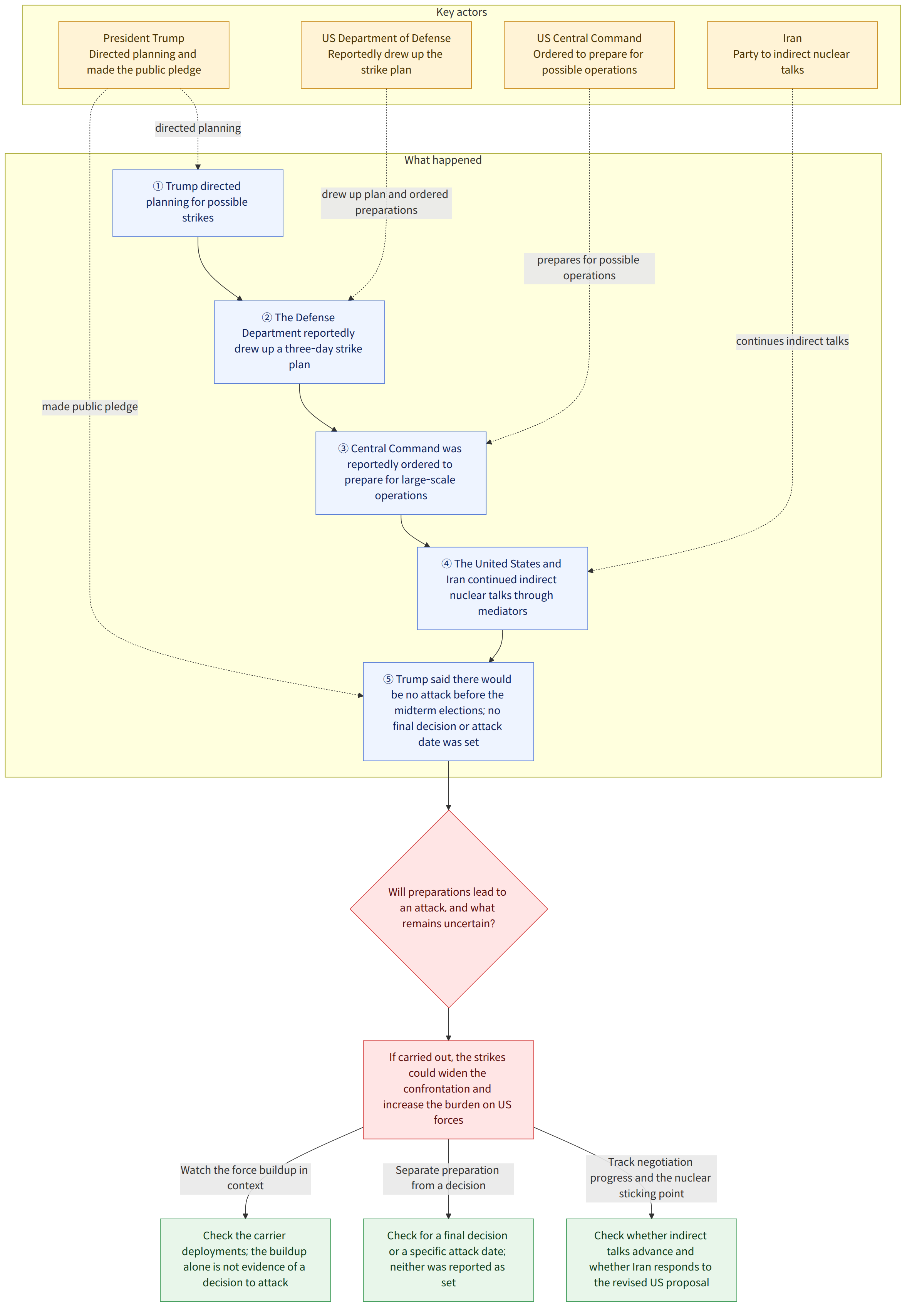
Reports say the U.S. Department of Defense (미 국방부) has drawn up an operational plan for three days of attacks on Iran, at the direction of President Donald Trump. The plan reportedly includes short, intense strikes on Iran’s missile and drone capabilities, energy facilities and military bases. Trump, however, said he would not attack Iran before the U.S. midterm elections on November 3. The key point amid conflicting reports about the plan and the president’s public remarks is that no decision to resume operations has been made.
Background and context
The reported plan’s main targets are Iran’s missile and drone capabilities, which the Islamic Revolutionary Guard Corps (이란 혁명수비대) rebuilt after the early days of the war. Energy facilities and the Guard’s leadership could also be included among the targets, according to reports. Separately, reports said the U.S. Department of Defense had ordered U.S. Central Command (중부사령부), which oversees operations in the Middle East, to complete preparations for resuming large-scale combat operations.
An order to prepare does not mean a decision to attack. Reports also said that no specific attack date had been set and that Trump had not made a final decision. Earlier, senior White House national security officials led by Vice President Vance discussed options for resuming operations at Camp David on the 2nd, and Trump reportedly spoke with Israeli Prime Minister Benjamin Netanyahu on the 7th.
The president has sent conflicting signals. Trump wrote on Truth Social that he was having productive discussions with Iran and that there would be no attack before the midterm elections. At the same time, reports say the White House national security team and the Pentagon proposed plans for major operations targeting Iran or the pro-Iranian Houthi rebels in Yemen five times in recent months, and that the president rejected all of them. This underscores the need to distinguish between the fact that military plans have been considered and the conclusion that the president has decided to carry them out.
What this news means
Because potential targets include not only Iran’s missile and drone capabilities but also energy facilities and military bases, carrying out the plan could broaden the scope of a military confrontation. The burden on U.S. forces could also be considerable. According to reports, Iran’s missile tactics and attack accuracy have improved, forcing U.S. forces to use more interceptor missiles than before to stop attacks.
The deployment of forces is another factor to watch. The carrier strike group led by the USS Theodore Roosevelt, which left San Diego last week, is expected to reach the Middle East as early as the end of this month and join the USS George H.W. Bush and the USS George Washington. The period during which all three ships are deployed together is expected to be temporary. This buildup can be viewed as part of the context for operational preparations, but it is not in itself evidence of a decision to attack.
For example, if nuclear negotiations show no progress after the midterm elections, attention could turn to whether military operations will resume. But this is a hypothetical scenario; there is no confirmation that an attack will actually take place after the election. Nor should Trump’s pledge not to attack before the election be interpreted as a commitment that settles what he will do afterward.
Where reports differ
Reports differ on whether indirect negotiations are making progress. One report said officials agreed with Trump’s assessment that there had been “some progress,” while another said the talks had made no headway and that Qatari mediators were waiting for Iran’s response to a revised U.S. proposal. Both reports said the United States and Iran were continuing indirect negotiations through mediators including Qatar, and that the nuclear program remained a sticking point.
Reports about the operational plan also stop short of asserting that it will be carried out. They have described a three-day strike plan and an order for Central Command to prepare, while also noting that no attack date or final decision has been set. What is currently established, therefore, is that operational preparations and deliberations have been reported—not that an attack has been confirmed.
What is confirmed and what remains unknown
Confirmed
- The reported operational plan involves concentrated strikes on Iran’s missile and drone capabilities, energy facilities and military bases.
- Trump said he was having productive discussions with Iran and would not attack before the November 3 midterm elections.
- Reports say Central Command was ordered to complete preparations for resuming large-scale operations.
- The United States and Iran are continuing indirect negotiations through mediators, but talks are stalled over the nuclear program.
Still unknown
- It is not known whether the United States will actually resume attacks on Iran after the midterm elections.
- It has not been confirmed whether indirect U.S.-Iran negotiations will make progress on the nuclear program issue.
What readers should watch
- Do not draw conclusions about possible military action after the election based only on the pledge not to attack beforehand; watch for subsequent official statements and decisions.
- Since the nuclear program is the central issue in the indirect negotiations, readers can watch for signs of progress and confirmation of Iran’s response to the revised U.S. proposal.
- Track the carrier strike group’s arrival in the Middle East and changes in its deployment, but do not interpret the movement of forces alone as a decision to attack.
References
- Other coverage consulted: koreatimes.co.kr