
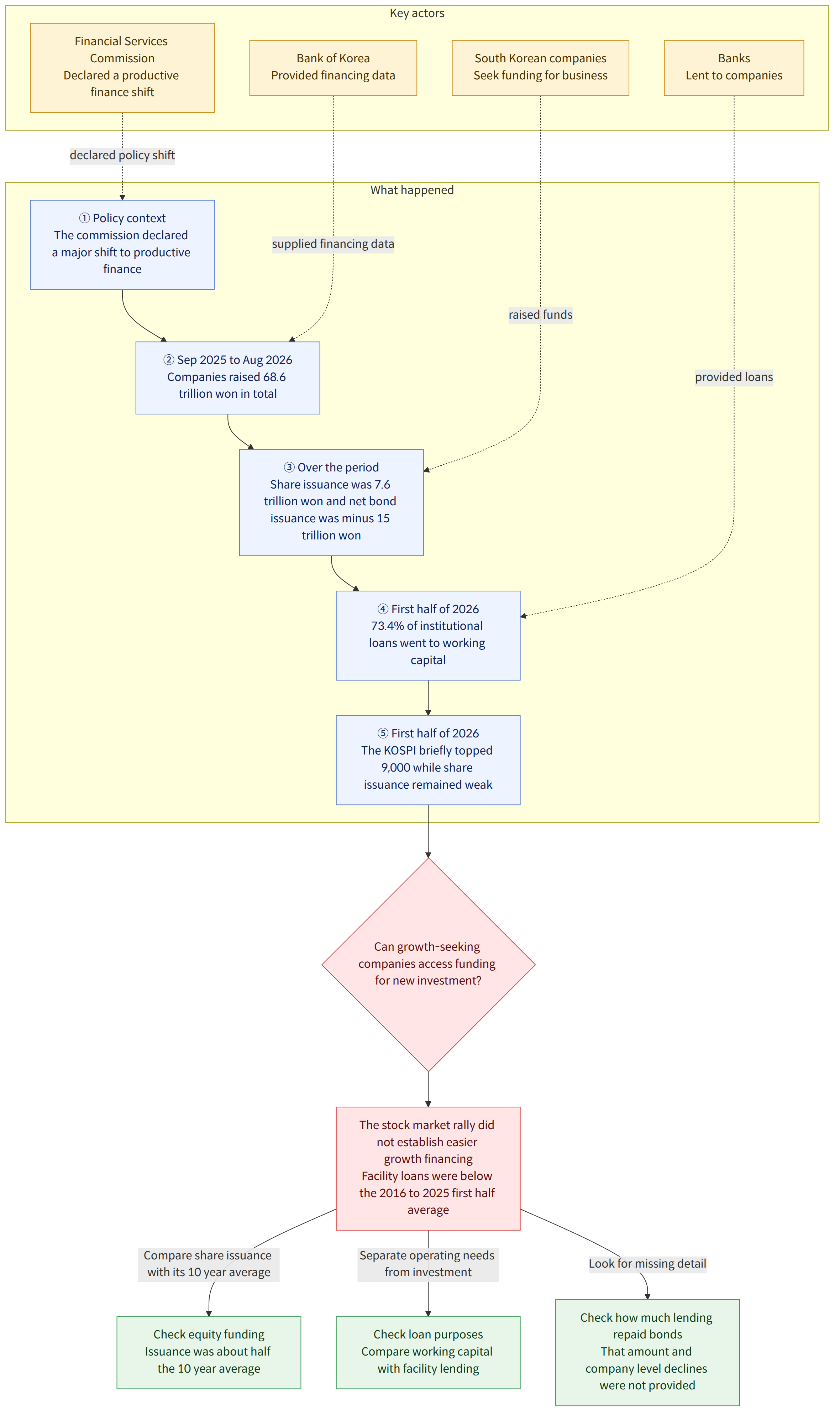
According to a report analyzing the Bank of Korea (한국은행)’s data on corporate financing, from September 2025 to August 2026—after the Financial Services Commission (금융위원회) declared a “major shift to productive finance”—South Korean companies raised about 68.6 trillion won through stock and corporate bond issuance and bank loans. That was more than the 59.3 trillion won raised in all of 2025, but about 16% less than the average of 81.8 trillion won for the previous 10 years. The stock market’s rally and companies’ ability to actually secure funding for growth were separate trends.
Background and context
The significance of corporate financing depends on how companies obtain the money. Issuing shares means offering new stock to raise funds, while corporate bonds are a way of borrowing from investors. Since funds raised directly from markets and bank loans can differ in maturity and repayment obligations, the total amount raised alone does not reveal how favorable conditions are for corporate investment.
Over the past year, companies raised 7.6 trillion won through stock issuance, about half the 10-year average of 14 trillion won. Net corporate bond issuance was minus 15 trillion won. Net issuance is the amount of corporate bonds redeemed subtracted from the amount newly issued, so a negative figure means companies repaid more than they raised during the period. The comparable 10-year average was positive 3.7 trillion won.
By contrast, financing through bank loans amounted to 76 trillion won, more than the 10-year average of 64.1 trillion won. But the increase in lending alone does not establish that more funding went toward new factories or technology development. Bank loans can also be used to repay corporate bonds or cover immediate operating needs.
This distinction is also evident in the purposes of loans in the first half of 2026. Of the 61.4871 trillion won in loans provided by deposit-taking institutions, 45.1556 trillion won, or 73.4%, went to working capital. That share was higher than the 58.1% recorded in the first half of 2025. By contrast, loans for facilities—such as factory construction and machinery purchases—totaled 16.3315 trillion won, below the average of 29.9466 trillion won for the first half of the years from 2016 to 2025. Facility loans accounted for 26.6% of all lending in the first half of the year.
What this news means
The key point is that rising stock prices should not be equated with easier access to financing for companies, particularly those seeking to grow new businesses. The stock market is divided into the secondary market, where existing shares are traded among investors, and the primary market, where companies issue new shares to raise funds. Although the KOSPI topped 9,000 briefly in the first half of 2026 amid enthusiasm for investments in “Samsung Electronics–SK Hynix,” stock issuance over the past year was about half the 10-year average. This reveals a gap: even vigorous trading in existing shares does not automatically increase the funds available to new companies.
Tae Yun-seon, a researcher at KB Securities, wrote in a July report that the IPO market had been relatively sidelined as investment flowed into a handful of large-cap stocks, including semiconductor companies. This may suggest that a rising stock market does not necessarily provide companies with equal opportunities to raise funds. However, the data provided do not show which industries or companies saw the largest declines in issuance.
The purposes of bank loans also matter when assessing the increase in lending. A Bank of Korea official quoted in the article said that many companies borrowed working capital from banks to repay corporate bonds as interest rates in the bond market rose. If this explanation is correct, some of the increase in lending went toward repaying existing debt rather than starting new investments. However, the amount of bank lending actually used to repay corporate bonds was not provided, so it should not be treated as equivalent to the entire increase in lending.
It is not enough to look at whether total corporate financing increased. We also need to consider which channels—equity, corporate bonds, or loans—companies used, and whether loans went to working capital or facility investment.
For example, if a growth company is seeking funds to acquire new equipment, whether equity issuance or long-term loans for facilities actually increased may be a more direct indicator than rising stock prices. This is an explanation based on a hypothetical scenario; the data alone cannot establish the terms on which individual companies actually obtained financing.
In March 2026, the Financial Services Commission formalized a policy direction to prohibit dual listings in principle. Since August, it has implemented rules requiring the consent of shareholders of a listed parent company to be confirmed when a subsidiary of that company seeks a new listing. The report relayed criticism that regulations intended to protect the secondary market had also contributed to a slowdown in the primary market. This is an interpretation of the policy’s effects, not evidence that the regulations alone caused the decline in stock issuance.
The report also said that the National Growth Fund (국민성장펀드) had only just begun disbursing funds, so its activity was not properly reflected in these financing figures. It is therefore too early to assess the fund’s performance from these figures alone. How corporate financing volumes and the uses of funds change after disbursements gather pace will need to be examined separately.
What is known and what remains unclear
What is known
- From September 2025 to August 2026, companies raised about 68.6 trillion won, roughly 16% less than the average for the previous 10 years.
- Over the same period, companies raised 7.6 trillion won through stock issuance, while net corporate bond issuance was minus 15 trillion won.
- Financing through bank loans amounted to 76 trillion won, above the 10-year average of 64.1 trillion won.
- In the first half of 2026, working capital accounted for 73.4% of lending, and facility loans were below the average for the first half of the previous 10 years.
What remains unclear
- The data do not show how much stock issuance declined by company or industry.
- It is not yet known how corporate financing volumes will change once disbursements from the National Growth Fund are in full swing.
- The published figures do not reveal how much of bank lending was used to repay existing corporate bonds.
What readers should check
- When assessing corporate financing trends, look beyond the total and distinguish among stock issuance, net corporate bond issuance, and bank loans. The figures for different financing channels may point in different directions.
- Do not assume that an increase in lending means more facility investment. Check the shares and amounts going to working capital and facilities as well.
- When follow-up figures become available after National Growth Fund disbursements gather pace, compare them with these figures to see what has changed. Be sure to distinguish the amount disbursed from changes in companies’ actual investment and financing.