
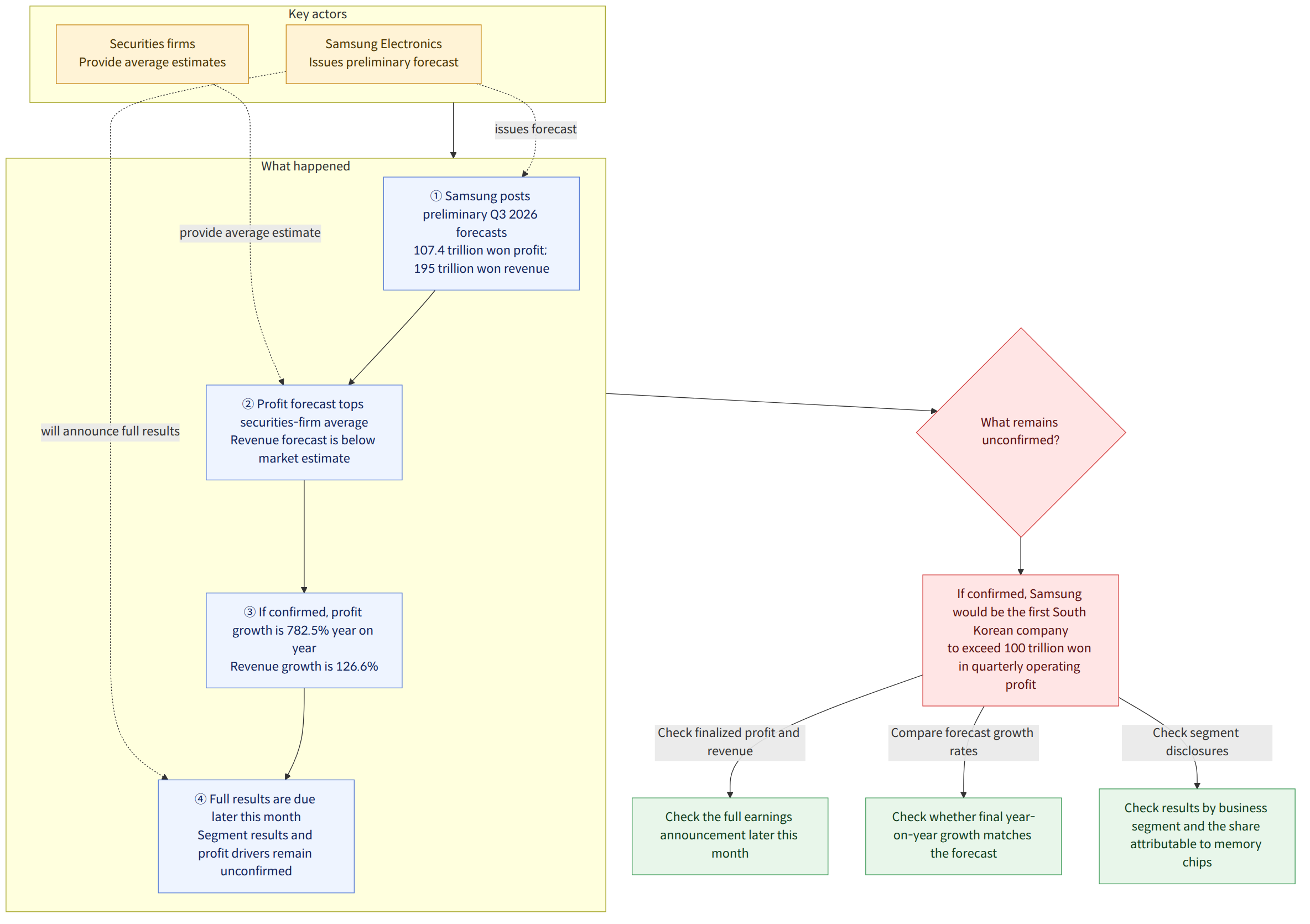
Samsung Electronics’ operating profit forecast for the third quarter of 2026 was set at 107.4 trillion won. It was reported under headlines describing a record quarterly result, but the figure is a preliminary estimate. The record will not be confirmed until the company announces its full results later this month.
The accompanying revenue forecast is 195 trillion won. According to reports, if the forecasts are confirmed, operating profit will have increased 782.5% year on year and revenue 126.6%. These growth rates, too, should therefore be read as conditional figures based on forecasts, not finalized results.
Background and context
Operating profit refers to the profit a company earns from its core business. Revenue alone does not show profitability after costs are taken into account, so looking at the revenue and operating profit forecasts together is a useful starting point for interpreting this earnings news.
The operating profit forecast was higher than the average estimate of 106.64 trillion won from securities firms. By contrast, the revenue forecast was slightly below the market estimate of 200.64 trillion won. This comparison does not mean that results exceeded expectations across the board; it shows that the profit and revenue forecasts moved in different directions.
The won had strengthened substantially compared with the previous quarter, raising concerns that this could weigh on profitability. Reports said that despite those concerns, the operating profit forecast was higher than the market estimate. However, the information provided does not establish the actual impact of the stronger won on results or what factors offset it.
What this news means
If the forecast is confirmed, Samsung Electronics will become the first South Korean company to exceed 100 trillion won in quarterly operating profit. The figure may draw attention not only as a measure of one company’s performance but also as an indicator of domestic industry trends. However, because it is still preliminary, it is important not to treat the record as already achieved before the final announcement.
For investors and readers following industry trends, it is important to consider not only the size of the profit but also how it compares with revenue and which businesses generated the results. Current reports say the company does not provide forecasts by business segment in its preliminary earnings guidance. Memory chips are widely cited as a key driver of the profit increase, but that should be distinguished from an explanation confirmed by segment-level figures.
For example, readers seeking to assess the semiconductor industry’s trajectory based on Samsung Electronics’ results should not draw conclusions about the extent of recovery in each business segment from the overall operating profit forecast alone. Their assessment can be broadened by checking whether segment-level results are disclosed after the overall figures are finalized.
What is confirmed and what is not yet known
Confirmed facts
- Reports put Samsung Electronics’ third-quarter operating profit forecast at 107.4 trillion won and its revenue forecast at 195 trillion won.
- The operating profit forecast was higher than the average securities-firm estimate of 106.64 trillion won, while the revenue forecast was slightly below the estimate of 200.64 trillion won.
- If the forecasts are confirmed, operating profit will have increased 782.5% year on year and revenue 126.6%.
- If the forecast is confirmed, it will mark the first time a South Korean company has exceeded 100 trillion won in quarterly operating profit.
What is not yet known
- Revenue and operating profit by business segment, as well as the actual share attributable to memory chips, have not been confirmed.
- It is not yet known whether the preliminary forecast will be confirmed unchanged in the final earnings announcement.
What readers should check
- Readers should check the final operating profit and revenue figures in the full earnings announcement scheduled for later this month.
- Once the final figures are announced, they can also check whether the year-on-year growth rates match those in the preliminary forecast.
- It is worth checking whether results by business segment are disclosed and interpreting the overall profit figure separately from segment-level results.
References
- Other coverage consulted: koreatimes.co.kr
- Other coverage consulted: m.koreaherald.com