
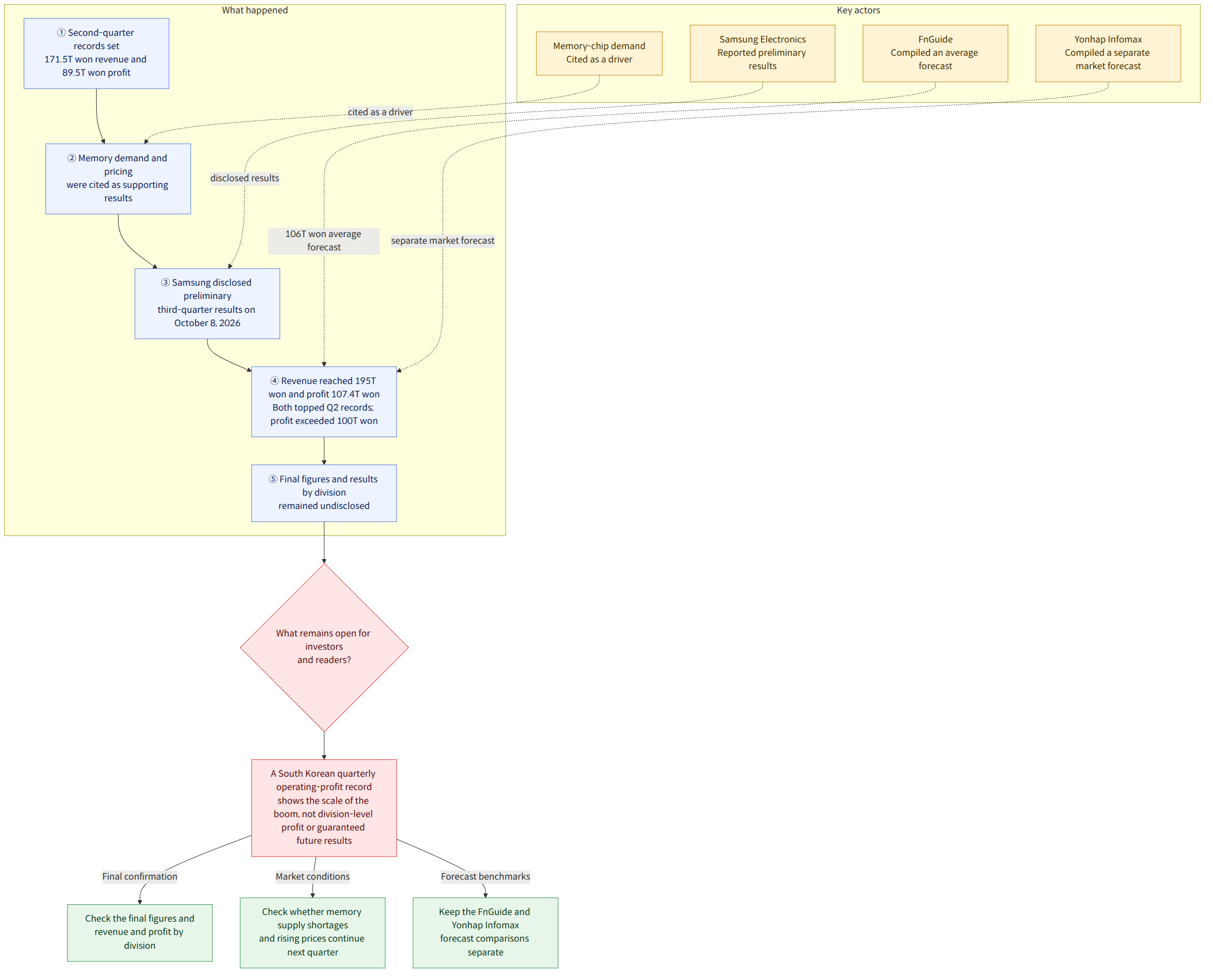
In its preliminary results disclosed on October 8, 2026, Samsung Electronics (삼성전자) reported consolidated operating profit of 107.4 trillion won for the third quarter. It is the first South Korean company to post quarterly operating profit of more than 100 trillion won. Revenue was 195 trillion won, up 126.6% from the same period a year earlier, while operating profit rose 782.5%.
These results are preliminary. Although both revenue and operating profit exceeded second-quarter records, final figures and results by business division have not yet been disclosed.
Background and context
Both third-quarter revenue and operating profit surpassed the previous records set in the second quarter of 2026. Second-quarter revenue was 171.5 trillion won and operating profit was 89.5 trillion won. By comparison, third-quarter revenue increased 13.7% from the previous quarter, and operating profit rose 20%. Reports said Samsung Electronics extended its all-time quarterly records for both revenue and operating profit for a fourth consecutive quarter.
The memory business in the semiconductor division was cited as a factor behind the results. Reports said demand for commodity DRAM, enterprise eSSDs (enterprise solid-state drives) and HBM (high-bandwidth memory) boosted profitability. Another report said ongoing investment in AI infrastructure sustained semiconductor supply shortages and rising memory prices, supporting the results.
The company’s preliminary figures were also compared with securities firms’ forecasts. One report said they were slightly above the average operating-profit forecast of 106 trillion won compiled by FnGuide (에프앤가이드).
What this news means
Quarterly operating profit of 107.4 trillion won shows how strongly memory-chip demand and pricing conditions can be reflected in the results of a major company. But this is the company’s total operating profit, not the profit of its semiconductor division alone. The preliminary results also do not include net income, so this figure by itself cannot establish the company’s final profit or loss or the contributions of individual business divisions.
For investors and readers interested in Samsung Electronics’ results, it matters not only that the company set a record, but also which products and market conditions produced it. Reports cited demand for memory products, supply shortages and rising prices as key factors, but it has not been confirmed whether these conditions will continue into the next quarter. It is therefore important to distinguish preliminary results from market conditions, rather than interpreting the results as meaning that the same level of profit will recur in the future.
For example, if memory supply shortages and price increases continue, they could affect the company’s results. The available information does not allow us to conclude what would happen if those conditions do not persist. This describes a possible scenario; it does not mean that future results have been determined.
Reports cited Saudi state-owned oil company Aramco’s second-quarter 2022 operating profit of $86.5 billion as a global example of quarterly operating profit exceeding 100 trillion won. Rather than comparing the figures directly by amount despite their different currencies, it is more appropriate to focus on the fact that Samsung Electronics’ preliminary results set a new quarterly operating-profit record for a South Korean company.
Differences in how reports presented the figures
Reports used different benchmarks when comparing the operating-profit forecast. One said the result was slightly above the 106 trillion won average compiled by FnGuide, while another said it was 1.6% higher than the average market forecast compiled by Yonhap Infomax (연합뉴스 인포맥스). The two figures were compiled by different organizations, so they should not be combined or treated as if they were based on the same measure.
What is confirmed and what remains unknown
Confirmed facts
- Samsung Electronics’ preliminary revenue for the third quarter of 2026 was 195 trillion won, and its operating profit was 107.4 trillion won.
- Revenue increased 126.6% from the same period a year earlier, and operating profit rose 782.5%.
- Both figures exceeded second-quarter results; revenue was up 13.7% and operating profit was up 20% from the previous quarter.
- Reports said demand for memory products drove the results.
What remains unknown
- What will the final confirmed figures for the preliminary results be?
- What were the revenue and operating profit of each business division?
- Will memory supply shortages and rising prices continue in subsequent quarters?
What readers should check
- Check whether the preliminary figures were confirmed or revised in the company’s final earnings announcement.
- Once results by business division are disclosed, check how much of total operating profit came from the semiconductor division.
- When reviewing the next earnings results, check not only demand for memory products but also whether supply shortages and price increases continued.
References
- Other coverage consulted: en.yna.co.kr
- Other coverage consulted: m.koreaherald.com