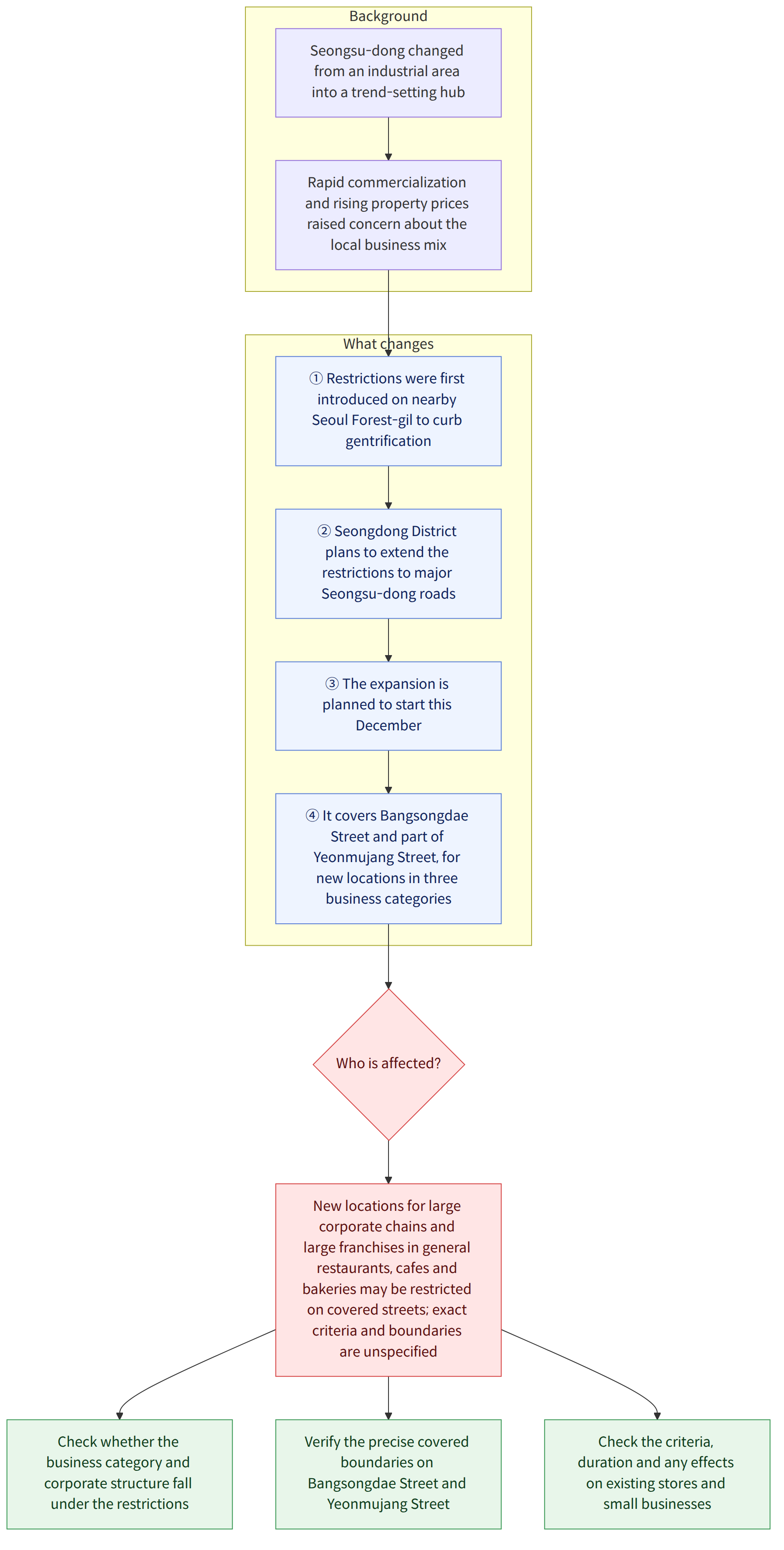
Starting this December, Seongdong District (성동구) plans to expand regulations restricting new locations for mega-chains affiliated with large corporations and large franchises on major roads in Seongsu-dong. The areas covered include Bangsongdae Street (방송대 거리) and part of Yeonmujang Street (연무장 거리), and the restricted business categories are general restaurants, cafes and bakeries. The regulations, first introduced on nearby Seoul Forest-gil (서울숲길) to prevent gentrification—the displacement of existing local merchants and residents as rents rise and for other reasons—will be extended to major streets.
Background and context
Seongsu-dong was once an industrial area with factories, shoe workshops and auto repair shops. Because of its mix of repurposed factories and youth culture, it is sometimes called “the Brooklyn of Seoul.” Over the past 10 years, it has transformed from a quiet neighborhood into one of Korea’s trend-setting hubs, with local boutiques, coffee roasters and pop-up stores drawing fashion-conscious young people and overseas tourists.
This change has attracted visitors but has also brought the burden of sharply rising property prices into focus. Seongdong District is expanding the regulations in an effort to prevent Seongsu-dong from turning into a uniform commercial strip dominated by large chains. According to the article, the policy was developed based on lessons learned in other parts of Seoul. However, the available reporting does not make clear what happened in those areas or which specific lessons were incorporated.
The measure is not described as a restriction on all new stores or all franchises. The report specifies new locations for mega-chains affiliated with large corporations and large franchises, as well as three business categories: general restaurants, cafes and bakeries. When considering the scope of the regulations, it is therefore important to distinguish this policy—which restricts new entry by large corporate chains in certain business categories—from a measure that blocks commercial activity across all of Seongsu-dong.
What this news means
The regulation’s direct effect is that it could change which kinds and sizes of businesses are allowed to open on some streets in Seongsu-dong. Limiting new locations for large franchises could help preserve a commercial mix centered on local boutiques and independent stores. The measure is noteworthy as an effort to protect the neighborhood atmosphere that has drawn visitors to Seongsu-dong.
However, the available facts are not enough to determine whether the regulations alone will ease rising property prices or the burden on existing merchants. It is also unclear whether the restrictions apply to existing stores or what effect they will have on small businesses. The policy’s stated aim and its actual impact should be considered separately.
For example, if a business owner wants to open a new cafe on a road covered by the regulations, the business’s eligibility could depend not only on its category but also on whether it qualifies as a chain affiliated with a large corporation or as a large franchise. However, no specific size criteria or boundaries for the restrictions have been provided, so this example cannot determine whether any individual business would be allowed to open.
What is confirmed and what remains unknown
Confirmed facts
- Starting in December, Seongdong District plans to expand restrictions on new large-franchise locations to major arterial roads in Seongsu-dong.
- The expansion will include Bangsongdae Street and part of Yeonmujang Street.
- The restricted business categories are general restaurants, cafes and bakeries.
- The regulations were first introduced on nearby Seoul Forest-gil to curb gentrification.
What remains unknown
- What size or other criteria will determine whether a business is classified as a chain affiliated with a large corporation or as a large franchise?
- What are the precise boundaries of the roads covered by the expanded regulations, and how long will they remain in effect?
- What effects will the regulations have on existing stores and small businesses?
- What actual changes will occur in the local business mix or property prices after the regulations take effect?
What readers should check
- Businesses planning to open or relocate a store in Seongsu-dong should check whether their business category and corporate structure fall under the regulations.
- Anyone considering a location around Bangsongdae Street or Yeonmujang Street should verify the precise boundaries of the covered area, which has only been described as including “part” of these streets.
- Ahead of the December start date, readers should watch for separate announcements specifying the criteria for affected businesses and the duration of the regulations. Based on the available reporting, it is difficult to determine whether any individual store will be covered.