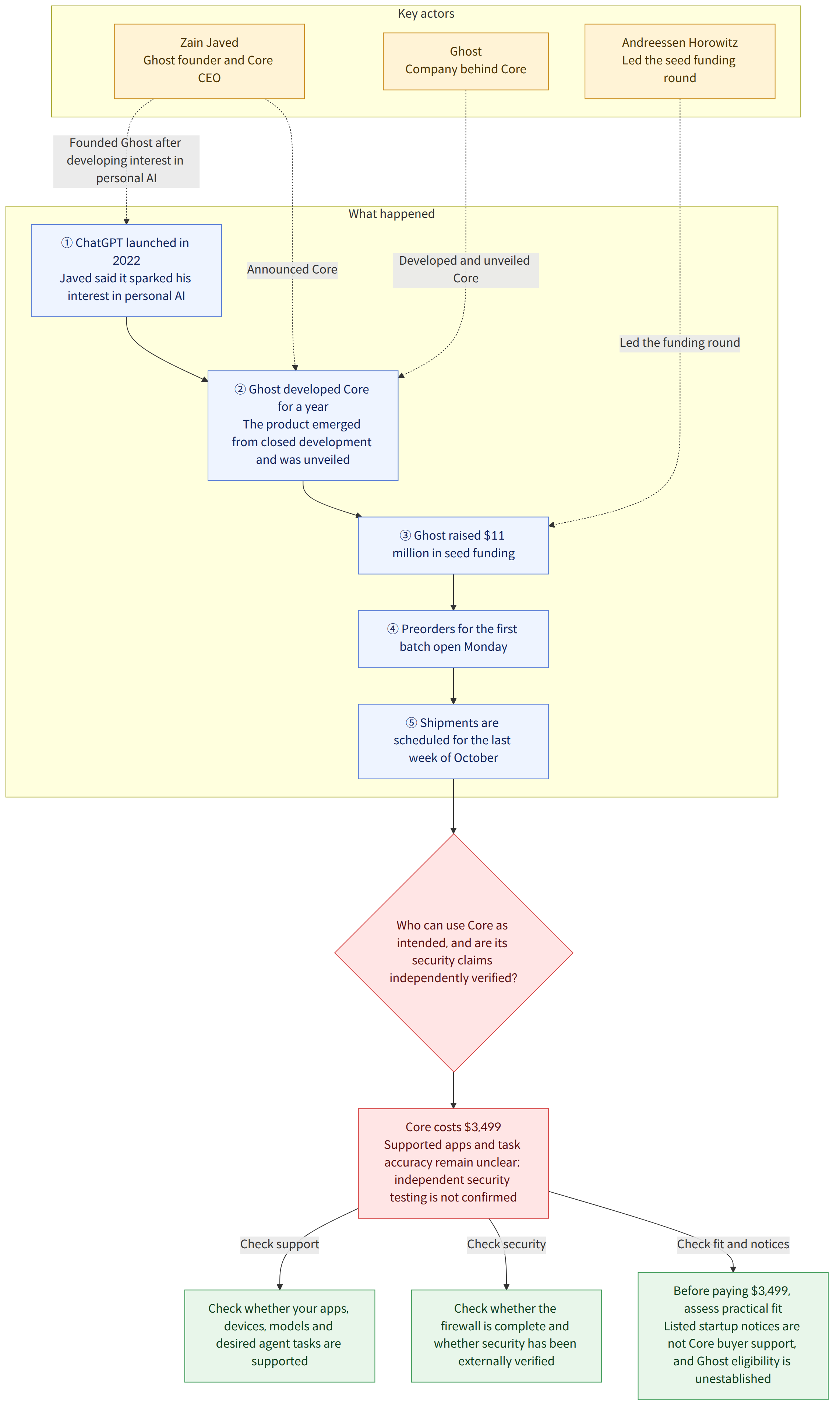
Ghost unveiled Core, a personal computer designed to let AI agents act on users’ behalf. Zain Javed, 19, Ghost’s founder and Core’s CEO, announced that the product had completed a year of development and emerged from a closed development phase. The company also raised $11 million in seed funding led by Andreessen Horowitz. Core is priced at $3,499. Preorders for the first batch open Monday, with shipments scheduled for the last week of October.
Background and context
Javed said he became interested in personal AI after ChatGPT launched in 2022. He said that interest led him to found Ghost. The co-founding team also includes Nicholas Chua, 19, Yifei Chen, 24, and Gautam Sharda, 23. Abstract, Audacious Ventures, SV Angel and Nova also participated in the funding round.
Core is a computer without a screen. Users connect to the device by phone or app, and to use voice mode they must speak to the Core app, not the device itself. Javed said Core has its own software layer, browser and file system, and is designed to continuously process information and carry out tasks.
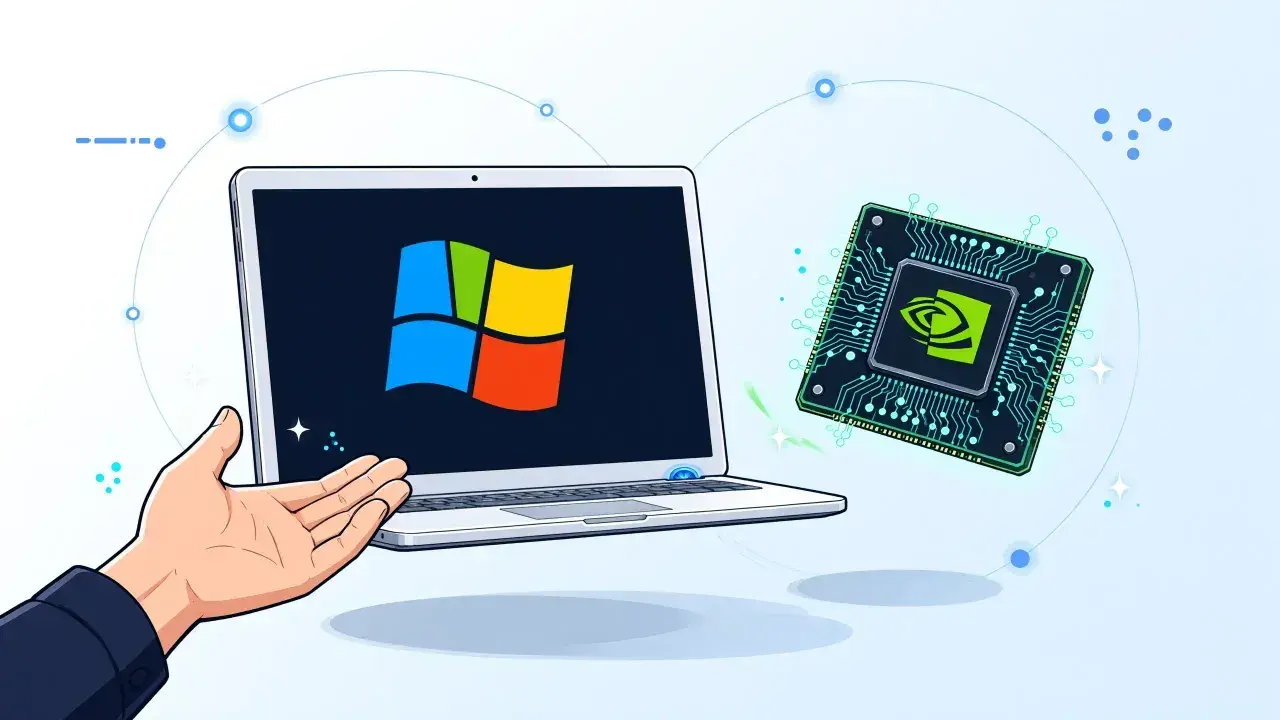
The product includes an Nvidia RTX Pro 4000 SFF Blackwell GPU (a graphics processing unit used to run AI models, among other things). According to Javed, the GPU is included in the price, so it does not need to be purchased separately. The Qwen-3.8-Next, Qwen-3.8-27B and Gemma-4-31B models come preinstalled. Users can install other models from Hugging Face or upload models they have trained themselves.
Javed described Core as a product that combines hardware and software specifically configured to run AI agents. He said this distinguishes it from setting up AI tools separately on a general-purpose computer. He also said model updates can be delivered over the air, and that when a new model becomes available, users can choose whether to switch or enable automatic updates.
What this news means
Core’s central premise is to bring together, in a single personal computer, an environment where AI agents can consult multiple sources of information and carry out real-world tasks. Ghost has outlined a plan to bring together data from users’ desktops, apps and even smart-home devices. However, the information disclosed so far does not show which apps or smart-home devices are actually supported, or what tasks the agents can perform and how accurately.
For consumers, the way the product is used matters as well as the price. Because the device has no screen and users must connect through a phone or app, using Core may be different from directly operating a conventional computer. Before paying $3,499, buyers should check whether the apps, models and tasks they use are actually supported.
Security and privacy have been presented as distinguishing features of the product, but the evidence available so far consists of the founder’s statements. Javed said models and personal memories run on the device, and that personal information is encrypted so that third parties, including cloud providers and Ghost, cannot meaningfully access it. He also said source code, logic and model weights are stored on the device rather than in a service. These are design policies described by the company; they do not mean that independent security testing has been confirmed.
Javed said Ghost is developing a firewall to limit how agents use credentials such as login information and passwords. The source says the firewall monitors the computer’s external network requests and rejects requests it considers problematic, asking the user to review them. However, it remains unclear whether the feature is complete or whether its security performance has been externally verified.
For example, someone who wants to use AI to handle repetitive tasks by referring to personal work documents might be interested in Core’s local-processing approach. But unless it is confirmed that those documents can be retrieved from the apps they actually use, that the desired agent tasks are possible, and that the credential-limiting feature works under the relevant conditions, the product’s concept alone cannot guarantee practical value.
Related programs and support information
The notices below are separate programs that domestic startups can consult if they are developing similar technologies or preparing to expand overseas; they are not support programs for Core buyers. There is no basis for concluding that Ghost is eligible for these programs.
- G1 — 2026 LX Semicon–Chungnam Center for Creative Economy and Innovation Nexus Connect Open Innovation Meetup Day (2026년 LX세미콘·충남창조경제혁신센터 Nexus Connect 오픈이노베이션 밋업 데이): Open to startups nationwide that have been in business for less than seven years as of the notice date, with a focus on identifying AI and deep-tech startups. The program offers one-on-one technical meetings with relevant departments, consideration for next year’s proof of concept (PoC—a process for checking whether a technology works in a real-world environment) and joint commercialization, as well as links to investment. The application deadline listed in the notice is October 5, 2026.
- G3 — 2026 Ulsan Startup Festa (USF) TOP 5 (2026년 울산 스타트업 페스타(USF) TOP 5): Technology-based startups from any region that have been in business for no more than seven years as of the notice date may apply. The notice lists cash prizes, awards and follow-up support for the finalist winners. The application deadline listed in the notice is October 6, 2026.
- G2 — Second Half of 2026 Seoul Business Agency (SBA; 서울경제진흥원) Tailored Kibo-Star Valley Companies (Overseas Expansion Linkage) (2026년 하반기 SBA 맞춤형 Kibo-Star밸리기업(해외진출연계)): Startups recommended by the Seoul Business Agency must meet the Korea Technology Finance Corporation (기술보증기금) requirements for selection as a Kibo-Star Valley company. The notice lists preferential terms including tiered financial support linked to sales performance, a maximum limit of 3 billion to 5 billion won, a fixed guarantee fee of 0.7%, and a 100% guarantee ratio. The support period is three years from selection and includes connections to overseas expansion programs. The application deadline listed in the notice is October 6, 2026.
What is confirmed and what remains unknown
Confirmed facts
- Ghost completed a year of development, emerged from a closed development phase and raised $11 million in seed funding.
- Core was introduced as a personal computer for AI agents and is priced at $3,499.
- It has no screen; users connect by phone or app, and use voice mode through the Core app.
- Javed described running models and personal memories on the device, encrypting personal information, and developing a firewall to limit the use of credentials.
What remains unknown
- The evidence disclosed so far does not state how many devices are in the first batch or which regions can place orders and receive shipments.
- It has not been confirmed whether the device’s data protection and the agent firewall’s security features have been independently verified.
- The product’s real-world performance and the range of supported apps and smart-home devices have also not been specified.
What readers should check
- Before ordering, check the size of the first batch, eligible delivery regions and whether the delivery schedule applies to your location.
- Check whether Core supports the apps and models you use regularly, and whether models or agents you install yourself can carry out the tasks you need.
- Find out what privacy protections and firewall features will be available when the product launches, and whether there are any external verification results.
References
- 2026 LX Semicon–Chungnam Center for Creative Economy and Innovation Nexus Connect Open Innovation Meetup Day: Recruitment of Participating Companies
- Seoul Second Half of 2026 SBA Customized Kibo-Star Valley Company Support Plan (Overseas Expansion Linkage)
- 2026 Ulsan Startup Festa (USF) TOP 5: Call for Participants