
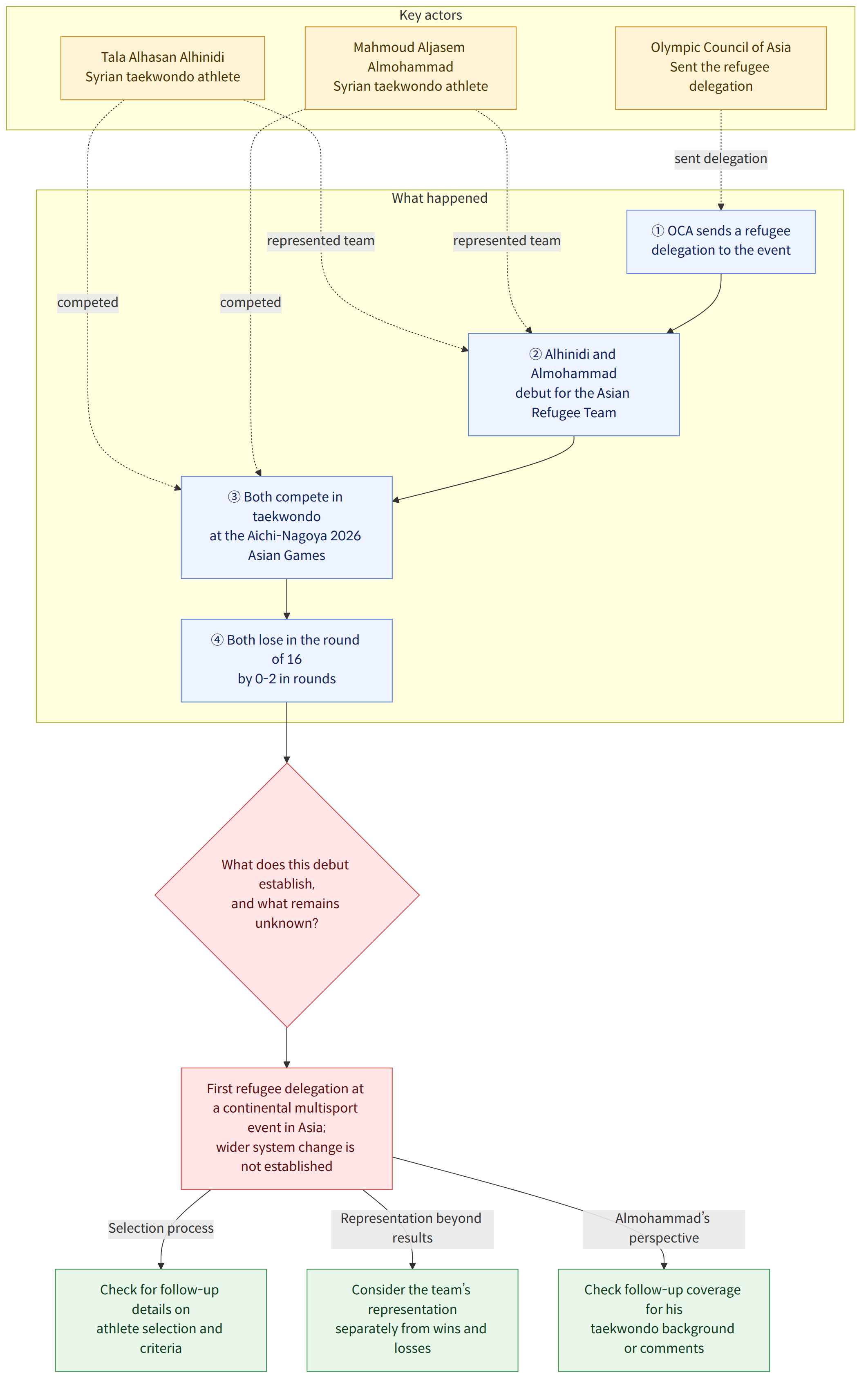
Syrian taekwondo athletes Tala Alhasan Alhinidi and Mahmoud Aljasem Almohammad competed as members of the Asian Refugee Team (아시아 난민팀) at the Aichi-Nagoya 2026 Asian Games. Eighteen-year-old Alhinidi competed in the women’s under-49kg division, while 24-year-old Almohammad competed in the men’s under-80kg division. Both were eliminated in the round of 16.
Alhinidi lost to China’s Ma Jingwei by a 0-2 score in rounds, and Almohammad lost to South Korea’s Kang Jaegwon by the same score. In terms of results, both athletes’ runs ended in the round of 16, but their participation was described as the first time athletes from the Asian Refugee Team had competed at the Asian Games.
Background and context
The event was reported to be the first time the Olympic Council of Asia (올림픽평의회, OCA) had sent a refugee delegation to a continental multisport event. The two athletes were described as the first to represent the Asian Refugee Team at the Asian Games, one of the biggest sporting stages in Asia.
Their participation therefore touches on not only wins and losses, but also the question of who gets to be represented at the event. Both athletes lost their matches, but the fact that refugee athletes competed as team representatives at a major Asian sporting event is worth noting apart from the scoreboard.
What this news means
This case shows that refugee athletes can be represented on the international sports stage. However, their participation cannot be taken as evidence that opportunities or systems have changed for refugee athletes as a whole. What is confirmed is that two athletes from the Asian Refugee Team competed in taekwondo at this Asian Games, and that this was the first time the OCA had sent a refugee delegation to the event.
In a statement released by World Taekwondo (세계태권도연맹, WT), Alhinidi said taekwondo had become a window of hope, and that being a refugee did not define or limit her future. Her statement shows what participation and taekwondo meant to her, separately from the competition results.
For example, a young person with a refugee background who hears about this story might see it as an example that refugee identity and future possibilities do not necessarily mean the same thing. This is an interpretation drawn from what Alhinidi said, not a claim that it will have the same effect on every young refugee.
Confirmed facts and what remains unknown
Confirmed facts
- Alhinidi and Almohammad are from Syria and competed in taekwondo at the Aichi-Nagoya 2026 Asian Games.
- Alhinidi competed in the women’s under-49kg division, and Almohammad in the men’s under-80kg division.
- Both athletes lost in the round of 16 by a 0-2 score in rounds.
- According to reports, this was the first time the OCA had sent a refugee delegation to a continental multisport event.
What remains unknown
- Through what selection process and procedures were the two athletes chosen to compete as members of the Asian Refugee Team?
- What does taekwondo mean to Almohammad? The provided original text does not include his related explanation in full, so this cannot be confirmed.
What readers can look for
- Further explanations of the athletes’ selection process or criteria would provide a clearer understanding of how this delegation was formed.
- Considering the Asian Refugee Team’s representation separately from the athletes’ results can help avoid judging their participation solely by wins and losses.
- The information provided does not reveal Almohammad’s taekwondo experience or comments, so if these are included in follow-up coverage, they should be considered separately from Alhinidi’s statement.