
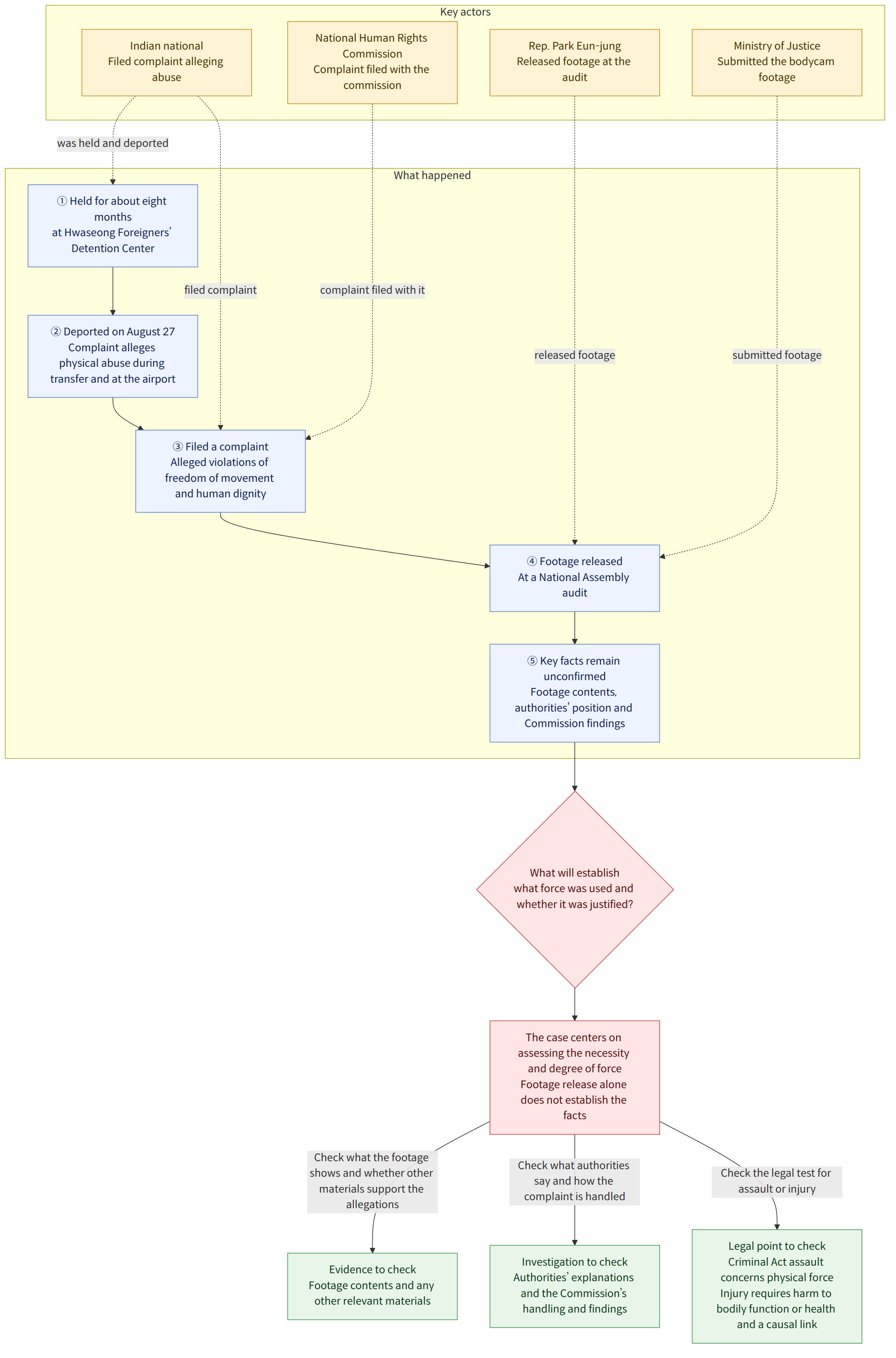
An Indian national has filed a complaint with the National Human Rights Commission of Korea (국가인권위원회), alleging that he was physically abused during his deportation. The man claims that his freedom of movement and human dignity were violated. On Thursday, Rep. Park Eun-jung (박은정) of the Cho Kuk Innovation Party (조국혁신당) released bodycam footage from the deportation, submitted by the Ministry of Justice (법무부), at a National Assembly audit (국정감사).
The complaint alleges that the man was handcuffed, had duct tape placed over his mouth, and was physically abused after arriving at the airport, including being slapped and choked. These are allegations described in reports to date; it has not been confirmed that abuse occurred or that the footage supports the claims.
Background and context
According to the complaint, the man had been held for about eight months at the Hwaseong Foreigners’ Detention Center (화성 외국인보호소) before being deported on August 27. The facility is about 40 kilometers south of Seoul. According to the report, the Immigration Control Act (출입국관리법) allows foreign nationals subject to deportation to be held in such facilities for up to nine months.
The reported detention period was therefore shorter than the maximum period cited in the law, but the length of detention alone cannot establish whether the detention or deportation process was appropriate. The central issue raised in the complaint is the man’s physical treatment while being taken from the detention center to the airport and just before his deportation. The allegations in the complaint and whether the actions taken at the time were justified require separate verification.
The release of bodycam footage at the audit by Rep. Park is notable because material for examining the case has been presented. But the fact that the footage was released does not reveal its contents or whether it matches the complaint. Reports made public so far do not say what scenes the footage shows or what explanation the Ministry of Justice and immigration authorities have given.
What this news means
The issue is how the necessity and degree of force used by public authorities during deportation procedures will be established. The mere fact that a person was physically restrained during deportation does not determine whether the actions were unlawful; the specific conduct and circumstances must also be examined. The details needed to make that assessment are not available from current reporting.
Now that a complaint has been filed, an investigation and finding by the National Human Rights Commission could involve examining relevant materials and the authorities’ explanations, as well as the man’s allegations. However, reports have not said how the Commission will handle the complaint or when investigation results might be released. The release of the bodycam footage does not, by itself, amount to a conclusion about the facts.
For example, if the alleged conduct is confirmed by the footage or other materials, the necessity of the force used at the time and any resulting physical harm could be examined together. Conversely, if the footage captures only part of the situation, other materials and the accounts of those involved may need to be reviewed. This describes possible lines of inquiry; it does not establish what the footage actually shows or what the investigation will find.
Relevant legal framework and support information
According to an internal legal guide, under the Criminal Act (형법), assault is the use of physical force against a person, while injury involves harm to a person’s bodily function or health. Therefore, even if the complaint’s allegations that the man was slapped or choked are confirmed, determining whether the conduct could legally constitute assault or injury would require examining the specific acts, any harm to his health, and the causal link between the acts and the outcome. The presence or absence of external injuries alone does not automatically determine whether an injury occurred.
Another guide explains that the state may be held liable to pay compensation if a public official, intentionally or negligently, violates the law while performing official duties and causes harm. However, the requirements, including a causal link between the breach of an official duty and the harm, must be established; compensation is not automatically granted simply because an official’s conduct is alleged to have been improper. This is general legal guidance and does not mean that the requirements for state compensation have been met in this case.
Reported allegations must be distinguished from legal findings. Until the complaint has been investigated and the facts established, it cannot be concluded that assault, injury or state liability for compensation has been established.
Points reported differently by different outlets
Reports differ in how they describe who filed the complaint. One report said the Indian national filed a complaint with the National Human Rights Commission, while another said the man’s legal representative filed it. It has not been confirmed whether the two reports describe the same complaint differently or whether a representative was involved in the filing process.
What has been confirmed and what remains unknown
Information reported and contained in the complaint
- An Indian national filed a complaint with the National Human Rights Commission, alleging physical abuse during his deportation.
- According to the complaint, the man had been held for about eight months at the Hwaseong Foreigners’ Detention Center before being deported on August 27.
- The complaint alleges that he was handcuffed, had duct tape placed over his mouth, and was slapped and choked at the airport.
- On Thursday, Rep. Park Eun-jung released bodycam footage from the deportation, submitted by the Ministry of Justice, at a National Assembly audit.
What remains unknown
- How the National Human Rights Commission will handle the complaint and what findings it will make.
- What scenes the bodycam footage contains and whether they match the allegations in the complaint.
- What position the Ministry of Justice and immigration authorities have taken on the man’s allegations and the footage.
- What physical actions actually took place and what harm, if any, the man suffered as a result.
What readers should look for
- Whether updates on the Commission’s investigation and findings are released. Current reports do not provide an outcome or timeline.
- Whether the full contents of the bodycam footage and explanations from the Ministry of Justice and immigration authorities are made public. The fact that footage has been released and a finding that it proves the allegations are separate matters.
- In similar cases, specific conduct, physical harm, causation and whether an official duty was breached may be central to assessing legal liability. Relevant legal guides set out general standards and do not determine the outcome of an individual case.
References
- Guide to Bodily Injury, Assault, and Self-Defense under the Criminal Act
- Guide to State Compensation Claims: Requirements and Responsible Parties
- Other coverage consulted: en.yna.co.kr
- Other coverage consulted: m.koreaherald.com