
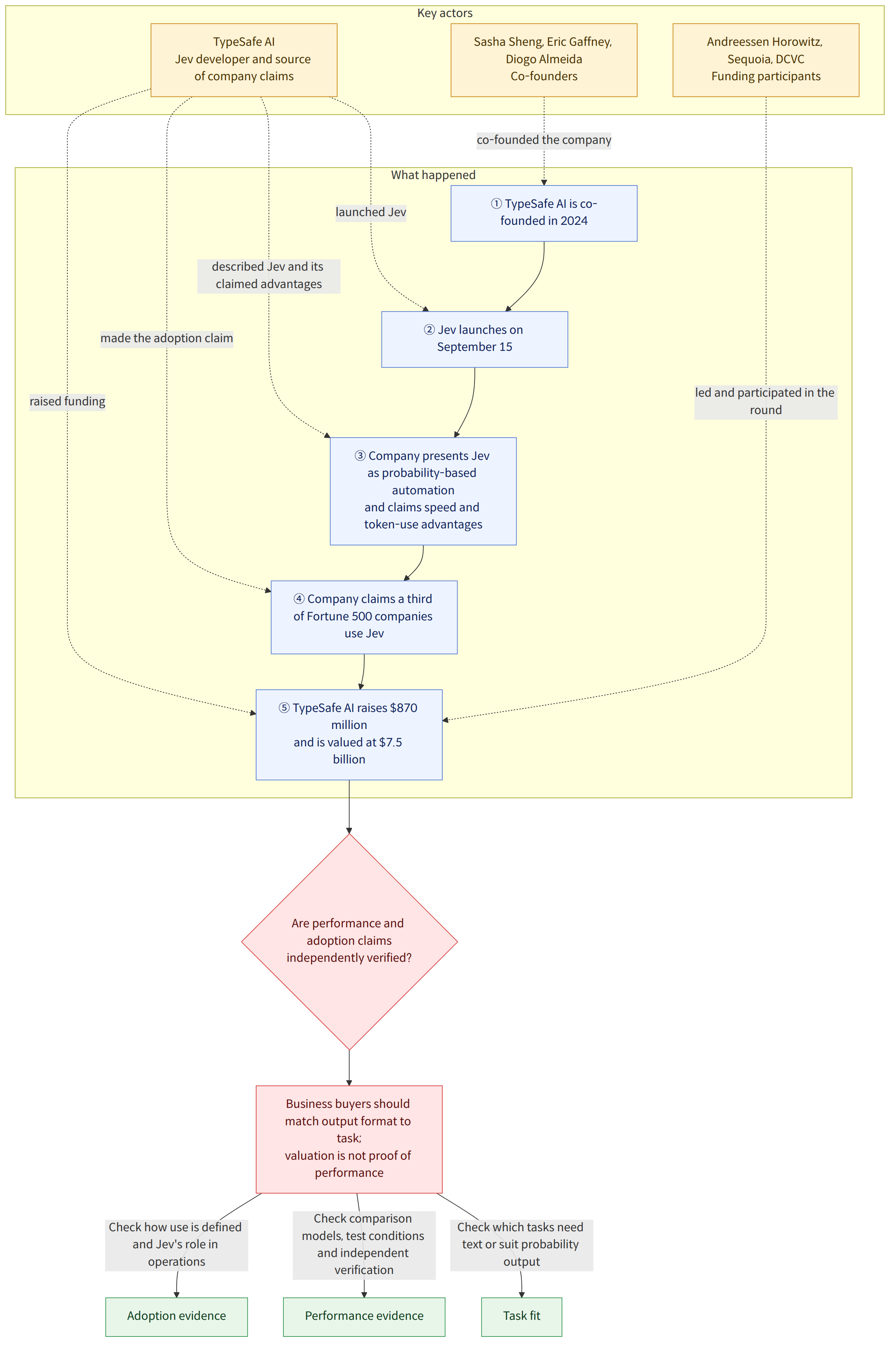
Startup TypeSafe AI, which says it plans to use probabilities instead of generating text or code when building AI models to automate tasks, has raised $870 million. In the funding round, the company was valued at $7.5 billion. The investment was led by Andreessen Horowitz, with participation from Sequoia and existing investor DCVC.
Background and context
TypeSafe AI’s model, Jev, gained popularity quickly in the weeks after its launch on September 15. The company claims that a third of Fortune 500 companies are already using Jev. This is the company’s account of the scale of enterprise adoption cited in the article; it does not specify what qualifies as “adoption.”
Jev is based on the transformer architecture (a structure for AI models that process input information), but it is not a large language model (LLM—a model trained on large amounts of language data and primarily used to work with text). Jev outputs probabilities instead of text, which TypeSafe AI calls “calibrated decisions.” The company claims Jev is much faster than LLMs and uses far fewer tokens (units of text processed by a model).
This difference is tied to the use case TypeSafe AI promotes. The company says Jev is suited to automating tasks rather than generating text or code. Co-founder Diogo Almeida told TechCrunch that being proficient in human language is not useful for automation because computers use a different language from humans.
TypeSafe AI was co-founded in 2024 by former Meta research engineer Sasha Sheng and engineer and entrepreneur Eric Gaffney. Almeida was also identified as a co-founder and previously worked as a researcher at OpenAI. Jev’s focus on automating enterprise tasks rather than generating text is part of the context for the attention around the company’s large funding round and claims of enterprise adoption.
What this news means
The news suggests that when evaluating AI for business use, it may be important to consider not only how naturally it generates text but also which output format is suitable for a particular task. However, investment and company valuation are not the same as independent proof of a model’s performance.
For example, a company considering automation to read documents and assign them to set task categories could assess whether sentence generation is necessary and whether probability-based output fits the work. This is a hypothetical example; the article does not say how Jev has performed on any specific task.
The claims that Jev is faster, uses fewer tokens and is used by a third of Fortune 500 companies come from the company. The article provides no independent performance verification or specific criteria for what counts as adoption.
What is confirmed and what remains unknown
Confirmed facts
- TypeSafe AI developed Jev, raised $870 million and was valued at $7.5 billion.
- The funding round was led by Andreessen Horowitz, with participation from Sequoia and existing investor DCVC.
- Jev is based on the transformer architecture but is not an LLM; it outputs probabilities instead of text.
- TypeSafe AI describes Jev as a model suited to automating tasks rather than generating text or code.
What remains unknown
- The article does not say how TypeSafe AI plans to use the $870 million it raised.
- It has not been established whether independent performance test results support the company’s claims about Jev’s speed and token use.
- It is unclear what criteria and number of companies are behind the claim that a third of Fortune 500 companies use Jev.
What readers should check
- Anyone considering Jev should first distinguish whether the task requires text generation or is better suited to automation using probabilities.
- When assessing the company’s claims about speed and token use, readers should check the comparison models, measurement conditions and whether the results have been independently verified.
- When evaluating enterprise adoption, it is important to check how “use” is defined and what role the model actually plays in business operations.