
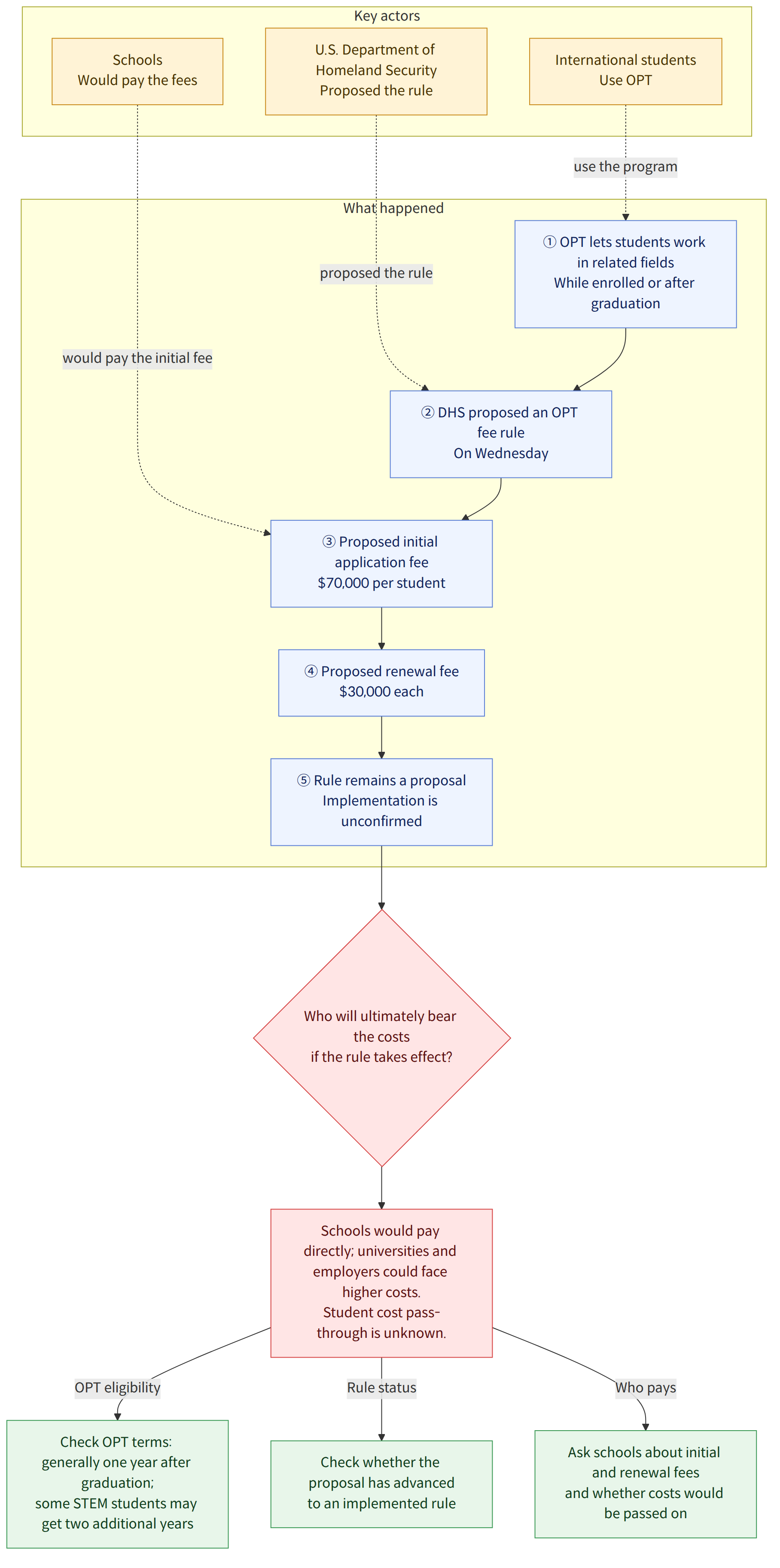
On Wednesday, the U.S. Department of Homeland Security (미국 국토안보부; DHS) proposed a rule that would charge schools a $70,000 fee for each student in connection with international students’ employment in the United States. Under the proposal, schools would pay $70,000 for a student’s initial application to participate in Optional Practical Training (선택실무훈련, OPT) and $30,000 for each renewal. The rule is still at the proposal stage, and its implementation has not been confirmed.
Background and context
OPT is a program that allows international students to work in jobs related to their field of study while enrolled or after graduation. Students generally qualify for one year of OPT employment after graduation, and some students in science, technology, engineering and mathematics (STEM) fields may receive an additional two years.
The proposal would charge schools, not the individual students who use OPT. However, because it sets different amounts for initial applications and renewals, if implemented as proposed, it would require schools to pay for each OPT application and renewal.
The report said the proposed change could affect not only U.S. universities that actively recruit international students and earn tuition revenue from them, but also technology companies and other industries that employ large numbers of international students in technical jobs.
What this means
Schools are the parties that the proposal would require to pay the fees directly. If the rule takes effect, the costs for schools that recruit students participating in OPT or process related applications could increase, and companies that hire many international students could also be affected in their efforts to secure workers. However, based on the information available, it is not possible to determine whether the costs would be reflected in tuition or other student expenses.
For example, if a university supports an application from a student seeking to work in the United States through OPT, under the proposed rule the university could be responsible for a $70,000 fee for that student’s initial application. It is not yet known, however, whether the cost would be passed on to the student, absorbed by the university, or lead to any changes in student recruitment or hiring decisions.
The proposed fees are structured as a cost for schools, but it is not yet known how much students or companies would actually have to pay.
What is confirmed and what remains unknown
Confirmed facts
- On Wednesday, the U.S. Department of Homeland Security proposed a fee rule related to OPT.
- The proposal would require schools to pay a fee for each student participating in OPT.
- Schools would be required to pay $70,000 for a new student’s initial application and $30,000 for each renewal.
- OPT is a program that allows students to work in jobs related to their field of study while enrolled or after graduation, and generally provides one year of eligibility after graduation.
- Some students in STEM fields may receive an additional two years of OPT after graduation.
What remains unknown
- When and through what process a decision will be made on whether to implement the proposed rule
- How students’ or schools’ actual costs would change if schools pay the fees
- How universities, companies and student groups respond to the proposed rule
- Whether the proposed amounts or method of application will remain unchanged in the final rule
What readers should check
- If you are preparing to work in the United States through OPT, make sure to distinguish this proposal from a finalized rule.
- When contacting your school, ask separately what fees have been proposed for initial applications and renewals, and whether the school would pass them on to students.
- Universities and companies should check whether a decision has been made on implementing the proposed rule and who would bear the final costs.