



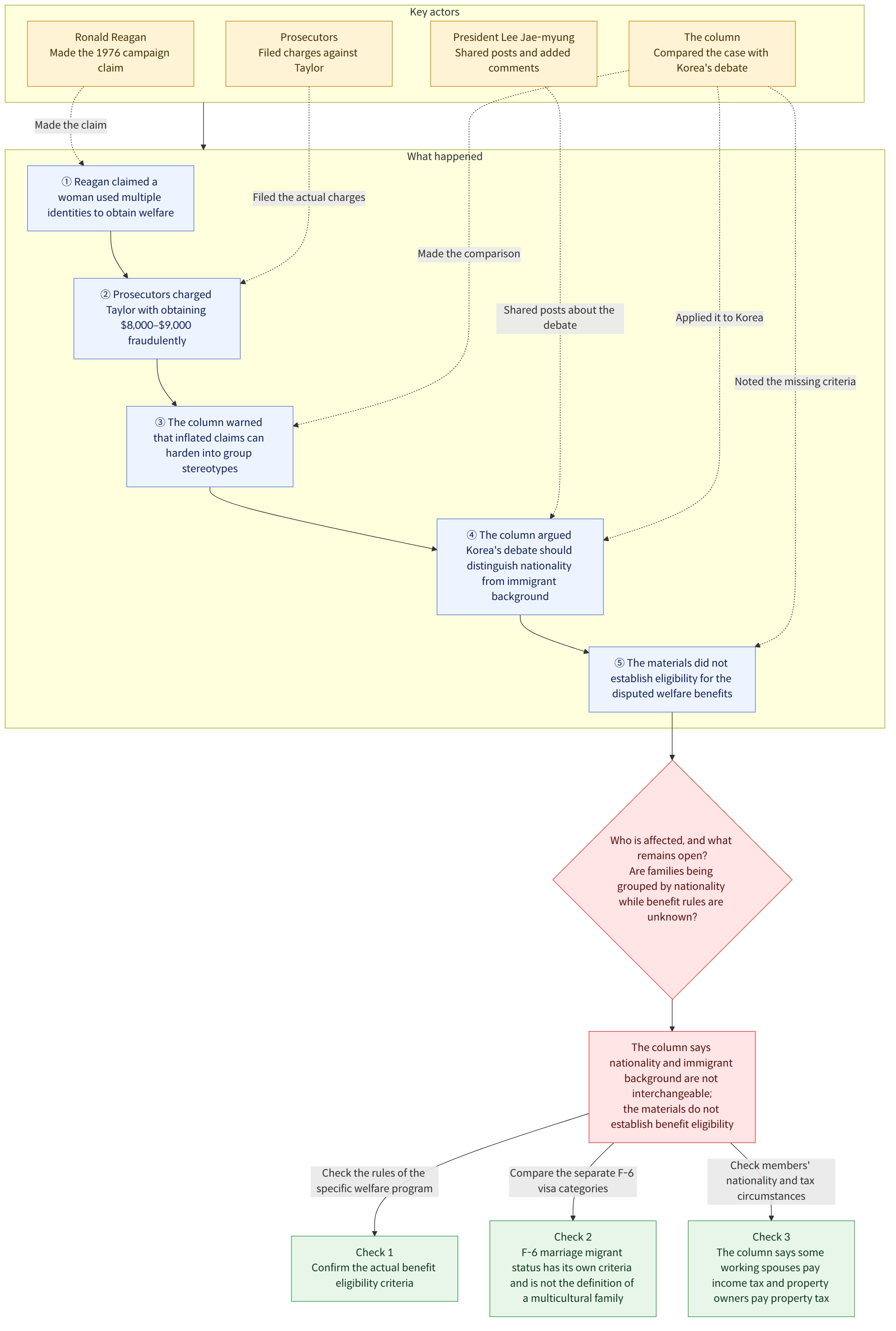
A column says President Lee Jae-myung shared online posts he considered worth referring to and added his own comments, and examined the controversy over mothers in multicultural families alongside the U.S. “welfare queen” case. According to the column, before becoming president, Ronald Reagan claimed during the 1976 presidential primary that a woman had fraudulently obtained welfare benefits by using multiple identities. The column contrasts this with the much smaller amount prosecutors actually charged her with defrauding the government of.
Background and context
The column says Reagan claimed that the woman used 80 names, 30 addresses and 12 Social Security cards, and received veterans’ welfare benefits under the names of four husbands who were dead or did not exist. Reagan also reportedly claimed that she had $150,000 a year in tax-free cash income and had taken $1 million from the government.
Although Reagan did not name the woman, the column says it is reasonable to assume he was referring to Linda Taylor of Chicago, who was called the “welfare queen” in the media at the time. According to the column, prosecutors charged Taylor with using four identities to fraudulently obtain $8,000–$9,000. The key point of this comparison is that Reagan’s claims should not be treated as if they were the actual charges filed.
The column is not saying that cases of welfare fraud did not exist. Rather, it argues that one case can be greatly exaggerated and harden into a stereotype about an entire group. The column also interprets the idea of the “welfare queen” in the United States as having influenced attacks on and cuts to welfare programs. It applies this perspective to the debate in Korea, while cautioning against treating the two issues as if they were directly the same case.
What this means
The issue the column highlights is not only whether people receive welfare, but also whom people group together as “Korean nationals” or “foreigners.” The column describes a multicultural family as one in which at least one spouse is a Korean national. It also says that if either spouse is economically active and earns above the tax-exempt threshold, the couple pays income tax, and that people who own property also pay property tax. On this basis, the column argues that claims such as “my taxes are being spent on foreigners” do not adequately reflect the makeup and nationalities of multicultural families.
According to the column, the most common arrangement in multicultural families is a Korean-born husband and a foreign-born wife, and many marriage migrants have already acquired Korean nationality. Given that their children are also Korean nationals, the column argues that claims of discrimination against Korean nationals based solely on nationality are not persuasive. However, this is the column’s argument and explanation, not evidence establishing the eligibility rules or actual benefit receipt under any specific welfare program.
For example, even if one spouse in a family was born abroad, if that person has already acquired Korean nationality, calling the family simply a “foreign family” may not accurately describe its members’ nationalities. Conversely, people cannot be assumed to receive welfare benefits simply because they have an immigrant background. Actual eligibility depends on the rules of the relevant program, but the materials provided here do not name the welfare program raised in the controversy or give its eligibility criteria.
Related rules and support information
The term “multicultural family” and the Marriage Migrant (결혼이민, F-6) status do not use the same criteria. According to internal materials, F-6 status is for foreign nationals who intend to marry and live with a Korean national, a mother or father raising a minor child born from a marital relationship, and people whose marriage has ended who meet specified requirements. The subcategories are Spouse of a Korean National (국민의 배우자, F-6-1), Child-Rearing (자녀양육, F-6-2) and Marriage Breakdown (혼인단절, F-6-3).
F-6-1 is for foreign nationals whose marriage is validly established in Korea and who intend to stay in the country to continue married life with a Korean national. F-6-2 is for a parent who intends to raise in Korea a minor child born from a marriage or de facto relationship with a Korean national after the relationship has ended. F-6-3 is for people who were staying in Korea while married to a Korean national and became unable to maintain a normal marital relationship because their spouse died or went missing, or for reasons not their fault.
People who enter Korea on an F-6 visa are instructed to apply for Foreigner Registration (외국인등록) and an Extension of Period of Stay (체류기간 연장) within 90 days of arrival. Required documents vary depending on the subcategory and application process. For example, an F-6-2 application may require documents proving family or parent-child relationships and the raising of the child. This guidance concerns the procedures for marriage migrants to stay in Korea; it cannot be taken as explaining or guaranteeing eligibility for the welfare benefits at issue in the controversy.
What is confirmed and what remains unknown
Confirmed facts
- The column reported that Reagan raised the “welfare queen” case during the 1976 presidential primary.
- According to the column, Reagan’s claims included the use of names, addresses, Social Security cards and husbands’ identities, as well as claims of $150,000 a year and $1 million in benefits.
- The column says prosecutors charged Taylor with using four identities to fraudulently obtain $8,000–$9,000.
- The column questions claims of “discrimination against Korean nationals” by pointing to the nationalities of members of multicultural families and the naturalization of marriage migrants.
- F-6 has spouse, child-rearing and marriage-breakdown categories, and people entering Korea on an F-6 visa must apply for Foreigner Registration (외국인등록) and an Extension of Period of Stay (체류기간 연장) within 90 days of arrival.
What remains unknown
- The materials do not provide the specific content of the online post mentioned by President Lee Jae-myung or explain how the controversy over mothers in multicultural families began.
- The name of the welfare program related to mothers that was raised in the controversy, its actual eligibility criteria and its application procedures have not been established.
- No materials have been provided to determine what support a particular household received or whether that support was lawful.
What readers should check
- For claims about welfare support, first check the name of the program and its official eligibility criteria. The materials provided here do not include the welfare program at issue or its actual criteria.
- When considering a family’s circumstances, distinguish immigrant background from current nationality, and check each member’s nationality. The column’s central point in raising the discrimination debate is that these two categories should not be treated as the same.
- If you need information about marriage migrant status procedures, check which category—F-6-1, F-6-2 or F-6-3—applies and what documents are required. If you entered Korea on an F-6 visa, you must apply for Foreigner Registration (외국인등록) and an Extension of Period of Stay (체류기간 연장) within 90 days of arrival.
















