
Marriage Migrant (F-6) Visa — Eligibility, Period of Stay, and Documents for Extension or Change
Based on Ministry of Justice manual (2026-09-18) · Translated from the Korean original.
The Marriage Migrant (F-6) status of stay is for foreign nationals who are living in a marital relationship with a Korean national, raising a minor child born of the marriage, or whose marriage has ended for reasons not attributable to them. The specific categories are spouse of a Korean national (F-6-1), child-rearing (F-6-2), and marital breakdown (F-6-3).
At a glance
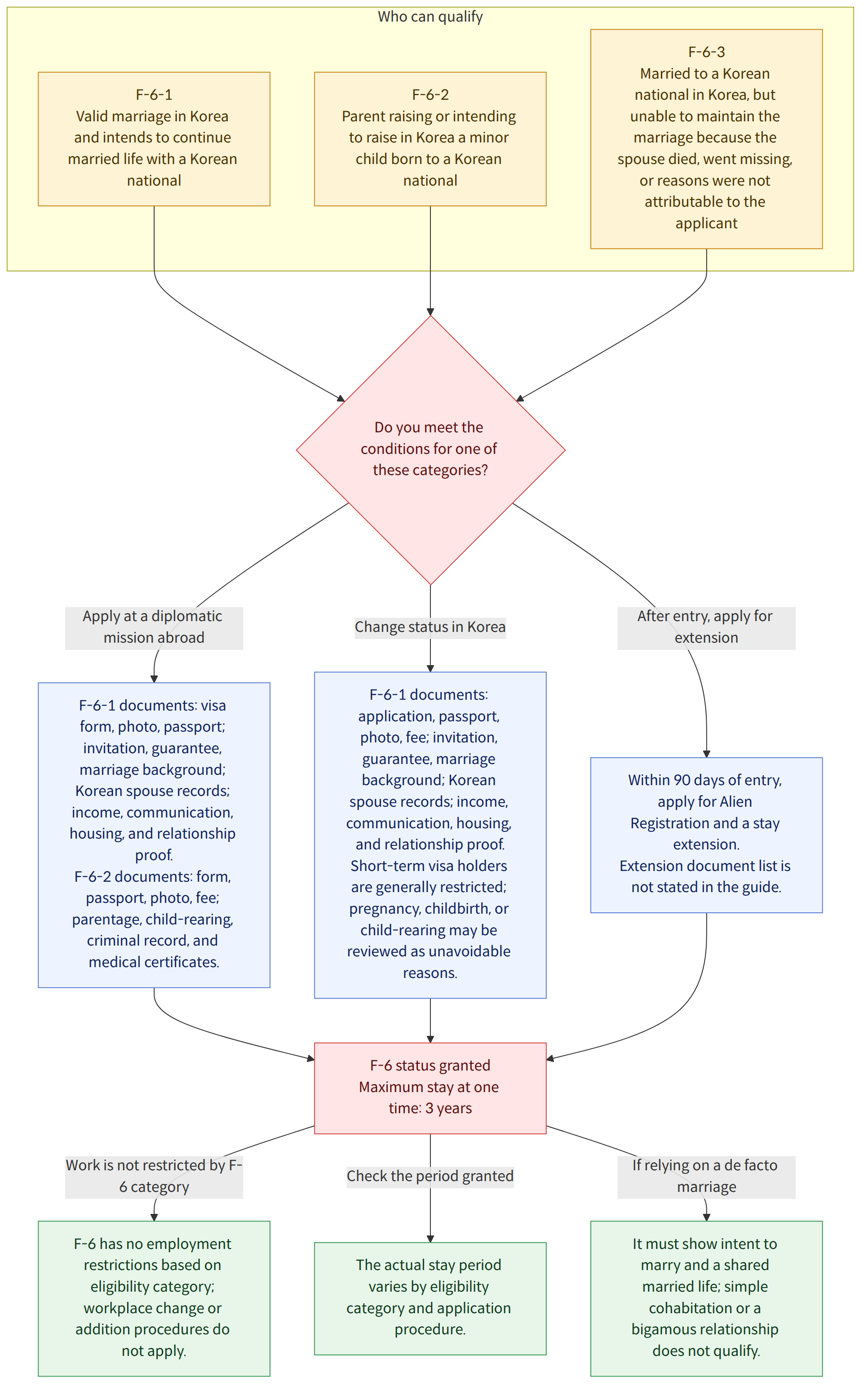
Who it is for
- F-6-1: A foreign national whose marriage has been validly established in Korea and who intends to stay in order to continue married life with a Korean national.
- F-6-2: A father or mother who, following the breakdown of the marital relationship, is raising or intends to raise in Korea a minor child born to a Korean national through marriage or a de facto marital relationship.
- F-6-3: A person who was staying in Korea while married to a Korean national and became unable to maintain a normal marital relationship because their spouse died or went missing, or for reasons not attributable to the applicant.
- A de facto marital relationship must involve an intention to marry and circumstances that establish a shared life as a married couple according to social norms. Simple cohabitation or a bigamous de facto relationship that cannot receive legal protection does not qualify.
What you can do
- F-6 status of stay is not subject to employment restrictions based on the specific eligibility category.
- Procedures for changing or adding a workplace do not apply.
Period of stay
The maximum period of stay that may be granted at one time is three years. However, the actual period granted varies depending on the specific eligibility category and application procedure.
Applications & documents
Visa issuance at a diplomatic mission abroad (F-6-1)
- Visa Application Form (사증신청서), passport-size photograph, and original and copy of passport
- Invitation Letter for Foreign Spouse (외국인 배우자 초청장), Guarantee Letter (신원보증서), and Statement on the Background of the Marriage (결혼배경진술서)
- Copy of the Korean spouse’s passport, Basic Certificate (기본증명서), Marriage Relationship Certificate (혼인관계증명서), Family Relations Certificate (가족관계증명서), and Resident Registration Abstract
- Certificate of completion of the International Marriage Guidance Program (국제결혼 안내프로그램 이수증) (for those subject to the requirement)
- Documents proving income (except for those exempt from the requirement)
- Documents proving communication ability (except for those exempt from the requirement)
- Documents proving housing
- Documents proving the history of the relationship and the bona fide nature of the marriage
Generally, a single-entry visa is issued for a period of stay of no more than 90 days. You must apply for Alien Registration and an extension of your period of stay within 90 days of entering Korea. Required documents and exemptions vary by country, and additional documents may be requested during the review.
Visa issuance at a diplomatic mission abroad (F-6-2)
- Visa Application Form, passport, standardized photograph, and fee
- Documents proving the family relationship or parentage
- Documents proving child-rearing
- Criminal record certificate and medical certificate
Generally, a single-entry visa is issued for a period of stay of no more than 90 days. You must apply for Alien Registration and an extension of your period of stay within 90 days of entering Korea.
Change of status of stay in Korea (F-6-1)
- Integrated Application Form (통합신청서), passport, photograph, and fee
- Invitation Letter for Foreign Spouse, Guarantee Letter, and Statement on the Background of the Marriage
- Copy of the Korean spouse’s passport, Basic Certificate, Marriage Relationship Certificate, Family Relations Certificate, and Resident Registration Abstract
- Documents proving income, communication ability, housing, and the history of the relationship
- Where applicable, documents related to the International Marriage Guidance Program, health, and criminal records
The period of permission is up to one year, and the head of the competent Immigration Office or Branch Office (출입국·외국인청(사무소·출장소)) reviews the application. As a general rule, holders of short-term visas and certain others are restricted from changing their status of stay in Korea. If a change is considered unavoidable due to pregnancy, childbirth, or raising a child born to the couple, the change may be permitted following review.
Change of status of stay in Korea (F-6-2 or F-6-3)
- Application form, passport, Alien Registration Card (외국인등록증) (if applicable), photograph, and fee
- The child’s Basic Certificate and Family Relations Certificate (where applicable)
- Documents proving the family relationship, such as a birth certificate or DNA test confirmation
- Documents proving child-rearing, such as custody documents, a Resident Registration Abstract, or a child-rearing confirmation (F-6-2)
- Documents proving the reason for the marital breakdown and that the applicant is not responsible (F-6-3)
- Criminal record certificate and medical certificate (except for those exempt from submission)
F-6-2 applies to those raising in Korea a minor child born to a Korean national through marriage or a de facto marital relationship. Applicants for F-6-3 must meet the applicable eligibility requirements, including the required status of stay. The period of permission for each category is one year.
Extension of period of stay and Alien Registration
- Application form, passport, photograph, and fee
- Marriage Relationship Certificate and Resident Registration Abstract (F-6-1)
- The child’s Basic Certificate and Family Relations Certificate (where applicable)
- Documents showing that you continue to raise the child (F-6-2)
- Documents proving your place of residence
- Foreigner Occupation Declaration (외국인 직업 신고서)
If you entered Korea on an F-6 visa, you must apply for Alien Registration and an extension of your period of stay at the office with jurisdiction over your address within 90 days of entering Korea. The initial period of permission and subsequent extension periods vary depending on the specific F-6 eligibility category.
Frequently asked questions
Q. Can I apply to stay for one year on an F-6 visa?
As a general rule, an F-6-1 visa is issued by the head of a diplomatic mission abroad for a period of stay of no more than 90 days. You may apply for Alien Registration and an extension of your period of stay within 90 days of entering Korea.
Q. Can I work in Korea on an F-6 visa?
F-6 holders are not subject to employment restrictions based on their specific eligibility category. Procedures for changing or adding a workplace do not apply.
Q. Can I change my status of stay to F-6-1 while in Korea?
Foreign nationals lawfully staying in Korea may apply, but, as a general rule, holders of short-term visas and certain others may not change their status of stay. If a change is considered unavoidable due to pregnancy, childbirth, or raising a child born to the couple, it may be permitted following review.
Q. What is the income requirement for the Korean spouse?
According to the 2026 figures provided in the excerpt, the gross annual income for the preceding year must be at least KRW 25,195,752 for a two-person household, KRW 32,154,216 for a three-person household, or KRW 38,968,428 for a four-person household. For households of eight or more, the threshold increases by KRW 5,755,188 for each additional household member. The income requirement may be waived in cases such as when the couple has a child.
Q. Can I apply if I do not have Korean test scores?
Unless you are exempt from the communication requirement, you may submit one of the specified documents as proof, such as documents related to Korean-language education or test results. If you cannot submit such documents, whether you meet the requirement may be determined based on the results of an assessment by the diplomatic mission abroad.
Q. Which requirements are waived if the couple has a child?
If the couple has a child, submission of documents related to the income and communication requirements may be waived. The International Marriage Guidance Program, certain medical certificates and criminal record certificates, and documents related to the history of the relationship may also be waived in some cases. Check which documents proving the child’s status are required for the relevant procedure.
Q. In what cases can I obtain F-6-2?
This applies to a father or mother who is raising or intends to raise in Korea a minor child born to a Korean national through marriage or a de facto marital relationship. Documents proving the family relationship with the child and actual caregiving are required.
Q. Can I obtain F-6-3 if my spouse dies or we divorce?
This may apply if the spouse has died or gone missing, or if a person can no longer maintain a normal marital relationship for reasons not attributable to them. In the case of divorce, documents proving the reason for the marital breakdown and that the applicant is not responsible are required.
Watch out for
- After entering Korea on an F-6 visa, you must apply for Alien Registration and an extension of your period of stay within 90 days.
- As a general rule, changing to F-6-1 in Korea is restricted for certain applicants, including holders of short-term visas and individuals staying illegally.
- Unless a separate validity period is specified, submitted documents must have been prepared or issued within the past three months.
- The address shown on documents proving the housing requirement must match the address on the Resident Registration Abstract (주민등록등본).
Source
Compiled by AI from the Ministry of Justice "Visa Issuance Guide Manual" and "Residence Guide Manual" (HiKorea notice, in Korean). hikorea.go.kr
This is general guidance; the immigration office makes the final decision. Before applying, check the latest rules on HiKorea (hikorea.go.kr) or call the Immigration Contact Center at 1345.