



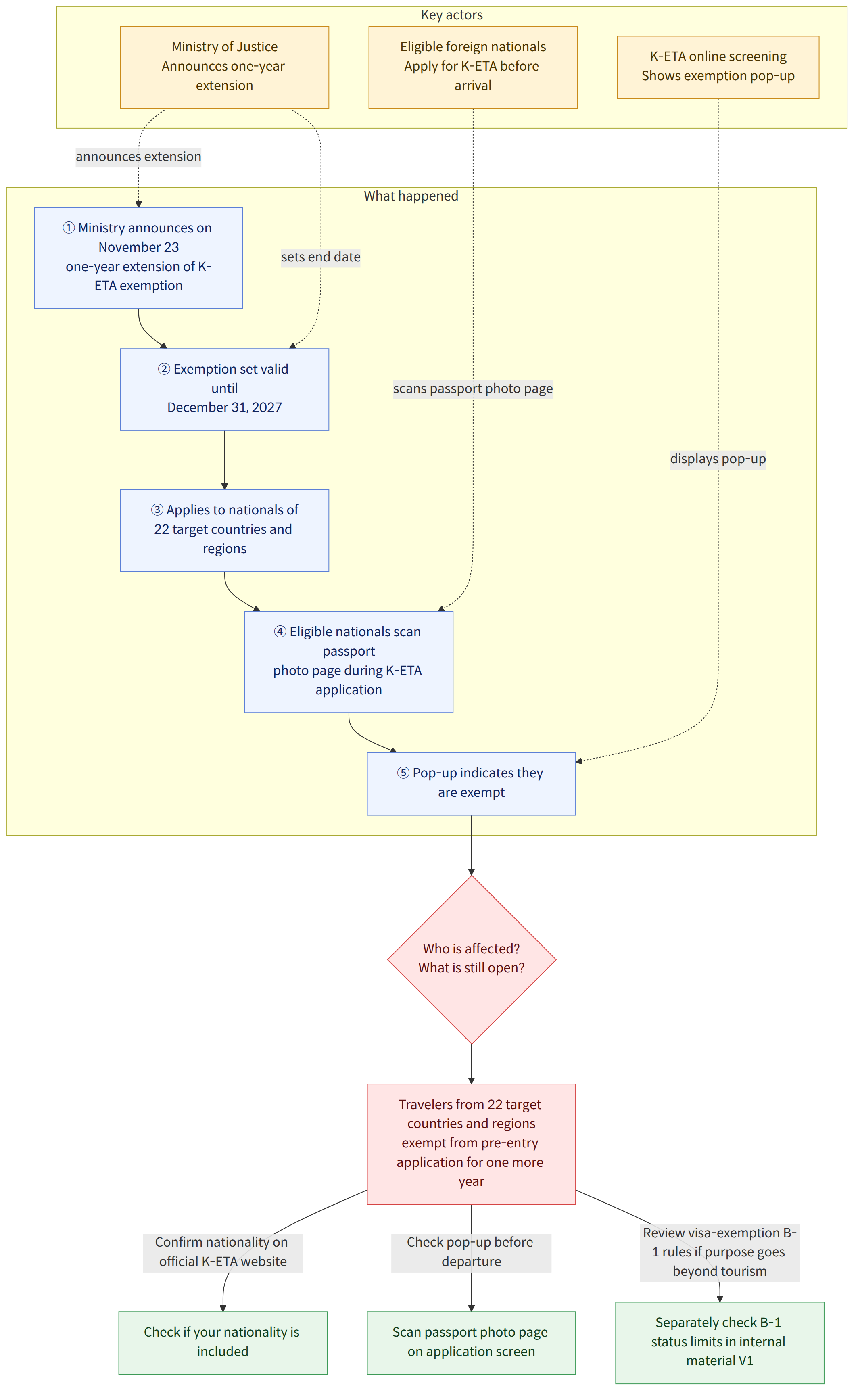
The Ministry of Justice (법무부) announced on November 23 that it will extend the temporary exemption from the Korea Electronic Travel Authorization (K-ETA, 한국전자여행허가), a pre-entry online screening that foreigners complete before arriving in Korea, by one year. The exemption is valid until December 31, 2027, and applies to nationals of 22 target countries and regions, including the United States, the United Kingdom, Japan, and Australia.
Background and Context
K-ETA is an online pre-entry screening system for foreigners who may enter Korea without a visa for short-term visits, including tourism, business, and family visits.
The Ministry of Justice said the exemption is intended to boost domestic tourism. According to the announcement materials, when eligible nationals scan the photo page of their passport during the K-ETA application process, a pop-up appears indicating that they are subject to the exemption.
What This News Means
The announcement means that travelers from the 22 target countries and regions will be exempt from the pre-entry application procedure for one more year. For example, if a national of a target country plans a tourism trip during 2027, checking whether the exemption pop-up appears on the application screen could be the first step in reviewing pre-departure procedures.
However, the source does not provide a full list of the 22 target countries and regions. Therefore, whether your nationality is included must be confirmed directly on the official website. The source also does not address how the extension will affect K-ETA operations after 2028.
Related Systems and Support Information
Internal material V1 describes the visa-exemption (B-1) status (사증면제(B-1)), a separate system. According to this material, visa-exemption (B-1) status applies when nationals of countries that have a visa exemption agreement with the Republic of Korea enter to carry out activities permitted under the agreement. In principle, they may engage in activities within the scope of short-term stay (C-3) (단기방문(C-3)), but the scope of permitted employment, profit-making activities, and study depends on each country's agreement.
- The agreed period of stay varies by country, and the material generally states it is three months.
- The material states that, in principle, extensions of the period of stay are not permitted for B-1, and changes of status are also in principle not permitted.
- To exceed the agreed period of stay or to engage in short-term employment or other profit-making or paid activities, one must obtain the appropriate visa before entering.
- The material indicates that Malaysian nationals are excluded from entertainment activities, including sports, and from employment under the agreement, so a visa is required to enter for friendly matches.
This information is not the same system as the K-ETA exemption. Based on the article alone, it cannot be confirmed how the 22 target countries and regions overlap with countries that have a visa-exemption (B-1) agreement. In addition, the reference date for the agreement country table in the material is September 22, 2022, so the latest agreement status must be checked separately.
Confirmed Facts and Unknowns
Confirmed facts
- The Ministry of Justice extended the temporary K-ETA exemption by one year, and it is valid until December 31, 2027.
- The exemption applies to nationals of 22 target countries and regions, including the United States, the United Kingdom, Japan, and Australia.
- When eligible nationals scan the photo page of their passport, a pop-up appears indicating that they are exempt.
- The Ministry of Justice said this measure is intended to boost domestic tourism.
Unknowns
- The full list of the 22 target countries and regions is not included in the source.
- The source does not state how the K-ETA system will be affected after 2028.
What Readers Should Check
- Confirm on the official K-ETA website whether your nationality is included in the exemption.
- Before departure, check whether the exemption pop-up appears when you scan the photo page of your passport on the application screen.
- If your purpose of visit goes beyond tourism or a simple visit, such as employment, entertainment or sports activities, or extending your stay, separately review the restrictions on visa-exemption (B-1) status described in internal material V1 and the terms of the relevant country's agreement.
















