
Visa Exemption (B-1) — Eligibility, Permitted Activities, Period of Stay, Extensions and Changes
Based on Ministry of Justice manual (2026-09-18) · Translated from the Korean original.
Visa Exemption (B-1) is a status of stay that applies when nationals of countries that have concluded a visa waiver agreement with the Republic of Korea enter to engage in activities permitted under the agreement. Permitted activities and periods of stay vary by country-specific agreement. Those who intend to work or engage in activities excluded under the agreement must obtain the relevant visa before entering Korea.
At a glance
Who it is for
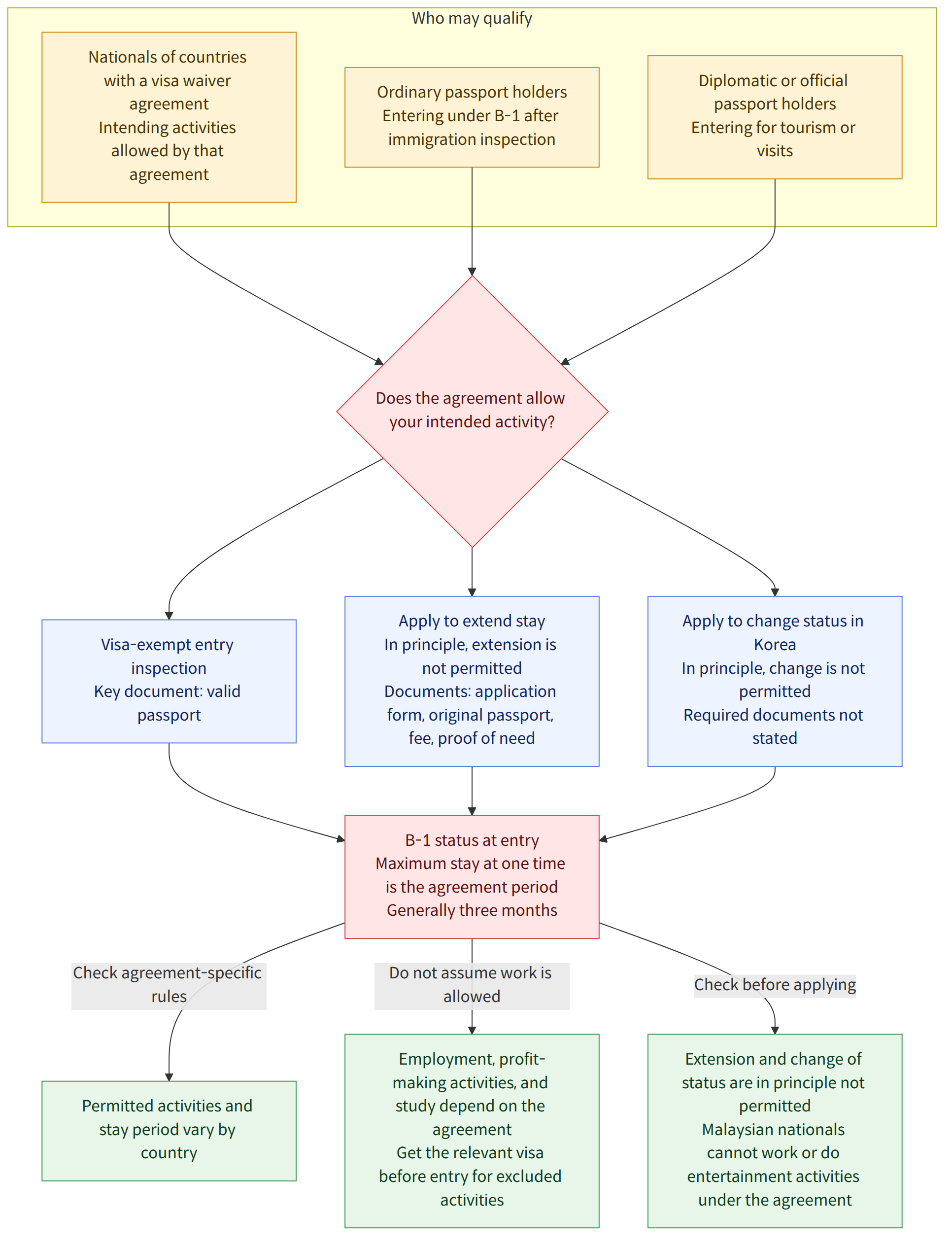
- Nationals of countries that have concluded a visa waiver agreement with the Republic of Korea who intend to engage in activities under the relevant agreement
- People who hold an ordinary passport and enter Korea under Visa Exemption (B-1) after undergoing immigration inspection
- Holders of diplomatic or official passports who enter for purposes such as tourism or visits
What you can do
- In principle, holders may engage in activities within the scope of C-3 (Short-Term Visit). However, they may not engage in activities excluded under the agreement.
- Whether employment, profit-making activities, study, and other activities are permitted depends on the country-specific agreement. B-1 does not mean that all employment is permitted.
- Under the agreement, entertainment activities, including sports, and employment are excluded for Malaysian nationals. They must obtain a visa to enter Korea for friendly matches or similar purposes.
- Brazil is listed as a country whose nationals may engage in business-purpose activities. For countries listed as having no restrictions on the scope of activities, this is interpreted to mean that employment, profit-making business activities, short-term language study, medical activities, and similar activities are permitted.
Period of stay
The maximum period of stay that may be granted at one time is the period of stay specified in the agreement. This period varies by country; the manual states that it is generally three months.
Applications & documents
Visa-exempt entry inspection
- Valid passport
Those covered by the exemption under the agreement may enter without a visa. Holders of ordinary passports are designated as entering under Visa Exemption (B-1) at immigration inspection.
Application to extend the period of stay
- Application Form (신청서, 34호 서식)
- Original passport
- Fee
- Documents substantiating the need to extend the period of stay
In principle, an extension of the period of stay is not permitted for B-1. The general fee information for permission to stay lists the fee for an extension of the period of stay as KRW 60,000.
Application to change status of stay
In principle, people who entered Korea for the purpose of a visa waiver agreement are not permitted to change their status of stay. The excerpt does not provide information on the required documents.
Frequently asked questions
Q. Can anyone apply for B-1?
No. The person must be a national of a country that has concluded a visa waiver agreement with the Republic of Korea and must intend to engage in activities specified in the agreement. The scope of the agreement applicable to each country must also be checked.
Q. Can I work in Korea under B-1?
That depends on whether the country-specific agreement permits employment. The manual states that people who intend to work or engage in other paid activities, including short-term employment, must obtain the relevant visa before entering Korea.
Q. How long can I stay in Korea under B-1?
You may stay for the period specified in the agreement. This period varies by country; the manual states that it is generally three months.
Q. Can I extend my period of stay?
In principle, an extension is not permitted. If an extension is needed, the required documents are an application, the original passport, the fee, and documents substantiating the need for the extension.
Q. Can I change to a different status of stay after entering Korea?
In principle, permission to change status of stay is not granted. If your period of stay or activities are expected to exceed the scope of the agreement, you must obtain a visa before entering Korea.
Q. What should I do if I want to engage in an activity excluded under the agreement?
You must obtain the relevant visa before entering Korea to engage in that activity. Permitted activities vary by country-specific agreement.
Q. Can Malaysian nationals take part in friendly matches?
The manual states that Malaysian nationals who intend to enter Korea for friendly matches or similar purposes must obtain a visa. Under the agreement with Malaysia, entertainment activities, including sports, are excluded.
Q. Can I obtain a Certificate of Visa Issuance (사증발급인정서) under B-1?
No. Visa Exemption (B-1) is excluded from eligibility for a Certificate of Visa Issuance.
Watch out for
- You must obtain the relevant visa before entering Korea if you intend to stay beyond the period specified in the agreement or engage in profit-making or paid activities such as short-term employment.
- In principle, people who entered Korea under a visa waiver agreement or for tourism and transit purposes may not receive permission to extend their period of stay or change their status of stay.
- Activity restrictions and periods of stay vary by country. The list of countries with visa waiver agreements included in the excerpt is current as of September 22, 2022.
Source
Compiled by AI from the Ministry of Justice "Visa Issuance Guide Manual" and "Residence Guide Manual" (HiKorea notice, in Korean). hikorea.go.kr
This is general guidance; the immigration office makes the final decision. Before applying, check the latest rules on HiKorea (hikorea.go.kr) or call the Immigration Contact Center at 1345.