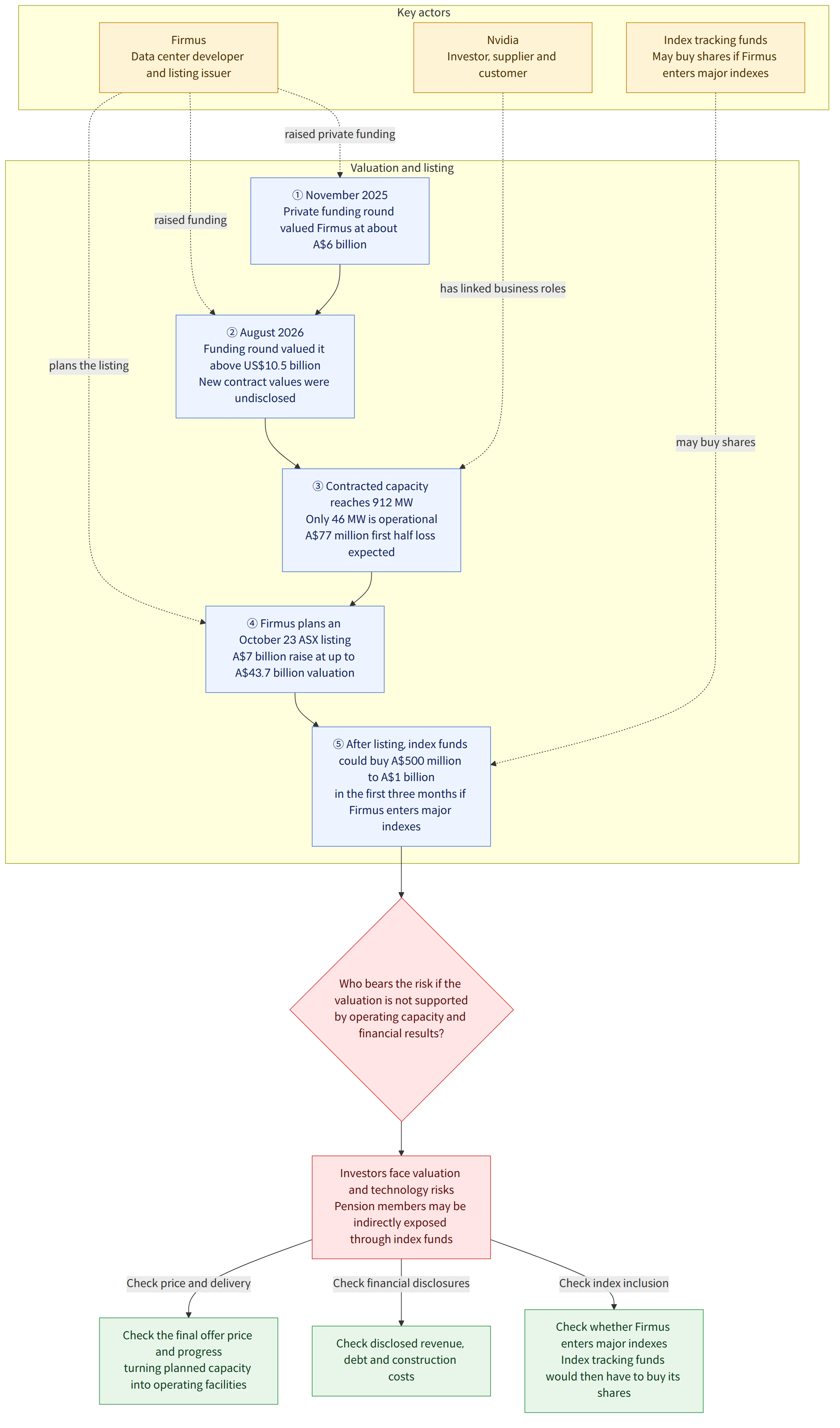
AI data center developer Firmus Technologies plans to raise A$7 billion from investors through an October 23 listing on the Australian Securities Exchange (호주증권거래소, ASX). The offering implies a valuation of up to A$43.7 billion. The article describes it as the second-largest initial public offering (IPO—the first sale of a company’s shares to the public) in Australian history, after Telstra in 1997. However, Firmus is loss-making, and only a portion of its contracted data center capacity is operational. The central question surrounding the listing is how well the high offering valuation reflects the actual scale and financial condition of the business.
Background and context
Firmus develops data centers equipped with Nvidia chips and rents computing power to large technology companies such as Meta and OpenAI. Unlike traditional data center operators, which mainly provide space and power while customers bring in their own chips, Firmus owns the chips itself. This model provides customers with the computing power they need, but also means the company is directly exposed to the value of the chips and changes in technology.
Firmus has contracted 912 megawatts (MW) of data center capacity. But only 46MW, or about 5%, is currently operational. Two data centers are operating, while the rest are planned or under construction. The article reports that Firmus expects a A$77 million loss in the first half of the current financial year. In other words, there is a significant gap between the scale of the contracted capacity and that of the operational facilities, and turning planned projects into actual facilities is an important factor in assessing the company’s valuation.
The pace of the company’s valuation increase is also striking. Firmus was valued at about A$6 billion in a private funding round in November 2025, and at more than US$10.5 billion in a round in August 2026. The A$43.7 billion valuation targeted for the listing is about three times the August valuation. The company signed new contracts after August, but their value has not been disclosed, making it difficult to gauge from public information alone the scale of the business supporting the increase in valuation.
There are also gaps in the financial information. The article notes that current and projected revenue, debt levels, and data center construction costs cannot yet be verified. These details are needed for investors to assess not only the potential for revenue growth but also the funding required to build the facilities and the burden of losses. There have been reports that the company is considering lowering the offering price, but no final decision has been reported.
What this news means
A high listing valuation does not, by itself, mean that the valuation is wrong. However, the fact that only about 5% of contracted capacity is currently operational means investors would be assigning substantial value not only to the business already in operation, but also to facilities yet to be built and the fulfillment of future contracts. If planned projects and contracts do not translate into operational facilities and revenue as quickly as expected, it may be difficult to justify the high valuation.
The business model of owning chips directly also carries technology risks. The article explains that Nvidia is involved as an investor, supplier, and customer. When several business relationships converge around one company in this way, changes in that company’s technology or business outlook could affect Firmus as well. However, the publicly available information does not show how much loss such risks could actually cause.
The listing could also be connected to individuals’ pension assets. If Firmus is included in major stock indexes, passive funds (funds that invest in a way that mirrors the composition of an index) tracking those indexes would have to buy its shares. The article estimates that passive funds could buy A$500 million to A$1 billion worth of shares in the first three months after the listing. If some pension money is invested in index-tracking funds, members could be indirectly exposed to changes in Firmus’s share price if those funds hold the stock, even if they did not choose the shares themselves.
For example, if a member’s pension money is invested in a fund that tracks an index and Firmus is included in that index, some of the member’s assets could become linked to Firmus’s share price through the fund’s purchases. This does not mean that every pension member will necessarily own Firmus shares. Actual ownership and the size of the holding depend on the pension product and the fund’s investment approach.
What is known and what remains unknown
Known facts
- Firmus plans to raise A$7 billion through an October 23 listing on the ASX and is targeting a valuation of up to A$43.7 billion.
- Of its 912MW in contracted capacity, 46MW is operational. Two data centers are operating, while the rest are planned or under construction.
- The company expects a A$77 million loss in the first half of the current financial year.
- Firmus is planning three data centers in northern Tasmania, and the Bell Bay facility is expected to become the state’s largest electricity-consuming facility.
- The Reserve Bank of Australia (호주중앙은행, RBA) has warned that circular financial relationships among AI companies could increase vulnerabilities in the financial system, but it did not name Firmus directly.
What remains unknown
- What are Firmus’s current and projected revenues, debt levels, and data center construction costs?
- Will the offering price ultimately be lowered?
- What are the specific values and terms of the new contracts with OpenAI and others?
- When will facilities that are planned or under construction become operational, and how quickly will contracted capacity translate into actual revenue?
What readers should check
- Once offering documents are released, readers should review revenue projections, losses, debt, and construction costs together to see what assumptions underpin the company’s valuation.
- Pension members can check whether their product invests in index-tracking funds and how holdings and volatility could change if those funds include Firmus.
- Readers interested in the planned data centers in Tasmania should distinguish between the progress of each facility, issues related to local electricity use, and the status of consultations with residents.