



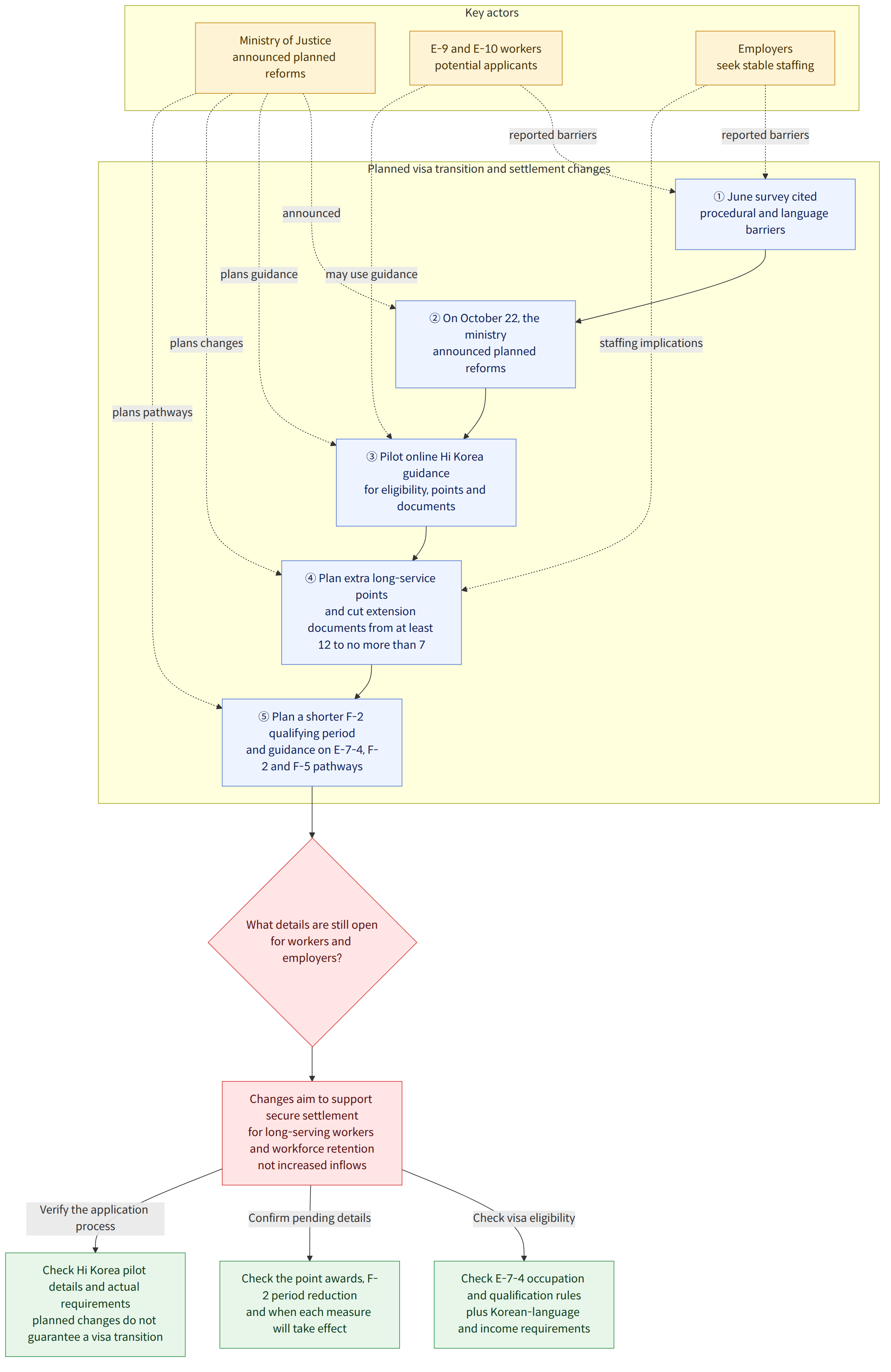
On October 22, 2026, the Ministry of Justice (법무부) announced plans to reform the E-7-4 Skilled Worker visa system. The plan is to revise the process by which E-9 Non-professional Employment and E-10 Seafarer Employment visa holders can switch to the E-7-4 visa, which allows them to stay longer if they meet the requirements, and to reduce the residency period required for long-serving workers to apply for F-2 residence status.
The proposed changes also include a pilot of online guidance through Hi Korea (하이코리아), where applicants can check their eligibility, calculate their E-7-4 points and prepare a document checklist, as well as a plan to reduce the documents currently required to extend a stay from at least 12 to no more than 7. However, the article does not give specific details on the extra points awarded for each length of service, how much the residency period for an F-2 application will be reduced, or when each measure will take effect.
Background and context
The E-7-4 visa allows E-9 and E-10 visa holders who meet certain requirements to switch to skilled-worker status and stay longer. Applicants are assessed on factors including Korean-language ability, income, and length of employment or residence. An in-house visa guide also describes E-7-4 as one type of skilled-worker status subject to a points system, and notes that eligible occupations and qualifications are specified.
The program’s quota rose from 2,000 to 35,000 in September 2023, and as of September this year, there were 52,648 E-7-4 holders. These figures show the scale of the program, but the quota and the number of holders are different measures, so they cannot be used on their own to determine an individual applicant’s eligibility or likelihood of switching status.
Procedural difficulties were cited as a reason for the reform. A survey in June of 470 companies and 316 foreign workers found that complicated immigration procedures and Korean-language requirements were major barriers to switching visas. Employers also emphasized the need to retain workers and secure a stable workforce.
Lee Jin-soo, acting Minister of Justice, said the reforms were not intended to increase the inflow of foreign workers, but to help those who have worked for a long time in industrial workplaces work more securely and settle in local communities. The announcement therefore focuses on the residency stability and retention of existing workers, rather than expanding the arrival of new workers.
What this news means
For workers, an online tool is planned to help them check application requirements and documents in advance, and long-term employment may count in their favor in E-7-4 assessments and F-2 applications. In particular, being able to calculate points and prepare documents in one place could help address the problem of complicated procedures blocking transitions. However, the pilot’s specific features and the actual application process will need to be confirmed once details are available.
For employers, working with the same worker over a long period could become part of workforce-retention planning. This is because extra E-7-4 points will be awarded based on length of service, and the residency period required for an F-2 application is set to be reduced. The Ministry of Justice also plans to provide guidance on pathways from E-9 and E-10 to E-7-4, F-2 and F-5 permanent resident status, with the aim of helping employers plan for long-term staffing and workers explore settlement pathways.
However, this assumption alone does not guarantee eligibility to switch status. Other assessment factors, such as Korean-language ability and income, as well as requirements for the relevant occupation, also affect the actual decision.
Related systems and support information
According to the in-house E-7 visa guide, E-7-4 is a points-based category that applies to three skilled-worker occupations. The E-7 designation does not allow someone to work in every occupation, so applicants should check both the relevant occupation and their individual qualifications. The planned Hi Korea guidance was described as a tool to help users check eligibility, calculate points and prepare a document checklist.
The guide lists the general documents for changing to E-7 status as an application form, passport and alien registration card, employment contract, documents related to the employer, documents proving qualifications such as work experience or academic degrees, and an employment recommendation or documents demonstrating the need for employment. For an extension of stay, it lists an application form, passport, alien registration card, employment contract, proof of income and proof of residence, among other documents. However, the documents required may vary depending on the occupation and application route, so this general list should not be treated as the definitive list for E-7-4 applications after the reforms.
F-2 is a residence status that covers several categories and pathways, and the in-house guide explains that application procedures and documents vary by category. Therefore, even if a pathway from E-7-4 to F-2 is set out, this does not mean that all E-7-4 holders automatically qualify for F-2 status. The guide states that F-2 status can be granted for up to five years at a time, but the actual period granted may vary depending on the category and assessment. The reduction in the required residency period announced as part of these reforms is a separate matter from this maximum duration of stay.
Confirmed facts and what remains unknown
Confirmed facts
- On October 22, 2026, the Ministry of Justice announced plans to reform the E-7-4 system.
- E-7-4 applicants are assessed on factors including Korean-language ability, income, and length of employment or residence.
- A pilot of online guidance through Hi Korea and a plan to reduce the documents required to extend a stay to no more than 7 have been announced.
- The plan is to award E-7-4 points based on length of service to workers who continue working for the same employer, and to reduce the residency period required for F-2 applications.
- The Ministry of Justice plans to issue guidance clarifying pathways from E-9 and E-10 to E-7-4, F-2 and F-5.
What remains unknown
- What specific criteria and scores will apply to E-7-4 extra points for each length of service?
- When will the online guidance pilot and the document reduction take effect?
- By how much will the residency period required for an F-2 application be reduced?
- What specific documents and detailed criteria will be required for each application pathway after the reforms?
What readers should check
- Workers considering a transition to E-7-4 should check their occupation and the assessment factors, including Korean-language ability, income, and length of employment or residence. Once the Hi Korea guidance is available, they can use it to check eligibility and calculate their points.
- Employers and workers should check the detailed criteria and effective dates for extra points based on length of service and the reduction in the F-2 residency requirement before incorporating them into actual employment and residency plans.
- Required documents may vary by visa type and application pathway. Applicants should not finalize their preparations based solely on the general E-7 guide’s checklist; they should check the latest guidance applicable to E-7-4 and extensions of stay.
If you are dealing with a similar issue, attorney Ji-sun Ahn of Ijun Law Firm can review your employment and stay history, any recommendation, and documents supporting a visa change or points application with you. These details can help clarify which options apply to your situation.

















