
Residence (F-2) Visa — Eligibility, Period of Stay, Employment, and Application Procedures
Based on Ministry of Justice manual (2026-09-18) · Translated from the Korean original.
Residence (F-2) is a status of stay granted to people who wish to stay in Korea long term to obtain permanent resident status. It covers various categories, including minor foreign children of Korean nationals, family members of permanent residents, recognized refugees, investors, and points-based outstanding talent. The application route and required documents, such as visa issuance or a change of status of stay, vary by category.
At a glance
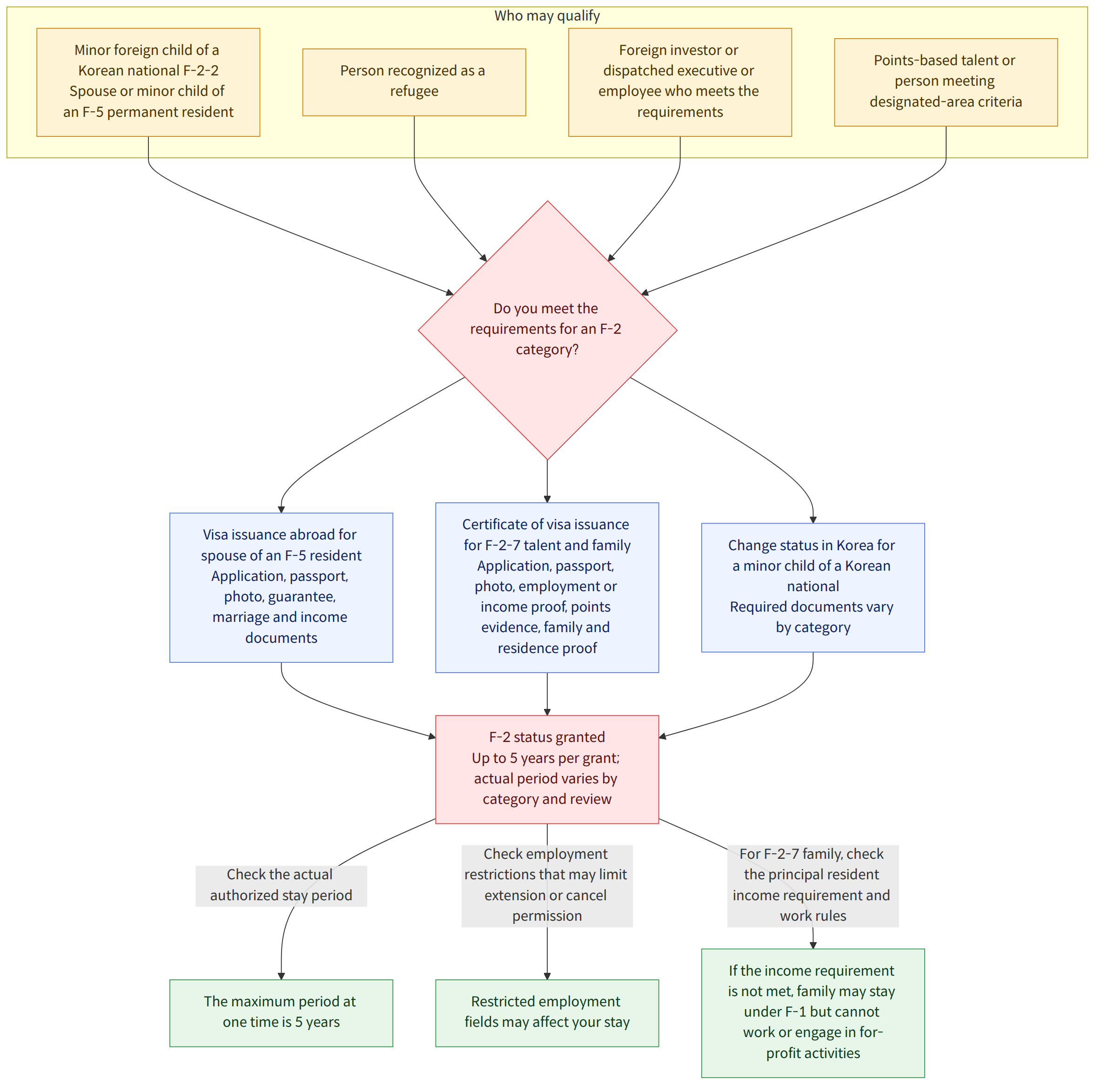
Who it is for
- Minor foreign child of a Korean national (F-2-2), or spouse or minor child of a permanent resident (F-5)
- A person recognized by the Minister of Justice (법무부장관) as having been born of a marriage relationship with a Korean national, including a de facto marriage
- A person recognized as a refugee
- A foreign investor or dispatched executive or employee who meets specified investment amount, period of stay, and Korean national employment requirements
- A person who has lost permanent resident status (F-5) but whom the Minister of Justice recognizes as needing to continue staying in Korea. People subject to deportation are excluded.
- A person whose basis of life is in Korea due to long-term residence in the country and who is recognized by the Minister of Justice. The period of stay requirement is stated differently in the two manual excerpts.
- A person who meets the notified criteria for age, education, income, and other factors; an investor meeting specified asset requirements; a person who has made a special contribution; or their spouse or child
- A person who meets the notified criteria intended to address labor supply and demand and restore vitality in areas with declining populations and other designated areas
What you can do
- If you attend an educational institution in the regular education system without undermining the original purpose of your stay, you do not need separate permission for activities outside the scope of your status of stay during your period of stay.
- Family members of an F-2-7 outstanding talent holder may engage in specified employment activities only if the principal resident meets the annual income requirement.
- If the principal F-2-7 resident does not meet the income requirement, family members may stay under F-1, but employment and for-profit activities are prohibited. Some activities require prior permission.
- For other long-term residents (F-2-99), whether permission for activities outside the scope of the status of stay is required depends on whether the person engages in activities in the field in which they worked under their previous status of stay.
- Engaging in fields subject to employment restrictions may limit an extension of the period of stay or result in cancellation of a stay permit.
Period of stay
The maximum period of stay that may be granted at one time is five years. The actual period authorized may vary depending on the applicable category and the review.
Applications & documents
Visa Issuance — Spouse of a Permanent Resident (F-5)
- Visa Application Form (사증발급신청서), passport, and photograph
- Letter of Guarantee (신원보증서) from the spouse in Korea
- Invitation letter and Statement of Circumstances of Marriage (혼인배경 진술서)
- Documents proving the marriage relationship in both countries
- Documents proving financial resources and income
- Credit Information Inquiry Report (신용정보조회서) of the inviter
- Criminal Record Certificates (범죄경력 증명서) and Medical Examination Certificates (건강진단서) for both parties
- Documents proving the dissolution of any previous marriage, if applicable
This category is for a single-entry visa with a period of stay of up to one year. The head of the overseas diplomatic mission may add or waive documents following review.
Certificate of Visa Issuance — Points-Based Outstanding Talent and Family Members
- Application for Certificate of Visa Issuance (사증발급인정신청서), passport, Alien Registration Card (외국인등록증) if applicable, and photograph
- Tuberculosis diagnosis certificate
- Documents proving the applicant's employment, such as an employment contract or Certificate of Employment (재직증명서), as applicable
- Documents proving the applicant's income, such as a Certificate of Income Amount (소득금액증명), as applicable
- Points table and documents supporting each evaluation criterion
- For family applicants, documents proving the legally recognized family relationship with the principal resident
- Documents proving place of residence
You may apply in person at the competent Immigration Office (출입국·외국인청) or through the Korea Visa Portal (대한민국비자포털). A visa issued on the basis of the certificate is described as single-entry and valid for 90 days.
Change of Status of Stay — Minor Foreign Child of a Korean National
- Application Form (신청서), passport, and photograph
- Documents proving the relationship between the Korean national and the minor child and who has custody
- Documents proving that the child is the foreign child of a Korean national
- Household Register (호구부) and Resident Identity Card (거민신분증) for the child
- Basic Certificate (기본증명서), Family Relations Certificate (가족관계증명서), and Resident Registration Certificate (주민등록등본) for the parent
- Letter of Guarantee from the father or mother who has custody
The visa and stay guidelines specify eligible and excluded applicants. Separate guidelines apply to people with multiple nationalities.
Change of Status of Stay — Recognized Refugee or High-Value Investor
- Application Form, passport and Alien Registration Card if applicable, and photograph
- For recognized refugees: certificate of refugee recognition and documents proving place of residence
- For investors: Investment Enterprise Registration Certificate (투자기업등록증) or Foreign Investment Notification (외국인 투자신고서)
- For executives and employees dispatched by a foreign corporation: secondment order and Certificate of Employment, or Certificates of Income Amount for the past three years
- For investors who employ Korean nationals: employment contract or the employee's Certificate of Income Amount
The guide states that high-value investors and recognized refugees are subject to the grant or change of status of stay and cannot obtain a visa from an overseas diplomatic mission.
Alien Registration
- Application Form
- Original passport
- Photograph
- Documents proving place of residence
The excerpt on general requirements lists the fee for issuance of an Alien Registration Card as KRW 35,000.
Frequently asked questions
Q. Who is the F-2 status for?
This status is for people who wish to stay in Korea long term to obtain permanent resident status. It includes various categories, such as family members, recognized refugees, investors, long-term residents, and outstanding talent.
Q. What is the maximum period of stay for F-2?
The maximum period of stay that may be granted at one time is five years. The period authorized for an individual may vary depending on the applicable category and the review.
Q. Can I do any kind of work if I obtain F-2?
The excerpts from the manuals do not allow the scope of employment permitted for all F-2 holders to be generalized. Separate standards for employment and activities outside the scope of the status of stay apply to family members of F-2-7 holders and to F-2-99 holders, so you should check your specific subcategory.
Q. Can family members of an F-2-7 outstanding talent holder work?
If the principal resident meets the annual income requirement, family members may also engage in specified employment activities. If the income requirement is not met, family members may stay under F-1, but employment and for-profit activities are prohibited.
Q. Can a minor foreign child of a Korean national apply for F-2-2?
Procedures are provided for visa issuance or changing status of stay in Korea. You must submit documents proving not only the relationship between the child and the Korean national, but also who has custody of the child.
Q. Is the long-term stay requirement in Korea five years or seven years?
The standards in the two excerpts differ. The Visa Issuance Guide Manual generally specifies seven years, or five years for some professional occupations, while the Guide to Sojourn for Foreigners Manual specifies five years. Check the latest standard applicable to your application before applying.
Q. Do I need separate permission to attend school on F-2?
If you attend an educational institution in the regular education system without undermining the original purpose of your stay, you do not need separate permission for activities outside the scope of your status of stay during your period of stay.
Q. Do I have to report my occupation and income when applying for a stay permit?
Foreign nationals holding a status of stay that permits employment must report their occupation and annual income amount when applying for alien registration and various stay permits. A change of occupation must also be reported.
Watch out for
- The guide states that high-value investors, recognized refugees, people who have lost permanent resident status, and long-term residents are subject to the grant or change of status of stay, rather than visa issuance.
- The two manual excerpts give different long-term stay requirements of five and seven years, so check the applicable requirement before applying.
- Registered foreign nationals aged 6 to 18 inclusive must report whether they attend elementary, middle, or high school. Any change in enrollment or attendance must be reported within 15 days.
- Holders of a status of stay that permits employment must report their occupation and annual income amount when applying for a stay permit.
Source
Compiled by AI from the Ministry of Justice "Visa Issuance Guide Manual" and "Residence Guide Manual" (HiKorea notice, in Korean). hikorea.go.kr
This is general guidance; the immigration office makes the final decision. Before applying, check the latest rules on HiKorea (hikorea.go.kr) or call the Immigration Contact Center at 1345.